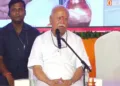
One of the greatest strengths of Indian civilisation has been its ability to preserve unity amid diversity. Worship practices may differ, languages may be different, and food habits and forms of dress may vary, yet India’s cultural consciousness has always sought to bind human beings together through a broader sense of fraternity and mutual belonging. From this perspective, the message delivered by Rashtriya Swayamsevak Sangh (RSS) Sarkaryawah Dattatreya Hosabale in Bhopal may be viewed not merely as an organisational message for volunteers, but also as an opportunity for introspection within Hindu society.
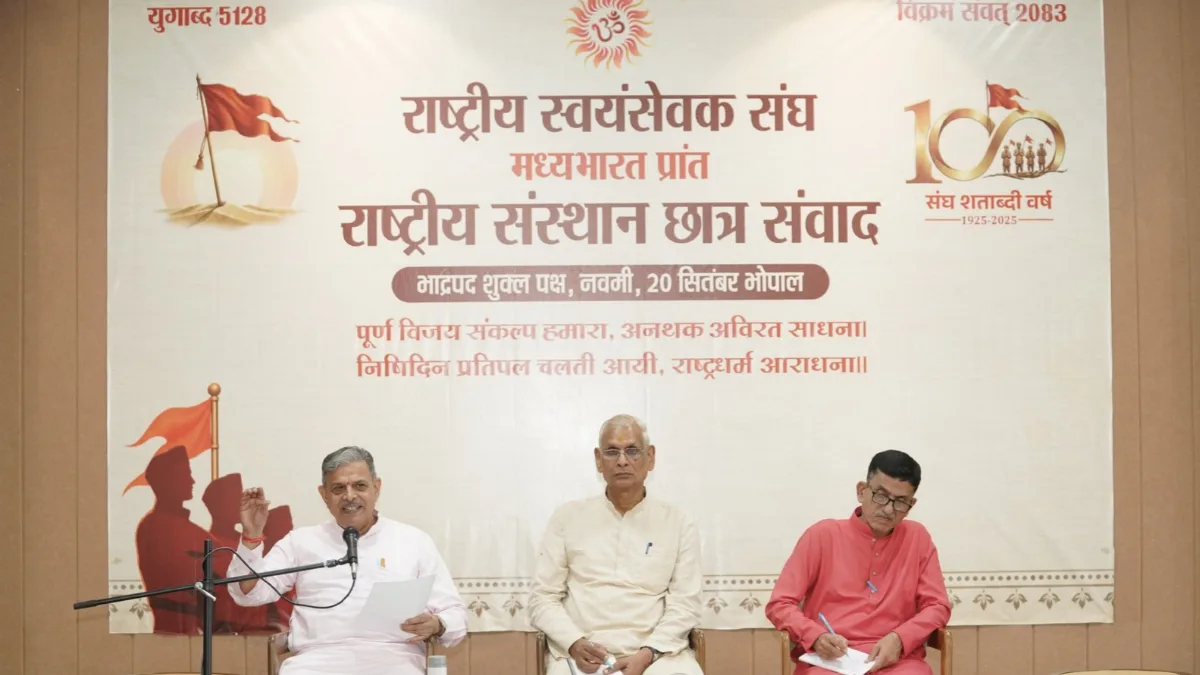
A massive gathering of RSS volunteers was organised at Lal Parade Ground in Bhopal as part of the Sangh’s centenary-year activities, with around 30,000 volunteers reportedly participating. Social harmony and service, along with the Sangh’s concept of ‘Panch Parivartan’, were among the prominent themes of the programme.
Casteism and Untouchability — From Introspection to Resolution
Hosabale described casteism and untouchability as a stigma on Hindu society. The significance of this statement lies in the fact that the question of social harmony is not merely about external accusations or counter-arguments; it also concerns the need for self-correction within society.
If a person considers another human being inferior merely because of birth, regards someone’s labour as insignificant, or maintains social distance from another person, such behaviour runs contrary to the fundamental spirit of the Indian worldview, which recognises the presence of the same consciousness in all living beings.
From Sant Ravidas and Kabir to Sant Tukaram, Narayana Guru and numerous other saints, India’s spiritual traditions have repeatedly awakened society against social discrimination. In the poetry of Sant Ravidas, ‘Begumpura’ is not merely the description of an imaginary city; it represents an aspiration for a society free from injustice, fear and social hierarchy.
Therefore, the challenge before Hindu society is not to reject its traditions, but to bring into practice the principles of equality, fraternity, compassion and mutual belonging that are also deeply embedded within its civilisational traditions.
Hindutva Means Connecting, Not Dividing
At the heart of the RSS understanding of social harmony is the idea that mutual affection and social interaction should increase among different castes, sects and social groups. In its earlier resolutions concerning social harmony, the RSS has also described caste-based arrogance and untouchability as social evils and emphasised the spirit of ‘Hindavah Sodara Sarve’—all Hindus are brothers and sisters.
From this perspective, an attempt can be seen to understand Hindutva not merely as a form of worship or religious identity, but as an idea of cultural unity and civilisational connectedness.
The strength of Hindu society lies not merely in its numbers, but in the mutual trust and solidarity among its people. When one person participates in another’s joys and sorrows, society develops into an organised social force, and that organisation can contribute to the strength of the nation.
A Volunteer Must Not Merely Watch; He Must Work Among Society
Another important aspect of Hosabale’s message concerns the role of the volunteer. Patriotism is not merely an idea or a slogan; it must be reflected through service and a sense of duty.
If poverty exists in society, there should be an effort to serve.
If a child is deprived of education, efforts should be made to support that child.
If a family is facing a crisis, society should stand with it.
If there is an environmental challenge, the volunteer should become part of the solution.
If social distance exists, efforts should be made to build greater human connection.
This is also why the themes of social harmony, family awareness, environmental protection, self-awareness and civic responsibility are being presented together under the concept of ‘Panch Parivartan’ during the RSS centenary year.
In other words, the role of the volunteer is not viewed as being confined to the organisational branch. It is connected with active participation in society and constructive social engagement.
‘Let Others Keep Watching’ Is Not the Culture of Nation-Building
Nation-building is not the responsibility of governments alone. Governments can formulate policies and institutions can provide systems, but sustaining social consciousness is ultimately a responsibility shared by society itself.
Therefore, a volunteer is expected not to remain a mere spectator. He is expected to identify social problems, come forward, bring people together for solutions and demonstrate commitment through personal conduct.
Service does not mean merely providing material or financial assistance. Teaching a child, helping a young person acquire skills, supporting a family in overcoming addiction, bringing companionship into the life of an elderly person, and standing with disadvantaged sections of society with a sense of equality are also forms of service.
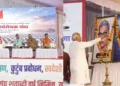
At the ‘Shram Sadhak Sangam’ organised in Bhopal on the occasion of Sant Ravidas Jayanti, Hosabale also emphasised the dignity of labour and social fraternity. According to reports, he stressed that the strength of society comes from the participation, labour and mutual affection of every individual, and that a person does not become inferior because of the nature of his or her work.
Dignity of Labour Is the Foundation of Social Harmony
Indian traditions have never regarded honest labour as inherently inferior. Sant Ravidas himself represents a remarkable synthesis of labour, devotion and spiritual consciousness.
The problem emerges when society begins to consider a person inferior because of the occupation that person performs. In modern India, an important dimension of social harmony is therefore to ensure dignity and respect for every form of honest labour.
Whether a person is a sanitation worker, farmer, artisan, labourer, soldier, teacher or scientist—each contributes to nation-building in a different way.
Therefore, the true meaning of social harmony is not merely the ceremonial act of sitting together. It is the ability to accept one another with genuine respect and affection.
Patriotism Means Reaching the Last Person in Society
If patriotism remains limited to flags, songs and slogans, its social impact will remain limited. Its living expression emerges when an individual is willing to rise above personal interests and contribute to society and the nation.
Within the RSS ideological framework, the development of volunteers is viewed in this context—making discipline, service, national consciousness and social responsibility part of an individual’s conduct.
Therefore, the question before a volunteer should be:
Instead of asking, “What did I say for the nation?” the more important question is, “What did I do for the nation?”
And beyond that:
“How much greater has the sense of fraternity in society become because of my actions?”
Hindu Society Must Rise Above Its Internal Divisions
History also demonstrates that social fragmentation can weaken any civilisation. Therefore, the need today is not for caste-based superiority, but for social fraternity.
The arrogance of declaring one caste superior to another is wrong, just as creating a sense of inferiority toward any caste is equally undesirable.
The broader concept of Hindu society becomes meaningful only when every individual—from temples to neighbourhoods, from villages to metropolitan cities, from workers to scholars—experiences a sense of equal belonging.
This is where social harmony ceases to be merely an organisational programme and becomes a broader social necessity.
From Service to Organisation, and From Organisation to National Strength
In the context of the RSS centenary journey, service, social harmony and patriotism are being presented as interconnected values. Public statements associated with the organisation have also repeatedly linked volunteers with social work through qualities such as discipline, integrity, patriotism and collective responsibility.
The most important point here is that the social contribution of an organisation should ultimately be reflected in its contribution to society.
If an organisation is large but does not reach vulnerable sections of society, questions about its social relevance may naturally arise. Conversely, when its workers are present during times of crisis and contribute to education, healthcare, service and social awareness while strengthening social bonds, its social role becomes visible through action.
The Message of Today — Hindu Society Must First Strengthen Itself
The Bhopal message can, in a broader sense, be viewed as a call for introspection within Hindu society.
We must rise above caste-based arrogance.
We must eliminate social evils such as untouchability.
We must respect labour.
We must make the family a centre of values and Samskar (संस्कार).
We must protect the environment.
We must make civic responsibility a part of everyday life.
And above all, we must ensure that the last person in society experiences a genuine sense of belonging.
If Hindutva is understood as an idea of cultural unity, then its most meaningful expression would be a society where a person’s caste is not the first thing that is noticed, but the human being within that person is recognised first.
The real strength of Hindu society will not merely be visible in the height of its temples; it will be visible in the reduction of distance between human beings.
Dattatreya Hosabale’s message from Bhopal can be understood in this direction:
Harmony above caste, fraternity above division, duty above entitlement, and service above mere thought.
This spirit can provide a foundation for a national life in which diversity is not a cause of division, but a source of collective strength and civilisational unity.
“Na Hindu Patito Bhavet” — No Hindu should feel like an outsider within his or her own society. This is perhaps the most important test of social harmony.