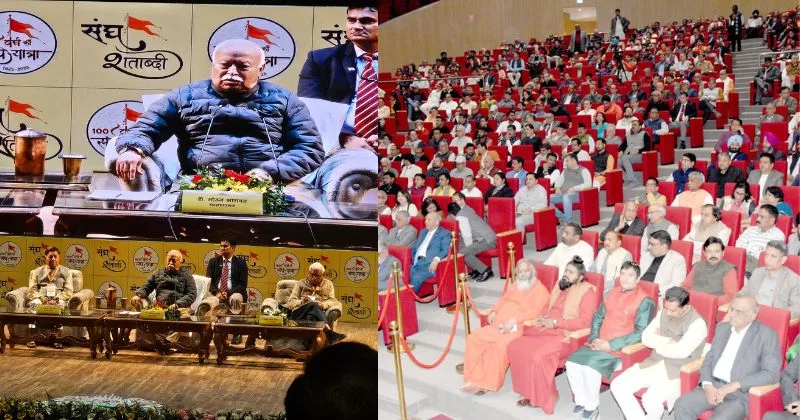
DEHRADUN: Emphasising that discrimination and social evils stem from the human mind rather than from systems alone, Sarsanghchalak of the Rashtriya Swayamsevak Sangh (RSS), Dr Mohan Bhagwat called for value-based social transformation through character building and collective strength. Addressing a public gathering titled “Sangh Yatra – New Horizons, New Dimensions” at the Himalayan Cultural Centre in Dehradun, Bhagwat j said that lasting change in society can only come through values, self-discipline and a strong national consciousness.
The event was organised as part of the centenary year celebrations of the RSS and brought together social leaders, academicians, industrial representatives and volunteers from across Uttarakhand. The programme featured an address by Bhagwat ji, followed by an interactive session covering issues ranging from social harmony and women’s participation to technology, education, the environment, and national identity.
The program began with the Sarsanghchalak offering flowers to a portrait of Bharat Mata and singing Vande Mataram collectively. The program was conducted by the Department’s Publicity Chief, Gajendra Khanduri.
In his opening address, Provincial Secretary Dinesh Semwal Ji provided information about various programmes organised in Uttarakhand under the centenary year of the Sangh, such as Path Sanchalan on Vijayadashami, Ghosh Sanchalan, an extensive door-to-door campaign, direct contact with families, and Hindu conferences, and also outlined the upcoming plans in detail.
“What Is Seen from Outside Is Not the Whole Truth”
In his address, Bhagwat said that the RSS is often misunderstood when viewed superficially. Observers who see route marches may mistake it for a paramilitary body, those who hear patriotic songs may consider it a cultural troupe, and those who witness service activities may see it solely as a charitable organisation.
However, he said, the RSS is a broader social movement dedicated to nation-building through individual transformation. Drawing an analogy, Bhagwat remarked that just as one must taste sugar to understand its sweetness, one must engage with the organisation’s work to understand its essence.
He added that the RSS does not compete with any organisation and maintains that a strong nation ensures the safety and dignity of its citizens. According to him, the organisation’s core objective remains “vyakti nirman” (character building), which in turn leads to a strong society and nation.
Reflections on Dr KB Hedgewar
Dr Bhagwat also recalled the life and contributions of RSS founder Keshav Baliram Hedgewar. He described Hedgewar as a born patriot who demonstrated his commitment to national freedom from a young age. Referring to an anecdote from Hedgewar’s childhood, Bhagwat ji said he had refused sweets distributed on Queen Victoria’s birthday, asserting that he would not celebrate the ruler of a nation under foreign rule.
He also noted Hedgewar’s association with revolutionary activities and his prosecution by the British for singing Vande Mataram. The founding of the RSS, Bhagwat ji said, was rooted in the resolve to ensure that India would never again face subjugation.
“After a journey of 2000 years, the world’s hope lies with India”
Dr Bhagwat said that, after a long historical journey, the world is looking forward to seeing India return to a leadership role. He called on the gathering to join the Sangh’s activities to empower society and the nation.
He also urged taking a pledge to take India to ultimate glory through the Sangh’s “Panch Parivartan” principles.
Key points from the Q&A session
Discrimination and social change
Dr Bhagwat said that the root cause of social evils and discrimination is not the system, but the mind. Darkness is eliminated not by beating it, but by lighting it. Discrimination will only be eradicated by a change in behaviour. Many volunteers in the Sangh work for decades without expecting recognition—because work is paramount.
Technology: A Tool, Not the Goal
In response to questions about the digital age, Dr Bhagwat observed that technology is a means, not an end. While acknowledging its utility, he cautioned against allowing it to dominate human relationships and family life. Discipline and moderation, he said, are essential to ensure that technological advancement does not erode social bonds.
He stressed the importance of nurturing emotional connections within families and ensuring that technological convenience does not come at the cost of human interaction.
Cultural Identity and National Strength
Bhagwat ji reiterated that cultural unity and devotion to the motherland form the basis of national integration. He said that the world respects strength as much as truth, and therefore India must acquire strength while ensuring that its use remains disciplined and ethical.
He described cultural identity as an inclusive force, adding that those who work to unite society embody the spirit of Hindutva. At the same time, he maintained that strength should always be guided by moral restraint.
Women’s Participation and Leadership
On the question of nari shakti, Bhagwat ji said women are fully capable of leadership in all spheres of national life. He expressed the view that their participation in governance and public affairs should not be limited to symbolic representation, suggesting it could reach 50 per cent.
He also highlighted the important role women played during challenging periods in the organisation’s history, emphasising that social progress requires equal partnership.
Environment, Education and Policy Issues
Touching upon environmental concerns, particularly in Uttarakhand, Bhagwat called for coordinated policy efforts and active local participation to protect rivers and ecological systems. He stressed that sustainable development must align with community engagement.
On education, he said the character and values of teachers are more important than curricular content in shaping young minds. He also commented on topics such as reservations and a uniform civil code, urging society to act with authenticity and harmony as it moves beyond divisive mindsets.
Politics and Public Life
Bhagwat clarified that the RSS does not engage in direct political activity but focuses on societal uplift through character building. He described corruption as a problem that originates in the mind and must be addressed at the individual level.
Regarding population issues, he suggested viewing demographic trends both as challenges and opportunities, advocating for balanced and well-considered policies applied uniformly.
The programme concluded with the national anthem, marking the end of an event that combined reflection on the organisation’s century-long journey with discussions on contemporary challenges. As the RSS marks its centenary year, Bhagwat ji’s address underscored themes of social harmony, cultural confidence and disciplined national strength—emphasising that enduring transformation begins with the individual and extends outward to society and the nation.