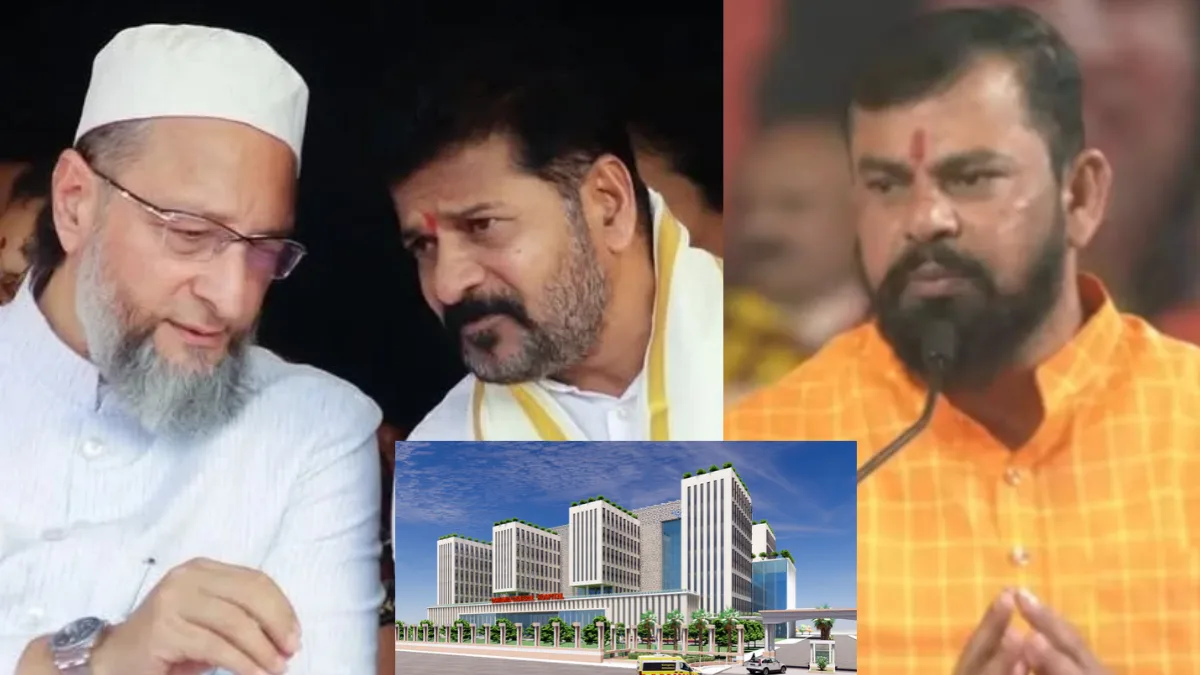
Hyderabad: The construction of a Rs 2,700-crore, 2,000-bed Osmania General Hospital at Goshamahal Police Stadium is officially projected as one of Telangana’s biggest public healthcare projects. But beneath the promise of a modern hospital, an expanding network of road-widening proposals, land acquisition notices and possible displacement has triggered a deeper political question in Goshamahal: will the project eventually alter the demographic, commercial and electoral character of the only Assembly constituency in the AIMIM-dominated Hyderabad Lok Sabha segment that has repeatedly resisted the party?
The documentary trail does not establish a Congress-AIMIM conspiracy to alter Goshamahal’s demography. But the scale of physical intervention, combined with the constituency’s peculiar electoral importance, has given such fears political traction among sections of residents and traders. What they see emerging is a possible “Trojan horse” — a public project so large and socially desirable that opposing it is difficult, while its accompanying roads, acquisitions and displacement could permanently transform the constituency.
Though the project was not part of the Congress’s electoral promises, it is worth noting that former CM K. Chandrashekar Rao had also attempted to rebuild and modernise Osmania General Hospital after the formation of Telangana. However, his government could not take the project forward due to various reasons. The present Congress government, led by Chief Minister A. Revanth Reddy, has now taken up the construction of a new OGH without having made it an electoral promise.
The story began on August 27, 2024, when Chief Minister A. Revanth Reddy directed officials to construct the new Osmania General Hospital at the Goshamahal Police Stadium and Police Sports Complex.
The project moved rapidly. On January 31, 2025, Revanth Reddy laid the foundation stone for the new OGH. The proposed hospital is massive: about 32 lakh square feet, 2,000 beds, 29 major and 12 minor operation theatres, robotic surgery facilities, a transplant theatre, super-speciality departments, academic blocks, multi-level parking and a helipad.
That scale raises the first question being asked locally: why was the hospital moved from its historic Afzalgunj location to Goshamahal?
The existing OGH campus itself extends over approximately 26.75 acres. The government has cited limitations of the existing infrastructure, heritage issues and the need for a modern facility. Yet residents argue that the decision to shift such a massive institution into the heart of Goshamahal inevitably required something much larger than a hospital building — it required the surrounding constituency to be physically redesigned.
That process is now visible.
Hospital expands beyond its compound
By June 2025, then Hyderabad Police Commissioner inspected works connected with relocating police units from the Goshamahal premises. He said the police facilities were being shifted so that land could be handed over to the Medical Department. The government separately allocated 11.5 acres for Hyderabad City Police facilities.
Planning documents propose widening and developing corridors connecting Darussalam, Malakunta, MJ Market, Muslim Jung, Begum Bazar, Siddiamber Bazar, Osmangunj, Feelkhana, Mozamjahi Market, Aghapura and Goshamahal.
One proposed stretch between MJH Market Junction and Muslim Jung Junction would be widened to 100 feet for 1.7 km. Another between Darussalam Junction and Malakunta would become 80 feet wide.
The master-plan document estimates Rs 2,545 crore merely towards private-property compensation for nine road stretches.
In other words, the compensation projected for the surrounding road network itself approaches the cost of the hospital.
The matter ceased to be an abstract master plan when the Telangana Revenue authorities issued a land-acquisition proclamation on August 16, 2026, proposing acquisition of approximately 5,022.42 square yards in Nampally Village for road widening and approach roads to OGH. The notification covers dozens of property entries and gives affected persons 60 days to object.
Residents and traders have consequently begun knocking on the doors of government officials, politicians and courts.
A formal representation by property owners, residents and traders of the Goshamahal-Begum Bazar-Muslim Jung corridor argues that widening the existing road to 100 feet would not solve congestion because traffic ultimately encounters the Muslim Jung Bridge bottleneck. They say the existing carriageway is itself underutilised because transformers, utility poles, loading activity and inadequate pedestrian management occupy substantial road space.
More importantly, they warn that the acquisition would strike at Hindu families with roots in Gujarat, Rajasthan and Haryana who have lived and conducted businesses in Begum Bazar for generations, threatening their homes, ancestral properties, rental income and livelihoods simultaneously.
The ‘Trojan horse’ fear
For residents suspicious of the larger project, this is where healthcare development and politics begin to intersect.
Residents and activists point out that the Goshamahal grounds have historically hosted Hindu religious gatherings, pravachan programmes, cultural functions, spiritual events and community activities. They argue that replacing one of the few large public spaces available to the community will permanently alter the social character of the area.
The metaphor captures the central anxiety
A 2,000-bed government hospital cannot easily be opposed. It promises healthcare, employment and modern infrastructure. But once accepted, residents argue, the hospital creates the justification for widening roads, acquiring property, demolishing commercial structures, reorganising traffic and eventually changing settlement patterns around it.
For them, the hospital is therefore not the target of opposition. The concern is what is being undertaken in its name.
Why Goshamahal is politically different
The political significance becomes clearer when Goshamahal is placed within Hyderabad’s electoral geography.
The Hyderabad Lok Sabha constituency contains seven Assembly segments. In the 2023 Assembly election, AIMIM led six — Malakpet, Karwan, Charminar, Chandrayangutta, Yakutpura and Bahadurpura. BJP led only Goshamahal.
The constituency was created following delimitation in 2008. In the first election in 2009, Congress candidate M. Mukesh Goud won with 55,829 votes against BJP candidate Prem Singh Rathore’s 35,341.
The political equation changed decisively in 2014. T. Raja Singh of the BJP won 92,757 votes — 58.5 per cent — defeating Congress’s M. Mukesh Goud by 46,793 votes. In 2018, Raja Singh retained Goshamahal with 61,854 votes against TRS candidate Prem Singh Rathore’s 44,120. In 2023, he won for the third consecutive time, polling 80,182 votes, or 54.08 per cent, against BRS candidate Nand Kishore Vyas’s 58,725.
That makes Goshamahal an electoral anomaly within the Hyderabad Lok Sabha constituency.
Available constituency-level reporting before the 2023 election estimated around 70,000 Muslim voters among roughly 2.67 lakh electors, making Muslims a minority in Goshamahal — markedly different from AIMIM’s other Old City strongholds. Raja Singh himself spoke during the 2023 campaign of support among Lodhas, Marwaris, Marathas, Yadavas and other communities, with political observers attributing his repeated victories partly to consolidation of the Hindu vote.
The electoral evidence, nevertheless, demonstrates Goshamahal’s distinct political character.
Kranthi, an activist and local journalist, told Organiser: “The current change, under the guise of constructing a multi-speciality hospital, is like bait before a ceremonial sacrifice and this has been sensed by only a few.”
Congress-AIMIM equation enters the debate
This is precisely why the physical transformation of Goshamahal is being viewed politically.
Critics allege that Congress, seeking Muslim electoral support in Hyderabad, has little political incentive to preserve a constituency that has become a symbol of Hindu electoral consolidation inside the AIMIM-dominated Hyderabad parliamentary seat. They further suspect that AIMIM would be the principal political beneficiary if Goshamahal’s present electoral composition changed substantially.
There is presently no documentary evidence proving that Revanth Reddy’s government or AIMIM president Asaduddin Owaisi devised the OGH project to engineer such demographic change. Any claim that Owaisi is deliberately using the hospital to “convert” Goshamahal into a Muslim-majority constituency would therefore go beyond the available evidence.
But the political question cannot simply be dismissed either.
The hospital is real. The road plans are real. The acquisition notification is real. The threatened displacement is real. And Goshamahal’s position as the lone constituency resisting AIMIM’s Old City dominance is equally real.
That combination is driving suspicion.
Now, with the potential displacement of thousands of Hindu residents from Goshamahal, critics fear that the constituency’s religious and political balance could gradually tilt, weakening the existing Hindu vote base and potentially benefiting Asaduddin Owaisi and AIMIM.
The AIMIM headquarters at Darussalam is itself located within the Goshamahal Assembly constituency, adding another layer to the political significance of the proposed transformation. If large-scale displacement alters the settlement pattern and consequently the electoral arithmetic, it could consolidate AIMIM’s political position in the constituency for generations. What is unfolding, critics fear, could therefore become a contest between political opponents today that permanently changes the political character of Hyderabad tomorrow.
Raja Singh’s silence questioned
Another uncomfortable question being raised locally concerns T. Raja Singh himself.
Raja Singh built his political career around defending Goshamahal as a Hindutva stronghold and won the constituency three consecutive times. He resigned from the BJP in 2025 following differences over the party’s Telangana leadership.
Against that background, residents who fear displacement are questioning what they describe as his inadequate public intervention against the larger transformation now unfolding around OGH.
For voters who repeatedly backed him precisely because Goshamahal was politically different from the rest of the Old City, his perceived silence on a project they believe could alter that distinction has become part of the controversy.
More than a constituency — an economic nerve centre
There is another dimension that makes the stakes considerably higher.
Goshamahal encompasses Begum Bazar, Afzalgunj, Aghapura, Dhoolpet, Mozamjahi Market, Nampally, Osmangunj and adjoining trading areas. These are not merely residential neighbourhoods. Begum Bazar and the surrounding wholesale markets form one of Telangana’s oldest commercial networks connecting national supply chain with local markets.
The residents’ representation describes Begum Bazar as a historic wholesale centre where businesses have operated since around 1900 or earlier and warns that disruption could damage supply chains across Telangana.
Thus, displacement here means considerably more than losing buildings. It could disperse communities, businesses and trading relationships that have sustained the constituency’s social and electoral character for generations.
That is why the central question surrounding the new Osmania Hospital is increasingly political.
Is Goshamahal merely receiving Hyderabad’s biggest new government hospital, or is a healthcare mega-project becoming the vehicle for a much larger restructuring of the last constituency in the Old City where AIMIM has failed to establish political dominance?
There is not yet evidence sufficient to prove the conspiracy alleged by critics. But with acquisition notices reaching residents, ₹2,545 crore in proposed road compensation, more than 5,000 square yards presently notified for acquisition and historic markets falling within the connectivity plan, the fears can no longer be treated merely as political rhetoric.
For Goshamahal’s residents, the battle is therefore not against Osmania General Hospital. It is over what Goshamahal will look like — economically, demographically and politically — after the hospital arrives.