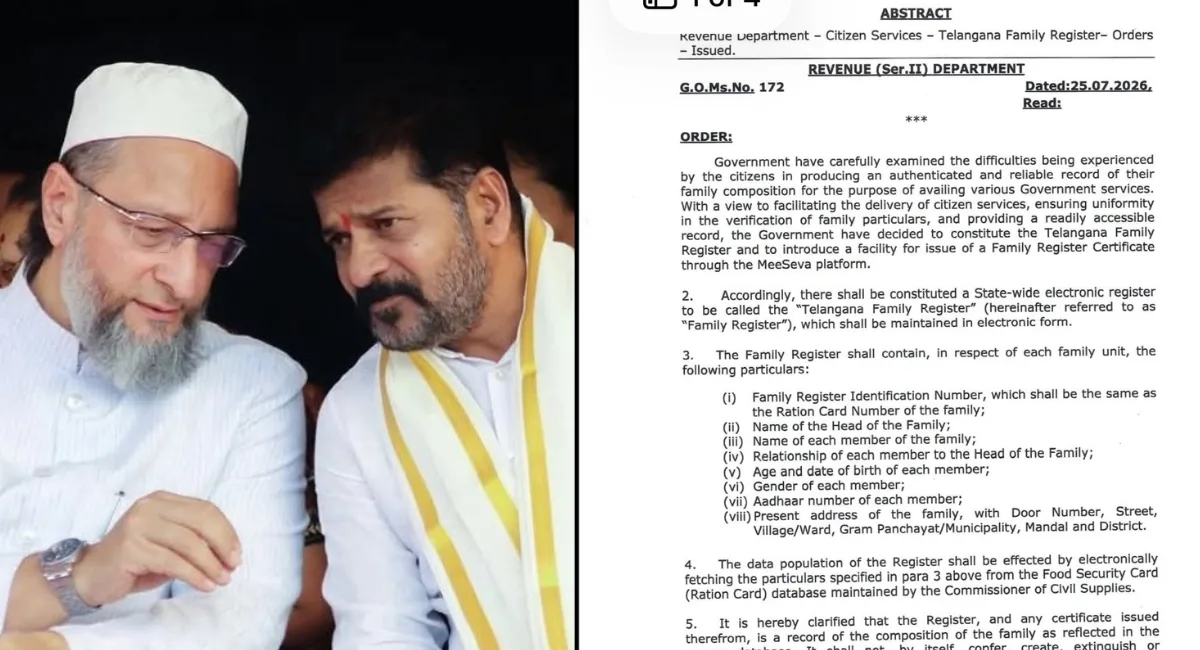
Hyderabad: The Telangana government has introduced the Telangana Family Register (TFR) and Family Register Certificate (FRC) through a Government Order dated July 25, 2026), creating a State-wide electronic family database and enabling citizens to obtain an authenticated Family Register Certificate through MeeSeva centres. The move comes amid the ongoing Special Intensive Revision (SIR) of electoral rolls in Telangana, with the Family Register Certificate now being accepted as one of the 12 valid documents for updating electoral rolls.
The initiative follows repeated representations made by AIMIM president and Hyderabad MP Asaduddin Owaisi, who had urged the Congress government led by Chief Minister A. Revanth Reddy to introduce either a Family Register Certificate (FRC) or Population Register Certificate (PRC) to help undocumented citizens comply with the Election Commission’s SIR process. The State government has now implemented the proposal through the new Government Order.
According to the order, the government has constituted the Telangana Family Register, which will be maintained in electronic form and populated using data from the Food Security Card (Ration Card) database maintained by the Commissioner of Civil Supplies.
The Family Register will include the Family Register Identification Number (same as the ration card number), name of the head of the family, names of all family members, relationship with the head of the family, age, date of birth, gender, Aadhaar number, and present residential address. The government has clarified that the register is only a record of family composition and does not determine legal heirship, property rights or eligibility for government benefits.
A new “Telangana Family Register Certificate” service has been introduced under the Revenue Department category on the MeeSeva platform. Any adult member of a registered family can apply for the certificate by quoting the family’s ration card number. Applications can be submitted through MeeSeva centres or the online MeeSeva portal, and the certificate is to be issued within two working days after verification by the concerned Tahsildar using a digital signature.
The Government Order also directs the Commissioner of Electronic Service Delivery (ESD) to integrate the MeeSeva platform with the Civil Supplies Department’s Food Security Card database through an API, while District Collectors have been instructed to oversee implementation across the State.
Owaisi’s representations
Welcoming the decision, Asaduddin Owaisi said the Telangana government had accepted his representation seeking issuance of the Family Register Certificate through MeeSeva.
“In a welcome move, the Government of Telangana has decided to issue Family Register Certificate through the MeeSeva platform. I had made a representation along with Faheem Qureshi. The certificate is one of the 12 acceptable documents under the Special Intensive Revision. It will benefit many poor and undocumented people if they receive notice. I thank the State government for its timely decision,” Owaisi posted on X.
In a welcome move, the Government of Telangana has decided to issue Family Register Certificate through the MeeSeva platform (₹62 as service charge). I had made a representation along with @FaheemQureshinc. The certificate is one of the 12 acceptable documents under the Special… pic.twitter.com/mTJoQe51YX
— Asaduddin Owaisi (@asadowaisi) July 27, 2026
Earlier, after the Election Commission extended the deadline for returning Enumeration Forms (EFs) to Booth Level Officers (BLOs) by ten days, Owaisi had urged the Telangana government to issue either the Family Register Certificate or PRC, saying it would become “a boon for poor people of Telangana.”
In another representation, Owaisi said he had met the Telangana Chief Secretary along with AIMIM leader Faheem Qureshi, requesting the Revanth Reddy government to issue the certificate under Article 162 of the Constitution during the ongoing SIR exercise. He pointed out that Karnataka already issues a similar Population Register Certificate (PRC) under the Karnataka Sakala Services Act, 2011, and argued that such a document would help poor citizens secure inclusion in the final electoral rolls without unnecessary hardship.
AIMIM welcomes implementation
AIMIM Nampally MLA Mohammed Majid Hussain said the Family Register Certificate was introduced following representations made by party president Asaduddin Owaisi and noted that it could now be used as one of the accepted documents in the ongoing SIR process as well as for accessing various government welfare schemes.
Mohammad Ali Shabbir, Advisor to the Telangana Government for SC, ST, BC and Minorities, observed that since the certificate is among the 12 accepted documents under the ongoing Special Intensive Revision (SIR), it would significantly benefit poor and undocumented citizens who receive notices during the electoral roll verification process.
However, critics argue that the Congress government, by accepting AIMIM’s demand to introduce the Family Register Certificate during the ongoing Special Intensive Revision (SIR), has opened the door for potential misuse of the electoral verification process.
They contend that recognising the Family Register Certificate as one of the 12 accepted documents could enable illegal Bangladeshi and Rohingya immigrants to enter the SIR process by relying on existing records such as ration cards and linked family databases.
According to the critics, this could further complicate efforts to verify citizenship and residency while placing additional pressure on authorities to recognise their residence and entertain subsequent legal claims. They argue that the prolonged verification process could eventually facilitate the inclusion of such illegal immigrants in the electoral rolls, thereby creating a permanent vote bank.
Critics further maintain that, despite the government already possessing multiple mechanisms for identity verification, the existence of duplicate ration cards, forged identity documents and other fabricated records creates a chain of supporting documents that could be exploited to prolong legal proceedings and facilitate the continued stay of illegal Bangladeshi, Rohingyas and foreign nationals in Bharat.