India is approaching a demographic turn that will quietly redefine how the nation looks after its own. NITI Aayog’s report, Reimagining Care: Strategies for Empowering Caregivers in Viksit Bharat@2047, published in August 2026, places one figure at the centre of the conversation by 2050, India’s elderly population is projected to reach 347 million, or 20.8 per cent of the country’s people.
The India Ageing Report 2023 had estimated 149 million persons aged 60 and above in July 2022, roughly 10.5 per cent of the population, rising to 194 million by 2031. Alongside this, Census 2011 recorded 26.8 million differently abled persons, 2.21 per cent of the population, many of them children with special needs who depend on parents or close relatives. Care, in short, is no longer a private household matter. It is becoming a national capability that must be planned, skilled and financed.
The global backdrop is equally instructive. The World Population Ageing Report 2019 recorded 703 million persons aged 65 and above worldwide, a figure projected to more than double to 1.5 billion by 2050. For the first time in recorded history, older people now outnumber the young.
An estimated 1.3 billion persons, 16 per cent of humanity, live with severe disability, while around 50 million people live with dementia and Alzheimer’s disease, expected to rise to 152 million by 2050. Supply, meanwhile, lags badly the long-term care sector struggles to attract and retain workers because of irregular hours, pay lower than comparable health occupations and greater occupational health risk, leaving the burden to fall on untrained family members.
Who is a caregiver?
The report adopts the World Health Organisation’s understanding of caregiving as the physical, emotional and social support extended to persons who cannot perform daily activities independently because of age, illness or disability. Within this definition, India recognises two distinct streams.
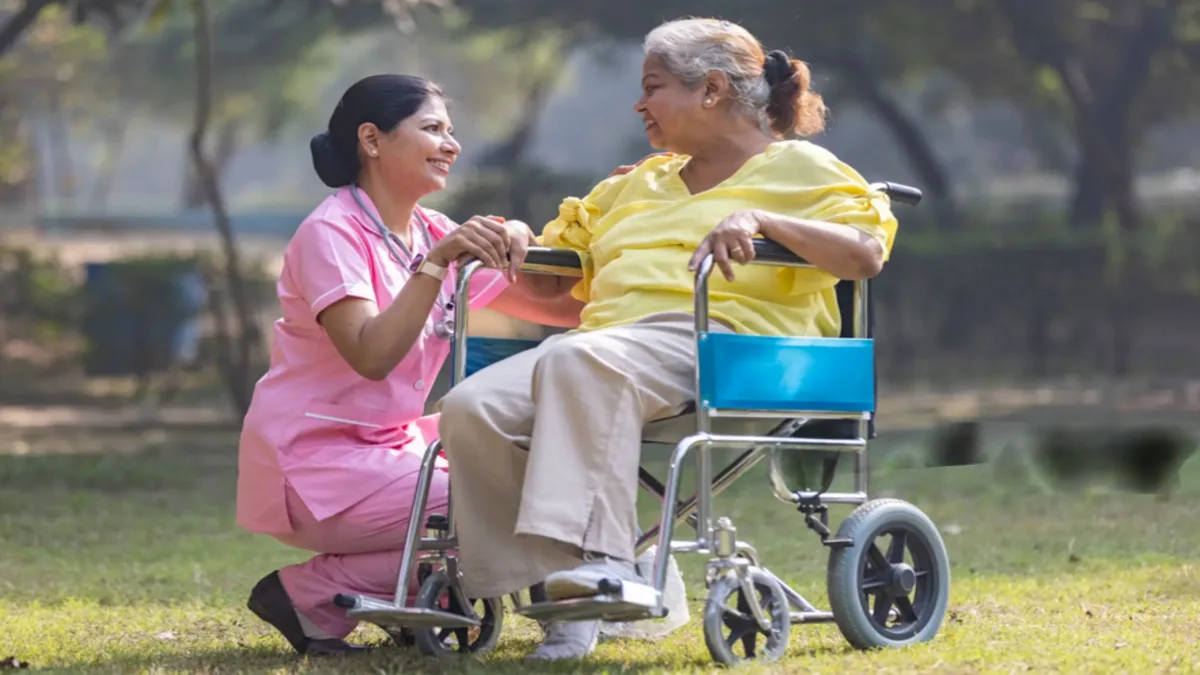
A formal caregiver, often described as a personal care aide, is a trained professional who provides non-medical assistance to older persons, persons with disabilities and patients living with terminal or chronic illness. An informal caregiver may be a family member, a friend or a volunteer who steps in without payment, training or formal recognition. The distinction matters because policy has so far addressed the first group while leaning almost entirely on the second.
India’s legal architecture supplies further precision. The Rights of Persons with Disabilities Act, 2016 defines a person with disability as someone with long-term physical, mental, intellectual or sensory impairment which, interacting with barriers, obstructs full participation in society.
The disability of 40 per cent or more constitutes benchmark disability, carrying entitlement to specified facilities. The Act recognises twenty-one conditions, among them visual and hearing impairment, locomotor and intellectual disability, autism spectrum disorder, cerebral palsy and multiple disabilities.
India also fixes the threshold of old age at sixty years, unlike developed economies where sixty-five is the marker, a difference that shapes eligibility for social security and retirement benefits.
The core duties that define the work
Caregiving is frequently dismissed as unskilled attendance. The report’s enumeration of core duties dispels that assumption. A caregiver is expected to safeguard the physical, emotional and social well-being of the care seeker in order to promote healthy living by managing medication, preparing specialised diets, operating medical equipment and responding to emergencies. To assist with activities of daily living such as bathing, grooming, self-care and physical movement.
Beyond this, caregivers also extend specialised support to patients with chronic illness and those requiring palliative care. Emotional companionship through active listening and encouragement to participate in social gatherings forms an equally central duty.
Caregivers coordinate with healthcare professionals for timely medication, record observable changes in health and maintain patient records. They participate in planning long-term care alongside the patient, the doctor and the family, including the time and financial commitment such care demands. They foster the care seeker’s own agency by encouraging safe independent activity and participation in household and community life.
This is clinical vigilance, emotional labour and household management performed simultaneously, usually without certification and almost always without institutional backing.
Why caregivers matter to the economy
The care economy, comprising both paid and unpaid work, has emerged as a global concern. The World Economic Forum estimates that the care sector accounts for 16 per cent of total employment worldwide, spanning formal and informal systems. The unpaid care is contributing approximately eleven trillion dollars annually at the global level, remains largely unrecognised in national accounting.
India’s own care services market was valued at approximately 29.62 billion dollars in 2023 and is projected to grow at a compound annual rate of 13.76 per cent to reach 72.31 billion dollars by 2030.
The international picture reinforces the opportunity. OECD countries will require a 60 per cent increase in care workers by 2040, an additional 13.5 million people, merely to hold the present caregiver-to-elderly ratio. The United States anticipates a shortfall of 151,000 care workers by 2030, widening to 355,000 by 2040.
Germany recorded a shortage of 120,000 care workers in 2020. In 2025, the WHO revised its projection of a global health workforce shortage upward to nearly eleven million by 2030. For India, professionalising care converts a domestic obligation into an employment engine, particularly for women and youth, while positioning the country as a trusted global supplier of trained caregiving professionals.
Family caregiving and the Indian social fabric
Informal caregiving remains the backbone of the Indian system. According to the International Alliance of Carer Organisations, approximately 10 per cent of India’s population are family caregivers. The burden, however, is distributed unequally.
The Time Use Survey of 2019, conducted by the National Statistical Office, found that Indian women devote roughly 299 minutes each day to unpaid domestic and caregiving work, against 97 minutes for men.
Community-based caregiving has long supplemented the family. Under this traditional arrangement, older persons living without immediate family were cared for by extended kin, neighbours and the wider community, care being treated as a moral obligation rather than a transaction. It is a civilisational instinct that has sustained generations.
That instinct is now under strain. Rising female labour force participation, urbanisation, the migration of younger family members and the steady shift from joint to nuclear households are reducing the availability of informal caregivers even as demand climbs.
Families providing care often lack the skills required for elderly persons with complex needs, particularly those bedridden or requiring palliative support. The report is candid about the policy gap. Family caregivers, despite constituting the primary support base of the ecosystem, remain largely unrecognised within formal frameworks and receive no financial assistance, though an allowance for those supporting persons with high support needs is acknowledged in the RPwD Act, 2016.
Prolonged caregiving produces emotional distress, physical exhaustion, social isolation and financial hardship. Caregiving continues to be perceived primarily as a family duty, which delays the use of professional services and limits social acceptance of formal care.
Initiatives by Central Ministries
The Ministry of Social Justice and Empowerment anchors the effort through two departments. The Department of Social Justice and Empowerment runs PM Special (Training of Geriatric Care Givers), supported by a National Action Plan to build a trained geriatric caregiving workforce, with the National Institute of Social Defence delivering courses.
In May 2026, the Ministry launched the SHATAYU dashboard, offering a real-time searchable database mapping certified geriatric caregivers by district and state. The JEEVAN mobile application, a single-window platform consolidating welfare schemes, senior citizen homes and support services with an SOS emergency feature linking users to police, medical and administrative responders.
The Department of Empowerment of Persons with Disabilities implements the Certificate Course in Caregiving through the Rehabilitation Council of India. The Ministry of Health and Family Welfare operates the National Programme for the Health Care of the Elderly, which trains family caregivers, arranges domiciliary visits for homebound and bedridden elderly persons and links households to support groups and day care centres.
The National Commission for Allied and Healthcare Professions, established under the 2021 Act, regulates ten categories of professionals, with palliative care professionals and community health promoters most closely matching the caregiver role.
NIMHANS, Bengaluru, conducts the monthly Road to Recovery programme for caregivers of persons with mental illness, a thirty-hour online course on geriatric mental healthcare and dementia care that has trained 240 caregivers, an online support group with Dementia India Alliance and the Vayo Manasa Sanjeevani awareness initiative. The National Institute of Public Health Training and Research offers a 414-hour Home Health Aid course, though enrolment has yet to be processed.
The Ministry of Skill Development and Entrepreneurship works through the National Council for Vocational Education and Training, which has approved ten short-term and one long-term qualification in geriatric care, aligned to the National Skills Qualification Framework and listed on the National Qualification Register.
Awarding bodies include the Home Management and Care Givers Sector Skill Council and the Healthcare Sector Skill Council. Through NSDC, India’s Technical Intern Training Programme places candidates in Japan for up to five years.
Under the Israel engagement, PIBA sought 5,000 home-based caregivers in May 2024, with 47 candidates having travelled by August 2025. In Germany, 32 caregivers placed in 2024 cleared B1 language training and earn between 2,300 and 2,700 euros monthly.
The Ministry of External Affairs maintains roughly twenty-one labour migration agreements, including arrangements with Italy, the European Union, Saudi Arabia and Japan’s Specified Skilled Worker framework covering nursing care. Its Pre-Departure Orientation Training, begun in 2018 at four centres, now operates from fifty-four.
Training, certification and the formal care network
Formal caregiving is itself an evolving system in India, concentrated in urban centres and delivered through private companies, hospitals and specialised agencies offering day care, nursing support, physiotherapy, dementia support, respite and palliative care.
Institutional caregiving is extended publicly through NPHCE and the Integrated Programme for Older Persons, which fund geriatric wards, physiotherapy units and grants to hospitals and voluntary organisations.
On the certification side, IGNOU offers the Certificate in Geriatric Care Assistance, developed with the Ministry of Health and Family Welfare as a six-month programme for science stream candidates, along with shorter home-based health care and home health assistance certificates open to Class X graduates.
NISD also conducts five-day caregiving training for family members in hospitals, communities and residential settings. Thus, it is developing a fresh modules spanning palliative and hospice care, dementia management, geriatric nutrition, counselling, physiotherapy and yoga for senior citizens.
Initiatives by State Governments
Odisha conducts a three-month geriatric caregiver certificate course at four locations, covering daily living support, dementia care, counselling, physiotherapy and first aid, targeting 400 caregivers annually. Tamil Nadu launched its Home-Based Elderly Care Support Assistant course on 1 October 2024 across 36 government medical colleges with an intake of 975 candidates.
Karnataka became the first state to introduce a Carer’s Monthly Allowance Scheme, granting Rs 1,000 monthly to parents of persons with severe disabilities including cerebral palsy, muscular dystrophy, Parkinson’s disease and multiple sclerosis, while supporting 5,000 carers groups and seven district-level associations.
Kerala’s Additional Skill Acquisition Programme runs care certification linked to the United Kingdom’s National Health Service, alongside Kudumbashree K4 Care network of trained women delivering geriatric, patient, disability and maternity care.
The Aswasakiranam Scheme, effective since August 2010, provides Rs 600 monthly to family caregivers of bedridden patients unable to seek employment, while the Neighbourhood Network in Palliative Care mobilises local volunteers for home-based care.
Road to 2047
The report also proposes a National Caregiving Council for institutional leadership, a National Caregiving Qualification Framework to standardise training and certification. A National Caregiver Registry for workforce planning.
For families, it recommends statutory care leave, workplace sensitisation, respite services, public recognition and counselling. A civilisation that has always treated seva as dharma now has the opportunity to give that instinct the dignity of a profession.