Matru devo bhava, pitru devo bhava
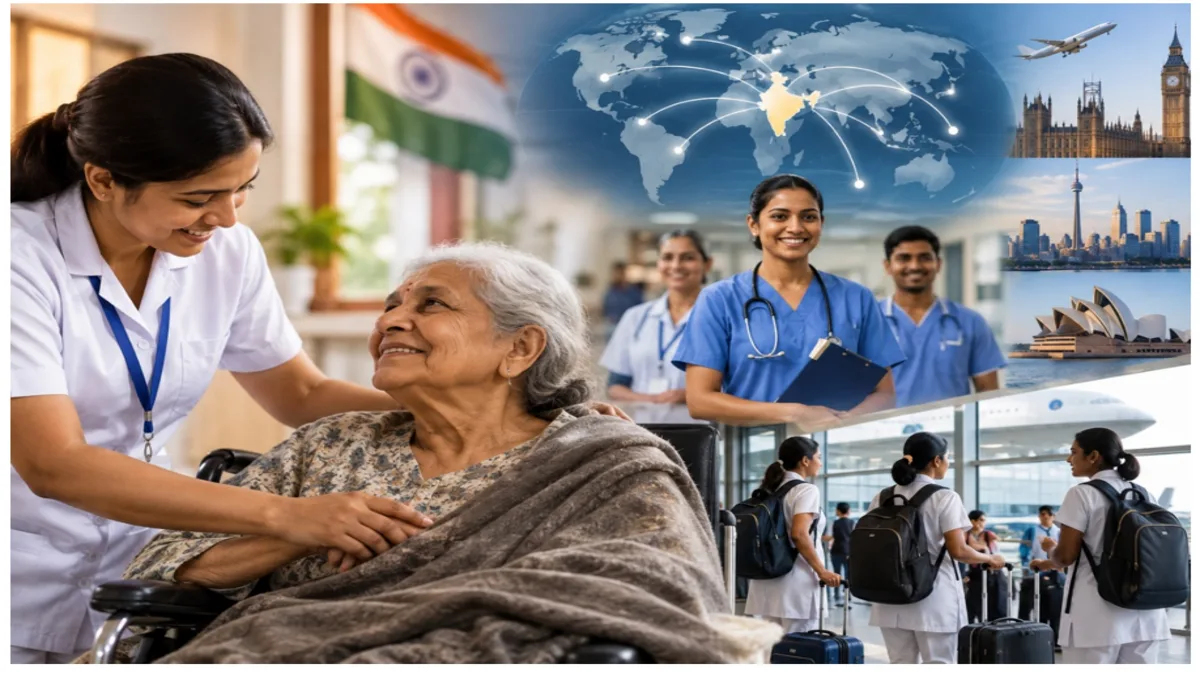
The Taittiriya Upanishad instructs to treat mother and father as divine has held Indian families together for millennia without a single line of statute behind it. NITI Aayog report on Reimagining Care: Strategies for Empowering Caregivers in Viksit Bharat@2047, was released in August 2026, with a goal that this inheritance is now India’s greatest social asset and its most urgent workforce question.
A demographic clock that India cannot reset
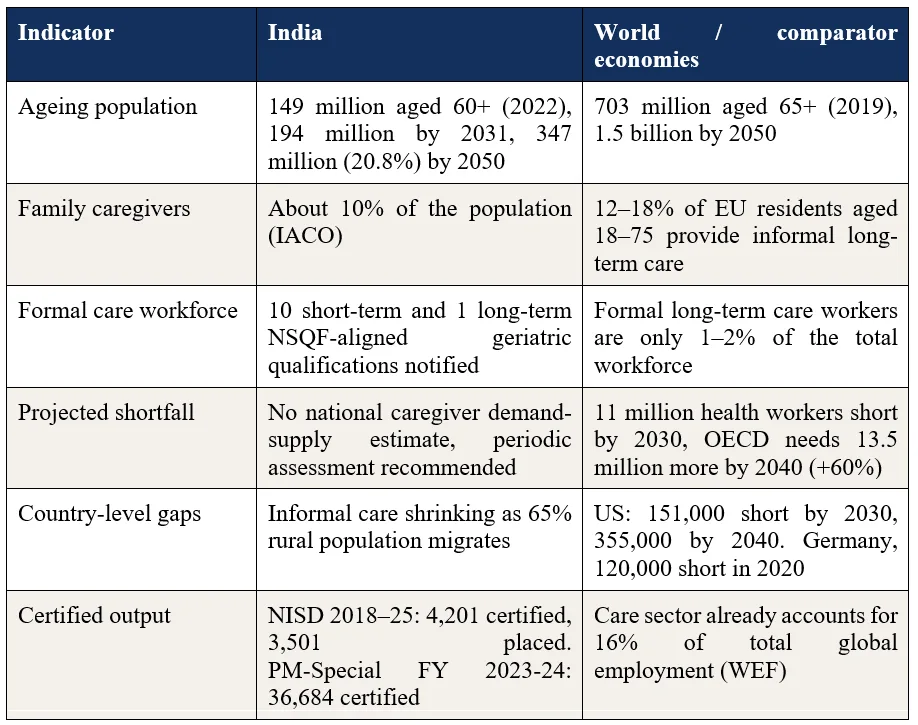
The India Ageing Report 2023 reflect that around 149 million persons are aged 60 and in July 2022, it’s roughly around 10.5 per cent of the population. The figure is projected to touch 194 million by 2031 and 347 million, 20.8 per cent of all Indians by 2050.
Census 2011 recorded 26.8 million persons with disabilities, 2.21 per cent of the population, many of them children dependent on parents as primary carers. The International Alliance of Carer Organisations estimates that about one in ten Indians already functions as a family caregiver.
Rising female labour force participation, urbanisation, migration of the young and the shift from joint to nuclear households are thinning the ranks of informal carers as demand rises. With nearly 65 per cent of Indians living in rural areas and small towns, intra-country migration has hollowed out village-level care networks. The report is neutral in nature and has asked a question about the reliance on traditional altruistic caregiving method which is no longer sustainable.
The world is short of hands and knows it
Indian transition is not an isolated story, it is the same story every ageing economy is living, only earlier and at greater scale. Globally the population aged 65 and above stood at 703 million in 2019 and is projected to more than double to 1.5 billion by 2050.
An estimated 1.3 billion people which is 16 per cent of humanity living with severe disability. Dementia and Alzheimer affect about 50 million people today, the number is expected to reach 152 million by 2050.
In 2025 the World Health Organisation estimated a global shortfall of nearly 11 million health workers by 2030, including doctors, nurses, midwives and personal care workers. It revised an upward from a projection of 10 million made in 2022.
OECD countries need their care workforce to expand by 60 per cent by 2040 merely to hold the present caregiver-to-elder ratio steady, an additional 13.5 million workers. The United States faces a projected deficit of 151,000 care workers by 2030, widening to 355,000 by 2040. Germany demand for carers rose 34 per cent between 2015 and 2018, with a shortfall of 120,000 recorded in 2020 and 76 per cent of care delivered at home.
The long-term formal care workers such as nurses and personal care assistants make up only 1 to 2 per cent of the total workforce in these countries. Between 12 and 18 per cent of European Union residents aged 18 to 75 provide informal long-term care.
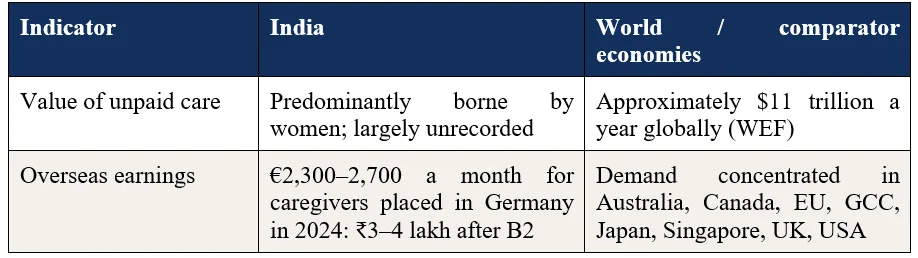
The World Economic Forum places the care sector at 16 per cent of total global employment across paid and unpaid forms, with unpaid care alone contributing an estimated $11 trillion a year that no national account records. In short, the richest economies are running their care systems on the same unpaid family labour of India and they have fewer families to draw on.
How other countries pay for care
The financing models differ sharply and India has yet to choose one. Germany, Japan and South Korea run mandatory social insurance for long-term care, needs-tested on dependency rather than means-tested on income, with beneficiaries free to take cash or in-kind professional support.
Spain, the Nordic countries, the Netherlands and Scotland fund care largely from general taxation. Italy, Spain and Portugal follow a residual model that steps in only after a family’s own resources are exhausted, covering roughly 10 per cent of the elderly. The United States leans on private insurance and spends comparatively little from public funds.
France, Germany and Austria have moved towards cash-for-care, allowing families to pay their own members a flexible but raises an accountability concern where regulation is weak.
Changing face after Vocational Education Training and Skill
The National Council for Vocational Education and Training has approved ten short-term and one long-term qualification for geriatric care, aligned to the National Skills Qualification Framework and listed on the National Qualification Register.
Awarding bodies include the Home Management and Care Givers Sector Skill Council and the Healthcare Sector Skill Council. The Rehabilitation Council of India, the National Institute of Social Defence and IGNOU each run certified caregiving programmes, and States including Odisha, Tamil Nadu, Karnataka and Kerala have launched their own initiatives.
Between 2018-19 and 2024-25, NISD conducted 172 training programmes, enrolling 4,300 caregivers, certifying 4,201 and placing 3,501 in employment.
Under the PM-Special training of geriatric caregivers in FY 2023-24, 39,450 candidates were approved and 36,684 were trained and certified across streams such as Wellness Therapist (Elderly), Elderly Care Companion and Geriatric Caregiver. Set against 347 million elderly Indians by 2050 these are pilot project not a pipeline.
The deeper constraint is design. Indian caregiving curricula concentrate on activities of daily living and care management, and are not aligned to international care curricula which leaves certification unrecognised abroad.
The consequence is visible in migration data where qualified Indian nurses are taking up personal care work overseas and being systematically underemployed. Retention suffers too without specialised training for dementia, stroke and neuropsychiatric conditions, burnout drives trained carers straight out of the profession.
The corridors are already open with the institutional help
The Ministry of External Affairs maintains roughly 21 labour migration agreements, including with Japan, Taiwan and Israel. Under the Technical Intern Training Programme with Japan, candidates are placed for up to five years after language, culture and domain training with the Specified Skilled Worker framework covers 14 fields, nursing care among them.
A Government-to-Government agreement with Israel led the Population and Immigration Border Authority to request 5,000 home-based caregivers in May 2024, as of 18 August 2025, 47 candidates had travelled under Implementation of Protocol B.
Germany offers the clearest signal on earnings. In 2024, NSDC International placed 32 caregivers, all of whom cleared B1 German, with leading hospitals and employers at €2,300 to €2,700 a month over ₹2 lakh.
On completion of B2 training in Germany, their salaries are set to rise to between ₹3 lakh and ₹4 lakh a month. The Kerala–Germany Triple Win programme, running since 2013 through ZAV, GIZ and Norka Roots, remains the template NITI Aayog wants replicated. Pre-Departure Orientation Training, begun in 2018 at four centres, now operates from 54.
The demand map is wide: Australia, Canada, European Union members, Gulf Cooperation Council states, Japan, Singapore, the United Kingdom and the United States.
The report central recommendation is a National Caregiver Council as the apex body for regulation, accreditation and coordination, supported by a National Caregiving Policy, a national qualification framework covering curriculum, competency, certification and continuing professional development and a National Caregiver Registry with a digital portal linking caregivers and care seekers.
It proposes extending the Unorganised Workers Social Security Act, 2008 to caregivers, along with occupational disease and work accident insurance, and recognition of caregivers as allied healthcare providers with the absence of which currently bars them from insurance, retirement security and injury compensation.
For overseas workers, it seeks mutual recognition of certifications, language and cultural competency training, regulated recruitment agencies, standardised contracts, grievance redressal through Indian Missions and a reintegration framework using Recognition of Prior Learning so returning caregivers re-enter the domestic system at their true skill level rather than at the bottom.
Nari Shakti and the Purple Economy
Because caregiving in India is overwhelmingly women’s work, professionalising it converts unpaid obligation into counted, paid, socially protected employment, the report links this directly to women economic participation and GDP.
It also asks the Department of Empowerment of Persons with Disabilities to map caregiving roles suitable for persons with locomotor disabilities, hearing impairments and other conditions that do not limit caring capacity the Purple Economy, treating persons with disabilities as contributors to growth rather than recipients of welfare.
India has the youth, the numbers and the cultural grounding. What it lacks is standardisation, certification the world recognises and social protection for its carers. Building those three is the whole opportunity.