
BRAJ: A young woman from Berlin arrived in Bharat in 1978 as a traveller. She was only 20 and was exploring the world, but her journey soon became much more than a tour. Drawn towards the spiritual traditions of Bharat, she eventually reached Radha Kund in Mathura in search of a Guru.
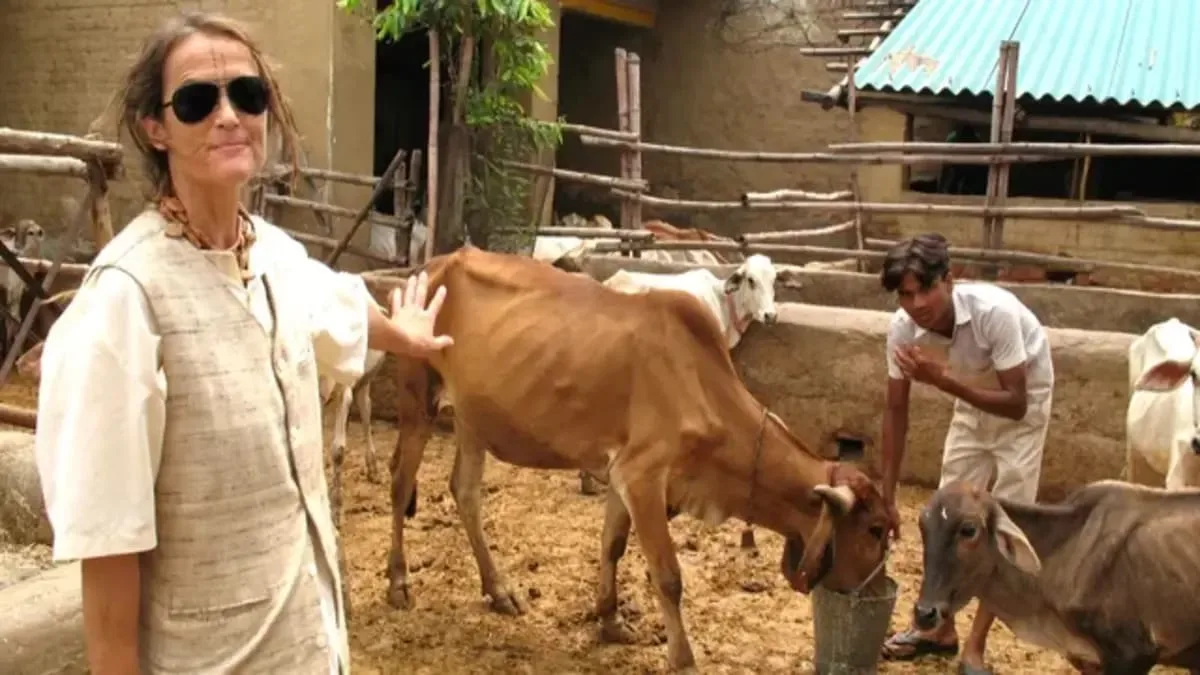
More than four decades later, that young traveller is known as Sudevi Mataji, the founder of Radha Surabhi Gaushala. Her life has become closely associated with the care of sick, injured and abandoned cows, with the shelter now caring for more than 2,500 animals, according to recent reports. Her story is one of an unusual journey — from Berlin to Braj, from a search for spiritual knowledge to a life dedicated to seva.
A journey that brought her to Bharat
Friederike Irina Bruning was born in Berlin in 1958. After completing her education, she travelled to explore the world. According to the Radha Surabhi Gaushala’s account, she travelled overland from Germany through Turkey, Iran and Afghanistan before reaching Bharat. Her travels later took her to several other countries before she returned to Bharat. During her travels, she developed an interest in yoga, spirituality and the teachings of different Indian traditions. Her search eventually led her to the Bhagavad Gita.
The Gaushala’s official account says that reading the Gita had a profound impact on her and inspired her to search for a spiritual teacher. That search eventually brought her to Radha Kund, in the sacred Braj region of Mathura. There, she found her Guru and received diksha from Shri Shri 108 Shri Kishorikishoranand Goswami Babaji Maharaj, popularly known as Tinkodi Baba Ji Maharaj. The Gaushala says she subsequently spent around two decades engaged in bhajan according to her Guru’s instructions.
The wounded calf that changed everything
Her eventual path towards Gau Seva began with an act of compassion. According to the Radha Surabhi Gaushala, she once came across a calf lying on the road with a broken leg. She took the injured animal home and cared for it. That calf became the beginning of what would eventually grow into a large Gaushala dedicated to animals in distress. She began taking in more cows and calves found abandoned or in need of care. What started as a personal act of compassion gradually developed into an organised effort to provide shelter, food and medical treatment. The Gaushala was eventually established at Radha Kund as Radha Surabhi Gaushala. The scale of the work changed dramatically over the years.
In 2017, reports said Bruning was caring for around 1,200 cows and calves, many of them sick, injured or abandoned. By 2019, the number had crossed 1,800. Recent reporting in September 2026 puts the number at more than 2,500 cows.
The Gaushala’s own website describes its residents as including blind cows, critically injured animals, permanently disabled cows, contagious cases, lame cows and orphaned calves. It provides shelter, food and medical care for these animals. The journey from caring for a single injured calf to maintaining a shelter for thousands of animals illustrates how a small act of compassion developed into a decades-long commitment.
For Sudevi Mataji, the connection with Radha Kund is not simply geographical. Her official biography says she has lived in Radha Kund for more than 45 years. The place where she initially came in search of spiritual guidance eventually became the centre of her life and service. Her adopted spiritual name, Sudevi Dasi, reflects the Vaishnava devotional tradition in which she has lived and served. Her life in Braj also became deeply connected with the traditions surrounding Bhagwan Shri Krishna and Gau Seva. Instead of returning to Germany after her travels, she chose to remain in Bharat and build her life around spiritual practice and service.
A Gaushala built around care
The work at Radha Surabhi Gaushala goes beyond simply providing shelter. The organisation says animals are given food, medical treatment and dedicated care depending on their condition. Particularly vulnerable cows are kept separately so they can receive appropriate attention. The Gaushala currently highlights medical care, shelter and food among its principal services. It also operates facilities and equipment required for the routine care of injured and disabled cattle.
For an animal arriving with a serious injury, the shelter can become the difference between being left on the streets and receiving continued care.
The Government of India formally recognised Bruning’s contribution in 2019. She was awarded the Padma Shri for Social Work — Animal Welfare. The official Padma Awards notification lists Ms Friederike Irina Bruning, Germany, under Social Work-Animal Welfare. The honour brought national attention to a woman who had spent decades largely away from the public spotlight. At the time, reports noted that she had already been caring for more than 1,800 cows and calves, many of them rescued after being abandoned by their owners.
The latest reports from September 2026 have again brought Sudevi Mataji’s story into the spotlight, with the Gaushala now associated with the care of more than 2,500 cows. But the most remarkable part of the story is not simply the number. It is the continuity.
A young woman who came to Bharat in 1978 in search of spiritual direction eventually made Radha Kund her home. A single wounded calf became the first step towards a lifetime of Gau Seva. And what began as an individual act of compassion grew into a shelter caring for thousands of animals.
From Berlin to Braj, Sudevi Mataji’s journey is ultimately a story of faith, compassion and seva — and of how a search for meaning can become a lifelong commitment to serving those who cannot speak for themselves.