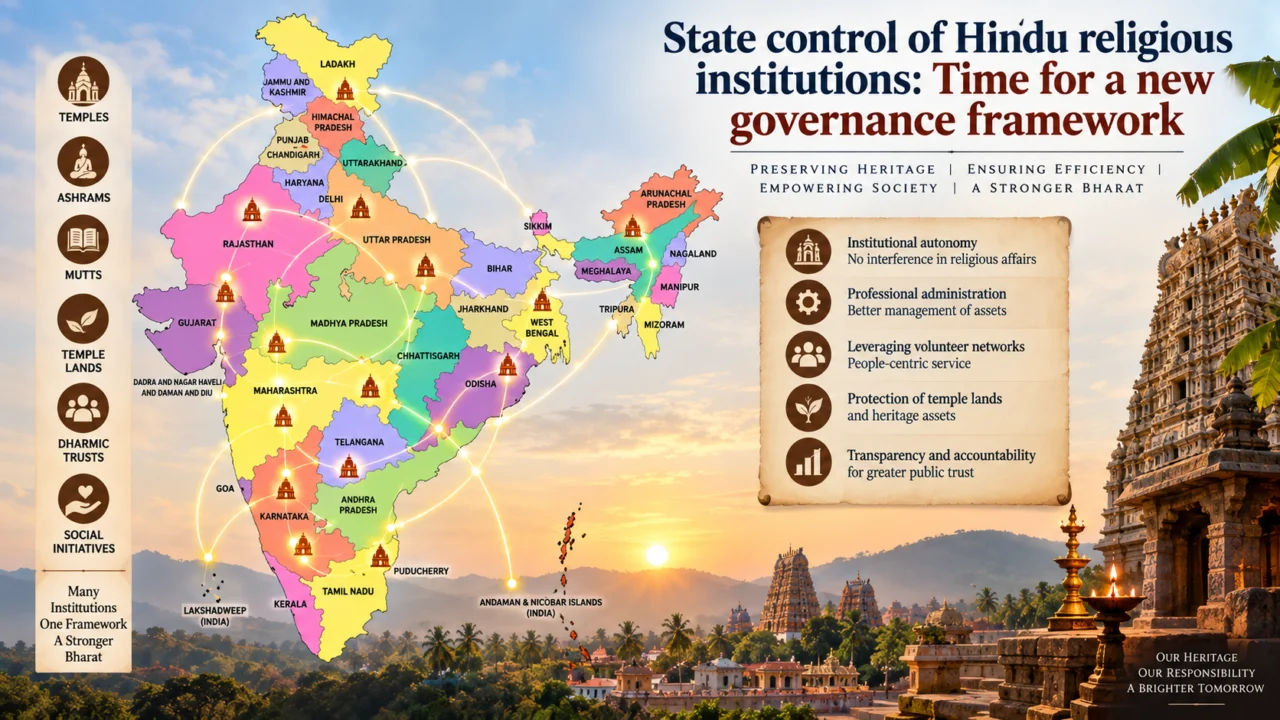
As Bharat actively seeks to accelerate its economic progress, celebrating its cultural diversity while fostering a sense of unity has become increasingly important. There is a pressing need to bring loosely or virtually connected dharmic institutions across the country into a common framework—an idea that has been awaiting realisation since Independence.
This can no longer be delayed by bureaucratic hurdles. What is needed is an authorised framework and a dharmic society and network of institutions that can continue to embody and disseminate the principles of Dharma to all. This article seeks to explore how such dharmic institutions can be brought together as a positive force for the country.
The constitutional balance
Bharat inherited a fragmented post-colonial legal landscape rather than a coherent national institutional system.
Article 26 of the Constitution provides religious denominations the right to establish and maintain institutions for religious and charitable purposes, manage their affairs in matters of religion, own and acquire property and administer such property in accordance with law. This constitutional distinction is fundamental.
The State has a legitimate role in regulating secular activities and ensuring that endowed property is not misused. But religious autonomy and denominational rights cannot become subordinate to routine administrative control. At the same time, religious autonomy cannot mean that valuable public religious assets are left without records, professional management or accountability.
The challenge is therefore to create a system that protects both principles. Do not control the faith. Protect the institution. That should be the guiding philosophy.
The problem of fragmented laws
India today has a fragmented legal framework for Hindu religious and charitable institutions. States such as Andhra Pradesh, Telangana, Tamil Nadu, Karnataka, Odisha and Himachal Pradesh have dedicated Hindu religious-endowment laws; Maharashtra, Madhya Pradesh and Rajasthan rely substantially on public-trust legislation; Kerala follows its distinctive Devaswom Board system, while Uttar Pradesh has important temple-specific laws.
A Mutt may possess property in Andhra Pradesh, Telangana, Karnataka and Tamil Nadu. An Ashram may have land in several States. A Peetham may operate educational, charitable and religious institutions in different parts of India. The State law may govern the property where it is located. But where is the single institutional record showing the complete picture? That is the gap.
Beyond the Endowment Acts
There is another important gap. Not every Hindu religious or charitable institution falls under a State Endowment Act. Many temples, particularly those below the prescribed income threshold, may remain outside the statutory framework. Numerous Shirdi Sai Mandirs, Goshalas, Annadanam institutions, charitable trusts and other service – oriented religious institutions similarly function outside the formal Endowments Department structure. Institutions such as Karivena Annadana Trust illustrate the wider network of Hindu charitable service that cannot be captured merely through State Endowment records.
This makes a national registry even more necessary. The absence of State Endowment coverage should not mean the absence of institutional identity, continuity or a mechanism to protect the assets entrusted to such institutions.
The proposed national framework should therefore cover the wider universe of Hindu religious and charitable institutions, while respecting their distinct legal status and autonomy.
The danger of political dependence
There is another reason for creating an enduring framework. The protection of religious institutions should not depend upon the political philosophy of whichever government happens to be in power in a particular State. Tamil Nadu has seen strong political debate over temple administration and State control. Similar debates occur elsewhere. Political governments will change. Institutions must survive them.
The protection of endowed assets should therefore be based on transparent systems and institutional records, not political goodwill. A national registry would not solve every political dispute. But it would create a permanent institutional record that cannot easily disappear with an administrative change.
Preserving institutional knowledge and civilisational heritage
But the challenge goes beyond the law, administration and property. These institutions are also repositories of Bharat’s civilisational memory. Ashrams, Mutts, Akharas and other religious institutions have evolved over centuries, carrying distinct histories, traditions, customs, spiritual practices and philosophical systems.
The traditions of Dvaita and Advaita, and the many Vaishnava and Shaiva schools, among others, represent not merely systems of philosophy but living traditions expressed through worship, rituals, festivals, learning and community practices. Their institutional histories, lineages, customs, forms of puja and path, and methods of teaching form part of an extraordinary body of knowledge.
A national academic and knowledge framework should therefore complement the proposed institutional registry. Its purpose should not be to standardise or homogenise these diverse traditions, but to document, study and preserve them in consultation with Dharmacharyas, Acharyas and recognised spiritual institutions, and to make this knowledge accessible to younger generations.
India’s civilisational strength has always rested on its ability to sustain extraordinary diversity of languages, philosophies, customs, forms of worship and festivals while retaining a deeper cultural continuity. Much of this knowledge still lives within institutions and through the oral traditions of their spiritual heads and communities.
Unless it is systematically documented and transmitted, valuable institutional memory and traditional knowledge can gradually disappear.
This effort should also lead to the creation of academic courses in Hindu institutional systems, philosophy, traditions and heritage, initiated with the support of the Ministry of Education and adapted to the needs of the present generation.
Such courses would create a professional talent pool of young people equipped with both traditional knowledge and contemporary skills. They could serve as a valuable bridge between religious institutions and the outside world, assisting institutions in documentation, administration, communication and preservation of their heritage.
Preserving the institution therefore also means preserving the knowledge it carries. Connecting the younger generation with these traditions can give them a deeper understanding of India’s civilisational heritage and ensure that its diverse religious customs, practices and philosophical traditions remain a living and influential force in contemporary society.
The need for a national layer
This is precisely where a National Registry becomes necessary. It should be institution centric, not Endowment-Department-centric—not replacing State laws or taking over religious administration, but providing a common national layer of institutional identity, continuity and asset visibility across this fragmented landscape. A Mutt may possess property in Andhra Pradesh, Telangana, Karnataka and Tamil Nadu. An Ashram may have land in several States. A Peetham may operate educational, charitable and religious institutions in different parts of India. The State law may govern the property where it is located. But where is the single institutional record showing the complete picture? That is the gap.
What India needs is therefore not necessarily another law to regulate every temple and Mutt. What it needs is a national institutional layer that can sit above the fragmented records without displacing them. The Government of India can create a National Registry of Hindu Religious and Charitable Institutions and assign each institution a Unique Institutional Identity Number.
That number can become the common identifier through which the institution’s various records can be connected. The State Revenue Department would continue to maintain its land records. The Registration Department would continue to register property transactions. The State Endowments Department would continue to exercise its statutory responsibilities.
Courts would continue to decide disputes. Religious institutions would continue to retain their denominational and spiritual authority. But the national registry would provide the missing institutional connecting layer. This distinction is crucial. The proposal is not for Delhi to administer temples in Tamil Nadu, Andhra Pradesh or Karnataka. It is not for the Union Government to appoint Mahants or trustees. It is not for a national authority to decide rituals or religious practices. It is to ensure that the institution itself has a nationally recognisable identity and that its assets can be systematically recorded.
One institution, one identity
Imagine a Mutt established several centuries ago and its headquarters are in one State. Over generations, devotees have donated land in four other States. Some properties are agricultural. Some are urban. Some are leased. Some are under litigation. Some may have been encroached upon. Some records may still exist only in physical files. Today, these properties may appear as separate fragments in different administrative systems.
The institution, however, is one. A unique institutional identity number can create the possibility of connecting these fragments. The conceptual chain would be: Institution → Institutional ID → Property → Survey Number → Revenue Record → Registration Record → Legal Status.
This does not alter ownership. It does not alter State jurisdiction. It simply makes the institutional picture visible.
Insert legal protection:
Where legally permissible, identified institutional properties could be classified as “prohibited properties” in the relevant State registration system, so that their sale, transfer or lease cannot be registered without prior verification and approval through a legally established mechanism. This would provide an important preventive safeguard against unauthorised transactions Linking litigation to the property
One useful feature of such a system would be to link every legal dispute to the property concerned. Religious institutions often face disputes over ownership, encroachment, leases, succession, management or sale of property. These cases can continue for years, during which trustees, lawyers or spiritual heads may change. A digital record linked to the property would ensure that the institution does not lose track of its own case. The record can be updated periodically. This would help preserve institutional memory and ensure continuity.
The larger question is how Hindu religious properties can be protected while respecting the autonomy of religious institutions. There are legitimate concerns that excessive State control can interfere with that autonomy. At the same time, simply removing government involvement without providing alternative systems of governance and asset protection could leave institutions vulnerable.
The answer, therefore, should not be a choice between government control and no accountability. We need strong and professionally managed institutions without interfering with their religious affairs. Autonomy must go hand in hand with accountability to the institution and the community it serves.
The Government of India’s role
The Government of India can therefore play an important role without taking over the religious institutions. Its responsibility could be to establish the national architecture.
This could include a National Registry, common data standards, institutional identification, interoperability with State land and registration systems, digital preservation, GIS standards, inter-State coordination and professional governance guidelines and updating the legal status
Build on DILRMP
India already has an important foundation through the Digital India Land Records Modernization Programme (DILRMP). The programme is modernising Records of Rights, cadastral maps, registration and related land information, and is moving into its next hase, DILRMP 3.0. This presents an opportunity to avoid a costly parallel exercise. Wherever possible, institutional properties should be correlated with the existing State land records, survey numbers, ULPIN and digitised cadastral information. Such integration would reduce duplication, lower costs and make use of State authenticated records.
The Union Government would not need to amend every State Endowment Act. It would not need to take over the powers currently exercised by the States. Instead, it would An Indian model of institutional stewardship. There is also an opportunity to use India’s own traditions of selfless service.
Availablity of Voluntary Force
Various Hindu organisations, including the RSS, Vivekananda Kendra and VHP, have created a dedicated pool of volunteers, generally known as pracharaks in such circles, who have devoted their lives to organisational and social work.
These organisations can extend their support by providing human resources to institutions that have assets but lack the administrative capacity to utilise and manage them effectively.
Where an Ashram, Mutt or charitable institution voluntarily seeks assistance, trained service-oriented persons could work under the authority of the institution to maintain records, coordinate property surveys, follow up administrative matters and preserve institutional continuity. This should never become a mechanism for organisational control. It should be a seva-based support system. The idea is worth exploring precisely because it combines modern professional governance with India’s own traditions of selfless service.
The Government of India can fill that gap without entering the sanctum of religious affairs. It can create the identity, the registry, common standards & facilitate interoperability. It can help institutions build capacity, enable national coordination.
And the States can continue to perform their statutory functions. This would preserve the constitutional and federal balance while addressing a genuine national deficiency.
Their economic value contributes to the nation’s wealth. Their institutional value contributes to the nation’s cultural foundation. Their wisdom traditions contribute to the preservation of India’s identity. We are merely temporary custodians of this inheritance. Protecting these institutions is not merely protecting property. It is protecting a living foundation of India’s civilisational identity.