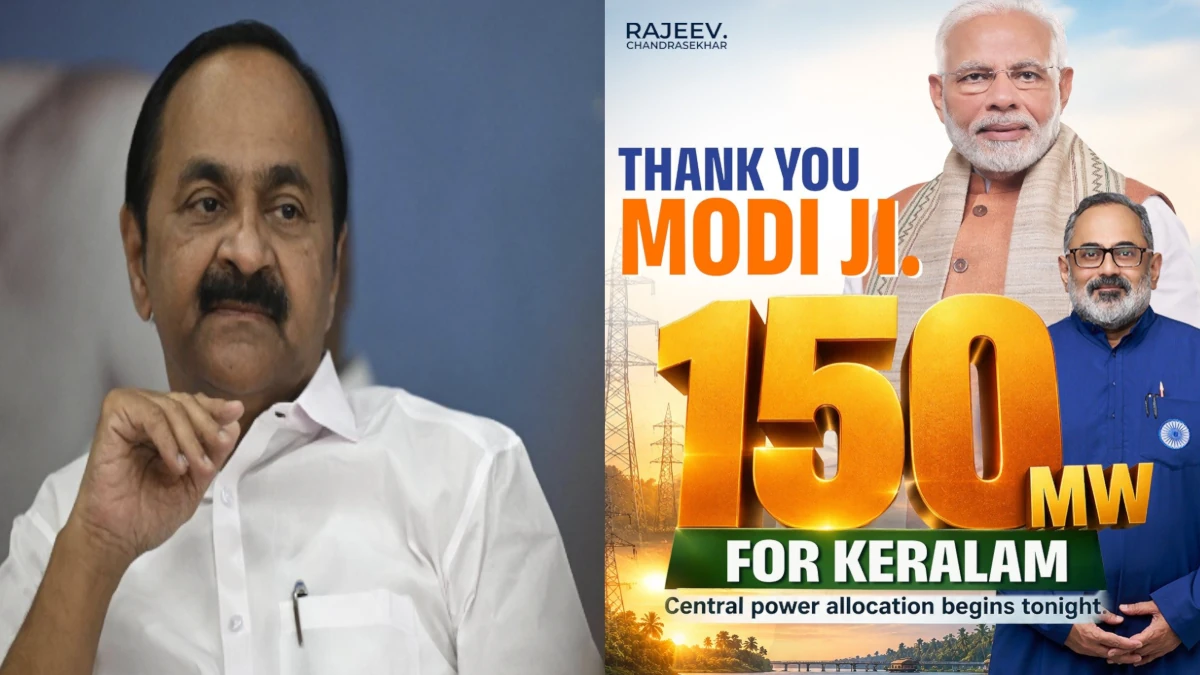
THIRUVANANTHAPURAM: As Keralam struggles with mounting electricity demand and an increasingly strained power supply situation, the Narendra Modi government is stepping in with immediate relief. Starting tonight, 150 MW will be allocated to Keralam from the central quota, providing additional power to a state battling shortages and rising procurement costs.
The Keralam BJP led by President Rajeev Chandrasekhar has slammed the Congress-led state government, arguing that the crisis is not merely the result of weather conditions or a temporary rise in demand, but the consequence of years of inadequate planning and failures by successive Congress and CPM governments.
When Keralam is in need, the @narendramodi government always steps up.
While people across the state continue to suffer due to years of Congress and CPM mismanagement, flawed contracts, and sheer incompetence, the Centre is stepping in. Starting tonight, 150 MW will be allocated… pic.twitter.com/axPjszVAep
— Rajeev Chandrasekhar 🇮🇳 (@RajeevRC_X) September 14, 2026
For the BJP, the central allocation is being projected as a clear example of what it calls the “Politics of Service” and “Politics of Performance” the Centre stepping in when Keralam needs additional power.
But the bigger question confronting the state government is far more uncomfortable, Why does Keralam, after decades of claims of development and a “new Keralam”, continue to depend so heavily on power from outside the state?
150 MW from Centre as Keralam battles power crunch
The allocation of 150 MW from the central quota comes at a time when Keralam’s electricity demand has surged, with peak demand cited at 6,033 MW.
The additional power is expected to provide immediate breathing space for the state’s electricity system. But the temporary relief cannot conceal the structural weaknesses that have left Keralam vulnerable to supply shortages and expensive market purchases.
Keralam remains heavily dependent on electricity sourced from outside the state, with up to 80 per cent of the state’s requirement. That dependence leaves Keralam particularly exposed whenever electricity becomes scarce or expensive in the wider market.
The truth behind Keralam’s power crisis is not the monsoon. It is years of suspicious contracts and procedural failure by Congress and the CPM.
The lack of vision that promised a Puthuyuga Keralam has pushed the state into darkness. It now has a name: the #SatheesanCut.
The… pic.twitter.com/aScCBPmh1g
— Rajeev Chandrasekhar 🇮🇳 (@RajeevRC_X) September 14, 2026
The financial consequences are already significant. The KSEB has power procurement expenditure of approximately Rs 13,344 crore, while emergency purchases have been put at around Rs 9 to Rs 15 per unit.
For consumers, the equation is simple, when cheaper and more secure power is unavailable, someone ultimately has to pay the higher price. And that someone is the public.
The 465 MW deal that became the political flashpoint
At the centre of the attack is a controversial long-term power purchase agreement involving 465 MW, which the party says could have provided electricity at approximately Rs 3.50 per unit until 2039. The BJP alleges that the Congress government responsible for entering into the agreement failed to comply with applicable Union Ministry guidelines and regulatory procedures.
That procedural failure later became the basis for the CPM-led government to cancel the arrangement, rather than, according to the BJP’s criticism, rectify the deficiencies and preserve the availability of relatively cheaper power.
Congress can point to the CPM’s cancellation of the agreement. The CPM can point to the procedural shortcomings in the original Congress-era arrangement.
But the consumer is left with the bill. According to reports, Keralam lost an opportunity to secure 465 MW at a substantially lower contracted rate and has subsequently become more exposed to expensive power purchases.
Congress created the procedural mess; the CPM compounded the problem by cancelling the arrangement.
‘Randalla, Onnanu’: BJP attacks Congress-CPM record
The power crisis has into a broader indictment of both Congress and CPM governance in Keralam. Its central argument is that the two parties may be fierce electoral rivals, but their record on Keralam’s long-term energy security represents the same failure of vision.
For decades, successive governments have struggled to create enough domestic generation capacity to keep pace with demand.
The BJP questioned the absence of an ambitious long-term Energy Master Plan, inadequate storage capacity and the lack of major generation projects capable of reducing Keralam’s dependence on external power.
The party has also pointed to Keralam’s hydropower history, arguing that after the Idukki project, successive governments failed to pursue generation expansion with the urgency required by a growing economy. The result, it says, is a state that has increasingly become a buyer rather than a producer of its own energy security.
“Randalla, Onnanu” not two, but one is the charge against Congress and CPM.
‘Satheesan Cut’
The electricity crisis has also triggered a direct attack on the Congress leadership. The BJP argues that the early months of the Congress-led administration have offered little evidence of a long-term solution to the power crisis and that the government is instead attempting to shift responsibility onto the previous CPM government.
But the BJP’s attack goes beyond the current administration.
Its contention is that Congress and CPM cannot indefinitely blame one another for a crisis that has developed over successive governments. If Congress blames the CPM, the question is what Congress is doing now.
If the CPM blames Congress for earlier decisions, the question is why its own government cancelled the disputed power agreement.
When ‘switch off appliances’ becomes a political controversy
The government’s appeals for consumers to reduce electricity consumption have added another layer to the confrontation. Energy conservation is necessary during periods of high demand. But asking households to switch off appliances cannot become a substitute for fixing the underlying supply problem.
- A student preparing for an examination cannot plan around an uncertain electricity supply.
- A small business cannot simply stop operating whenever demand peaks.
- An industrial unit cannot repeatedly interrupt production.
- A hospital cannot compromise on reliable electricity.
For millions of households, electricity is not a luxury. It is the basic infrastructure required to study, work, operate businesses and live normally. That is why the citizens should not be made to carry the burden of failures in long-term generation, procurement and infrastructure planning.
Power crisis threatens Keralam’s development ambitions
The implications extend far beyond power cuts. Keralam wants investment, new industries, employment opportunities, technology companies and expanded infrastructure. All of these require dependable and affordable electricity.
- An investor evaluating Keralam will inevitably consider the reliability and cost of essential infrastructure.
- A manufacturing company cannot build its business model around emergency electricity purchases.
- A technology-driven economy cannot afford persistent uncertainty over power availability.
- Small and medium businesses cannot absorb endlessly rising operating costs.
This makes the electricity crisis a development issue, not merely an operational problem for KSEB. If Keralam remains dependent on expensive external power while failing to develop adequate domestic generation and storage, the cost will ultimately be reflected across the wider economy.
Centre’s intervention puts state government’s failures under spotlight
The immediate allocation of 150 MW from the central quota starting tonight therefore carries significance beyond the additional electricity itself. The Union government is prepared to respond when Keralam faces a pressing requirement.
The immediate relief may help stabilise the situation. Keralam needs more than emergency purchases. It needs generation. And above all, it needs a long-term energy strategy that matches the state’s economic ambitions.
The 150 MW coming from the Centre tonight may provide relief to Malayalees facing the immediate crisis. But the political message from the BJP is unmistakable: emergency assistance can keep the lights on today; only competent long-term governance can keep them on for the next generation.