The deaths of more than 30 tribal children in Madhya Pradesh’s Balaghat have become a serious political and public health issue. Questions are being raised over healthcare facilities, nutrition, drinking water and the response of the state administration.
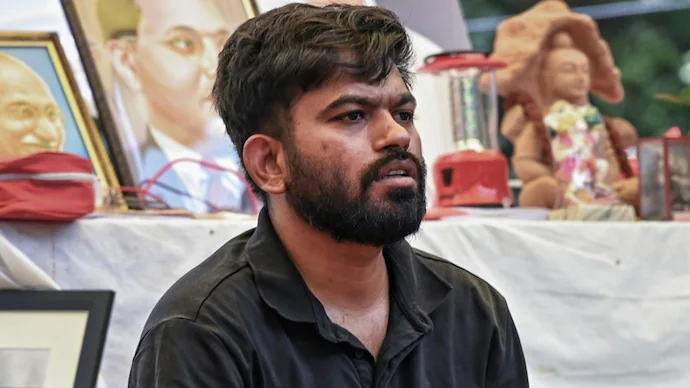
Amid this, Cockroach Janta Party (CJP) founder Abhijeet Dipke took a swipe at the Madhya Pradesh government by posting a satirical resignation letter on social media. The unusual part was that the letter was presented as if Dipke himself was the Chief Minister of Madhya Pradesh.
The letter said, “I tender my resignation as the Chief Minister of Madhya Pradesh with immediate effect,” and even thanked Prime Minister Narendra Modi for giving him the opportunity to serve the people of the state.
There is, of course, one basic problem with the letter, Abhijeet Dipke is not the Chief Minister of Madhya Pradesh.
Mohan Yadav is the Chief Minister.
So while the post was clearly intended as political satire, it raises a larger question about where political criticism ends and the use of official government identity begins.
The question is not whether Dipke can criticise the government
There should be little debate about whether Dipke has the right to question the Madhya Pradesh government.
He does.
In a democracy, a citizen, political activist or political party can question the government on issues affecting people. If more than 30 tribal children have died and there are concerns about healthcare and other basic facilities, asking the government to explain what happened is completely legitimate.
Dipke used his post to raise several such questions. He criticised the government’s handling of the deaths and referred to healthcare, drinking water, education, electricity and nutrition.
इस तरह का व्यंग्यात्मक पत्र सोशल मीडिया पर साझा करना आखिर कहां तक सही है?
भारत एक लोकतांत्रिक देश है,
यहां हर नागरिक को किसी भी मुद्दे पर अपनी प्रतिक्रिया रखने, सवाल पूछने और असहमति व्यक्त करने का पूरा अधिकार है।लेकिन सवाल यह है कि क्या अपनी बात रखने के लिए संवैधानिक पदों,… pic.twitter.com/xXOKpO3RtZ
— NCIB Headquarters (@NCIBHQ) September 13, 2026
He also questioned the compensation announced for the families and asked whether the same amount would have been considered sufficient if the children had been the children of ministers or MLAs.
These are political arguments and can be debated in the public sphere.
The more interesting question, however, is why the criticism had to be presented using the identity of the Chief Minister’s office.
But in what capacity was he ‘resigning’?
Dipke’s letter was not simply a social media post saying that the Chief Minister should resign.
It was designed to look like an official resignation letter.
The post used the designation of the Chief Minister of Madhya Pradesh, the Chief Minister’s Office address and an official-looking government symbol. It also carried a signature, making the document look like an actual resignation letter at first glance.
Dipke then used the document to make his political point.
That is where the issue becomes more complicated.
A person can write a satirical letter. A person can make fun of a government. A person can even write a fictional resignation letter as part of political commentary.
But does that automatically give the person the right to use an official designation and government insignia to make the document look like it has come from a government office?
That is the question which deserves to be asked.
Imagine an ordinary young person doing the same
Consider a simple example.
Suppose a young person is unhappy with the functioning of the police in his district. He wants to make a political point about law and order.
He creates a letter using the designation of the Superintendent of Police, adds the official address of the SP’s office and places a government emblem on the document.
He then posts it on social media claiming, as a joke, that he has resigned as the district’s Superintendent of Police.
Would the police department simply dismiss it as freedom of expression?
Attn @MPPoliceDeptt
This is gross violation of State Emblem of India (Prohibition of Improper Use) Act, 2005
Please take immediate action https://t.co/8TLKCH4cFf— Hindu IT Cell (@HinduITCell) September 13, 2026
What if another person did the same thing using the designation of a Police Commissioner, Director General of Police, District Magistrate, MLA, MP, Governor or even the President?
Would the use of the official identity suddenly become acceptable because the person said it was satire?
These questions are important because the standard should ideally remain the same regardless of who is making the post or which political side they support.
Satire is part of democracy, but presentation also matters
Political satire has always been part of democratic life.
Governments and politicians are regularly mocked through cartoons, memes, parody speeches, social media posts and satirical videos. No democratic society can function properly if criticism or humour directed at those in power is treated as unacceptable.
But satire also depends on context.
There is a difference between writing, “The Chief Minister should resign over this failure” and creating a document that looks like an official resignation letter from the Chief Minister’s Office.
In the first case, the criticism is direct and clearly political.
In the second, the person is using the identity and appearance of an official government document to make the point.
That distinction matters because government symbols and official designations carry authority of their own. They are not ordinary logos or decorative elements that anyone can simply use to make a social media post look authentic.
The Balaghat issue remains serious
The controversy over Dipke’s post should not take attention away from the original issue — the deaths of tribal children in Balaghat.
More than 30 children from the Baiga and Gond tribal communities have reportedly died amid concerns over suspected infectious diseases, including measles and malaria.
The incident has raised questions about healthcare facilities available to tribal communities and the government’s response.
The Madhya Pradesh High Court has also sought responses from the state Health Department, Women and Child Development Department, the Balaghat Collector and other authorities while hearing a petition concerning the deaths.
Concerns have also been raised about hospital capacity, drinking water, sanitation and malnutrition.
These are not small political issues. They involve the lives of children and the conditions in which vulnerable communities are living.
The government should therefore answer the questions being raised and, if there has been negligence, responsibility should be fixed.
His letter took aim at the Mohan Yadav government
In his satirical letter, Dipke portrayed himself as the Chief Minister and sarcastically accepted responsibility for the situation.
He addressed Madhya Pradesh Governor Mangubhai Patel and said his conscience did not allow him to continue in office after the deaths of the tribal children.
He also listed what he described as failures of the state government in healthcare, education, drinking water, nutrition and other areas.
Dipke argued that the deaths demanded accountability at the highest level.
His political message was therefore clear, he wanted to put responsibility for the situation on the state government and Chief Minister Mohan Yadav.
But again, the question is not whether he can make that argument.
The question is why he chose to make it through a document that presented him as the Chief Minister himself.
What if everyone started using official identities?
This is where the issue goes beyond Dipke or the CJP.
Imagine a situation where anyone unhappy with the government starts creating fake-looking official letters.
One person creates a letter as the Chief Minister.
Another creates one as the Governor.
Someone else uses the name and designation of a senior police officer.
Another person uses the letterhead of a government department.
All of them then claim that the documents are only satire.
At some point, the distinction between political commentary and an apparently official communication becomes difficult for ordinary social media users to understand.
In an age where posts can be shared thousands of times within minutes, presentation matters.
A document that looks official can be circulated without its original context. Many people may only see a screenshot and not the explanation accompanying it.
That is why people in public life need to be particularly careful when using official-looking material.
Freedom of expression also comes with responsibility
Freedom of expression is one of the most important parts of a democracy.
People must be allowed to disagree with the government. They must be able to question ministers, criticise policies and highlight failures.
But freedom of expression does not mean that every method of presenting that criticism is automatically beyond scrutiny.
There is also a responsibility to ensure that official institutions are not unnecessarily presented as something they are not.
Government designations, official addresses and state symbols carry a certain authority. Their use can create confusion about whether a document is genuine.
That is why the debate around Dipke’s post should not simply be reduced to “He was exercising his freedom of speech.”
Yes, he was making a political statement.
But the separate question is whether the manner in which he made that statement was appropriate.
The same standard should apply to everyone
The important thing here is consistency.
If an ordinary citizen uses a police officer’s designation and official insignia to create a fake resignation letter, people would naturally question it.
If someone uses the identity of a government department to create a document that looks official, there would again be questions.
The same standard should apply when a political activist does it.
It should also apply irrespective of political ideology.
The issue should not be whether someone supports the BJP, Congress, CJP or any other political group. The basic question is whether government identities and official symbols should be used in a way that can make a satirical document look like a genuine government communication.
The bigger lesson
Dipke’s criticism of the government can be debated. His questions over the deaths of tribal children can and should be examined. If there are failures in healthcare or administration, authorities must answer for them.
But political criticism does not require pretending to hold a constitutional or government office.
Dipke could have written a strongly worded letter demanding that the Chief Minister resign. He could have criticised the government’s handling of the Balaghat deaths. He could have used satire, humour and even sharp political language.
All of that is part of democratic debate.
But the use of the Chief Minister’s designation, CMO address and government insignia raises a different issue.
So the question is simple: If an ordinary citizen cannot present himself as the district’s SP, Collector or Chief Minister and issue official-looking documents in their name, why should political satire be presented in that form?
Democracy gives citizens the right to question those in power. It does not necessarily mean that citizens acquire the identity or authority of the office they are criticising.
Question the government. Demand accountability. Use satire. Make political points. But official institutions and government symbols have their own dignity and should be treated with the same seriousness by everyone.