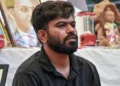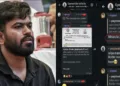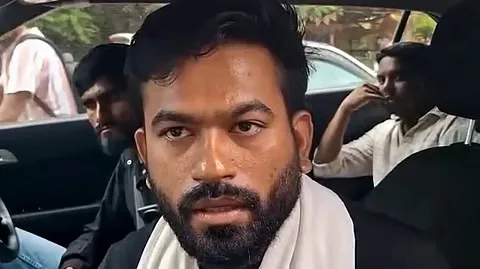
CJP founder Abhijeet Dipke faced questions and political pushback during his visit to Balaghat, Madhya Pradesh, where he had gone to meet families of tribal children reportedly killed by infectious diseases. A viral video shows a woman confronting Dipke over his visit and questioning whether he had come to “do politics on corpses”.
The confrontation has put the focus not only on the reported child deaths but also on the political debate surrounding Dipke’s visit, with local voices questioning the timing and purpose of his intervention in the sensitive issue.
Dipke confronted during Balaghat visit
Dipke visited Adori, Korka and Bondari villages in Balaghat district on Saturday to meet families of tribal children who reportedly died following infectious diseases. He also sought information about healthcare facilities and the treatment being provided to children in the area.
However, as he was leaving the area in a car, a woman social media influencer approached him with a microphone and questioned his presence in the village.
In the video, the woman can be heard asking Dipke whether he had come to “do politics on corpses” and questioning why he had arrived so late.
Welcome to MP Dipke 🤡🤡 pic.twitter.com/etdxOpSeFR
— Samrat (@BhaiiSamrat) September 12, 2026
Dipke was heard apologising for the delay.
The woman also pointed towards the road and said that a good road had been constructed in the area, asking Dipke whether he could not see it. The exchange then became more heated, after which CJP workers accompanying Dipke moved him into another vehicle and took him away.
As the vehicle left, the woman was heard saying that he had “run away”.
‘Do politics on corpses?’
The confrontation has triggered a wider political discussion over the manner in which the deaths of children are being raised in public and political spaces.
The woman’s question, “Do politics on corpses?” became the central point of the confrontation.
The incident came as the deaths of children in the region have already become the subject of legal proceedings.
The Madhya Pradesh High Court’s Jabalpur bench recently sought a response from the state government over the deaths of more than 30 children in the region.
A division bench comprising Acting Chief Justice Vivek Rusia and Justice Pradeep Mittal issued notices to the state Health Department, Women and Child Development Department, the Balaghat collector and other authorities while hearing a public interest litigation concerning the issue.
Political visit questioned amid court proceedings
Dipke’s visit took place against this backdrop.
The PIL has raised concerns over healthcare facilities and alleged inadequate treatment being provided to children in the affected region. It also claimed that around 400 children were being treated at a hospital with a capacity of only 50 beds.
With the matter already before the High Court, Dipke’s decision to visit the affected villages and meet families brought another political dimension to the issue.
Instead of receiving an unchallenged political platform, however, Dipke faced questions from people present during his visit. The viral video shows the confrontation taking place as he was leaving the area.
Dipke’s visit turns into a political controversy
What was intended as a visit to meet affected families quickly turned into a political controversy after Dipke was confronted on camera.
The episode has given local critics an opportunity to question the political messaging surrounding his visit, particularly when the region is dealing with the deaths of children and the healthcare system is already under judicial scrutiny.
The woman’s remarks reflected that anger, with her directly asking Dipke whether he had come to raise the issue for political reasons.
The confrontation also underlined the sensitivity of the issue. With families dealing with the deaths of children and questions being raised about healthcare facilities, any political intervention is likely to attract scrutiny over whether it is aimed at helping affected families or gaining political attention.