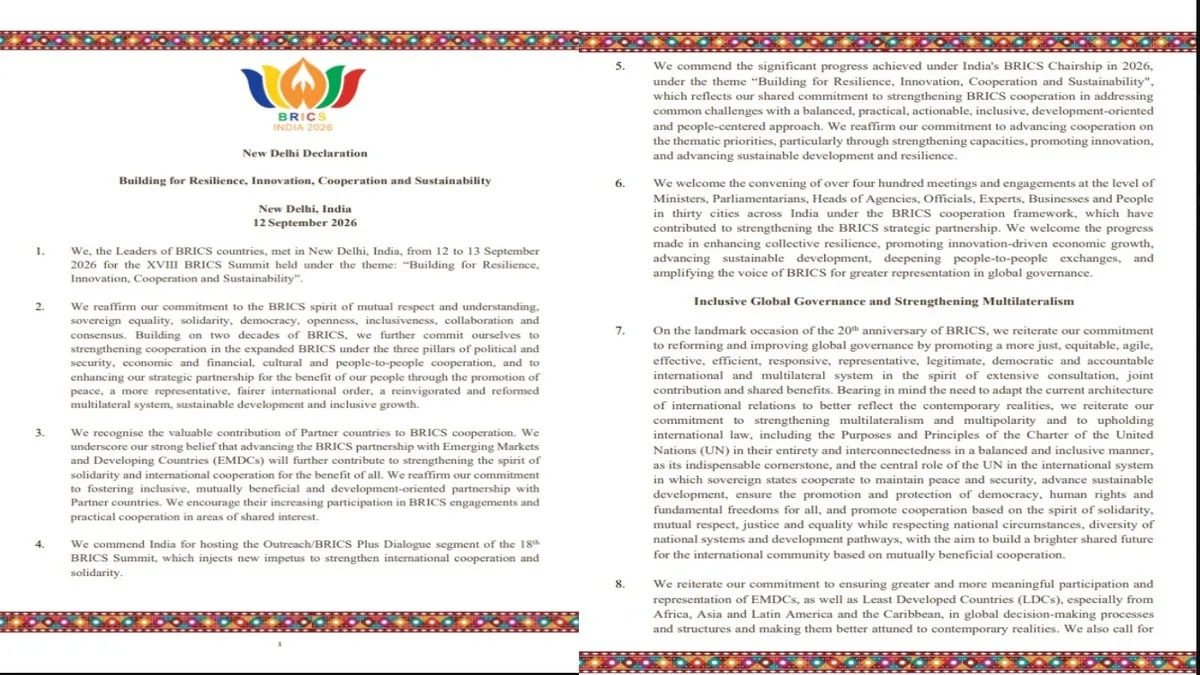
New Delhi: In a significant diplomatic breakthrough for India, BRICS leaders on September 12, Saturday unanimously adopted the New Delhi Declaration 2026, overcoming sharp differences among member states on the West Asia conflict and other contentious geopolitical issues following days of intensive negotiations.
Prime Minister Narendra Modi announced the consensus at the 18th BRICS Summit in New Delhi, underlining India’s role in steering the grouping towards a common position amid heightened global tensions.
BRICS New Delhi Declaration | We reaffirm our commitment to the BRICS spirit of mutual respect and understanding, sovereign equality, solidarity, democracy, openness, inclusiveness, collaboration and consensus. Building on two decades of BRICS, we further commit ourselves to… pic.twitter.com/h2Q9N7S86h
— ANI (@ANI) September 12, 2026
India steers BRICS towards consensus amid West Asia divisions
“No member has raised any objection. The New Delhi Declaration 2026 is adopted unanimously,” PM Modi said while announcing the adoption of the declaration. The consensus assumes particular significance as Iran, Saudi Arabia and the UAE are all members of BRICS despite their differing positions and competing interests on several regional and geopolitical issues.
Breaking
PM Modi annouces that New Delhi BRICS declaration has been adopted. pic.twitter.com/QY3nSkzI2U
— Sidhant Sibal (@sidhant) September 12, 2026
The language on the West Asia conflict emerged as one of the major sticking points during negotiations. BRICS Sherpas held intensive discussions for several days, with negotiations continuing until the early hours of Saturday before consensus was reached.
Sources said that the member states agreed on language to “deplore” all forms of “unprovoked aggression”, helping overcome the differences that had threatened to delay the joint declaration. India’s sustained consultations with member states helped bridge competing positions and prevent disagreements over West Asia from derailing the BRICS process.
Declaration backs dialogue, diplomacy and conflict prevention
The joint declaration stressed the importance of conflict prevention, including efforts to address the root causes of conflicts. The BRICS countries reiterated their commitment to resolving international disputes peacefully through dialogue, consultation and diplomacy. The declaration also advocated a multilateral approach that respects diverse national perspectives and positions on major global issues.
The leaders also expressed serious concern over the growing use of unilateral tariff and non-tariff measures, stating that such measures distort international trade and are inconsistent with World Trade Organization rules. The declaration also denounced unilateral acts of war and stressed the importance of protecting commercial navigation and the safety and well-being of seafarers amid continuing instability in West Asia.
BRICS backs reforms of global institutions
The New Delhi Declaration called for reforms of multilateral institutions, including a structural update of the United Nations Security Council (UNSC), reflecting the changing global economic and geopolitical landscape.
The issue of reforming global governance was also a major focus of PM Modi’s address at the summit session on Inclusive Global Governance and Strengthening. PM Modi proposed that BRICS members jointly formulate 10 proposals for global governance reform, with the objective of developing them into a BRICS Reform Roadmap by the next Summit.
“The Global South is today in the front row when it comes to facing global crises, but in the back row when it comes to decision-making,” PM Modi said. He called for transforming what he described as a “pyramid of privilege” into a “platform of partnership”, ensuring that every country has a voice and stake in global decision-making.
PM Modi calls for time-bound UNSC reforms
The Prime Minister said the proposed BRICS roadmap should focus on three pillars — Representation, Responsiveness and Rule-making. On representation, PM Modi said reform of the UNSC “can no longer be delayed” and called for text-based negotiations to be linked to a definite timeline and clear outcomes.
He also argued that voting power, leadership positions and policy priorities in international financial institutions should reflect contemporary economic realities. “Countries that drive global economic growth should also have an appropriate role in shaping global economic governance,” he said.
India proposes Seafarers Emergency Support Network
On responsiveness, PM Modi highlighted the critical contribution of seafarers to global commerce and proposed the creation of a Seafarers Emergency Support Network.
The proposed mechanism could connect maritime authorities and diplomatic missions of concerned countries to facilitate distress alerts, medical assistance, communication with families and evacuation support during emergencies.
The proposal comes against the backdrop of heightened security concerns in key maritime routes and disruptions to global trade caused by geopolitical conflicts. PM Modi also noted that September 12 is observed by the United Nations as the International Day for South-South Cooperation, saying that advancing such an initiative on a day dedicated to the Global South would carry special significance.
“India is ready to take the lead on this issue”, PM Modi said.
New Delhi Declaration marks diplomatic moment for India
The unanimous adoption of the declaration comes as India hosts the 18th BRICS Summit on September 12-13 under its 2026 Chairship theme, “Building for Resilience, Innovation, Cooperation and Sustainability”. The grouping has increasingly emerged as an important platform for coordination among major emerging economies and for advancing the interests of the Global South across multilateral institutions.
With Brazil, China, Egypt, Ethiopia, India, Indonesia, Iran, Russia, Saudi Arabia, South Africa and the UAE as its 11 members, BRICS now represents a diverse grouping of emerging economies with significant influence across global finance, trade, energy, technology and geopolitics.
The consensus on the New Delhi Declaration, particularly amid sharp divisions over West Asia, marks a significant diplomatic outcome for India’s BRICS Chairship and highlights New Delhi’s efforts to position the grouping as a platform for dialogue, cooperation and a stronger voice for the Global South.