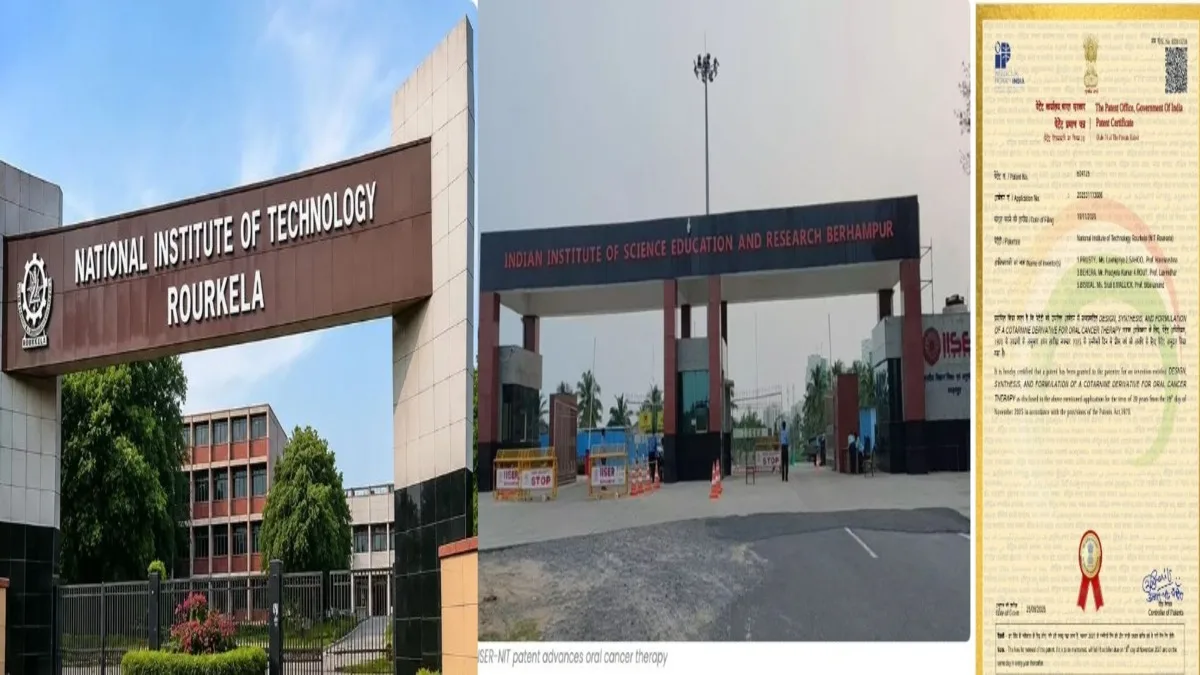
BHUBANESWAR: Researchers from the National Institute of Technology Rourkela (NIT Rourkela) and the Indian Institute of Science Education and Research (IISER) Berhampur have developed a novel cotarnine-derived formulation that has shown anticancer activity against oral cancer cells and has now received an Indian patent.
The research brings together scientists from the Departments of Chemistry and Life Science at NIT Rourkela and the Department of Chemistry at IISER Berhampur. Their work focuses on the design, synthesis and formulation of a new cotarnine derivative to explore alternative therapeutic approaches for oral cancer.
The innovation has been granted an Indian patent titled “Design, Synthesis, and Formulation of a Cotarnine Derivative for Oral Cancer Therapy” under Patent No. 604125. According to information published by IISER Berhampur researcher Professor Laxmidhar Rout, the patent application, numbered 202531113686, was filed on November 19, 2025, and the patent was granted on September 25, 2026.
The inventors include Laxmipriya Prusty, Professor Harekrushna Sahoo, Sruti Biswal and Professor Bibekanand Mallick of NIT Rourkela, along with Pradyota Kumar Behera and Professor Laxmidhar Rout of IISER Berhampur. The patent represents a collaborative effort combining expertise in medicinal chemistry, life sciences and formulation research.
Research focused on new therapeutic approach
Oral cancer remains an important healthcare challenge, particularly in India, where delayed diagnosis and limitations associated with conventional treatment can affect patient outcomes. Against this background, the research team sought to develop and investigate a new molecular entity that could serve as a starting point for further research into oral cancer therapy.
The work centres on a cotarnine derivative developed through chemical synthesis and subsequently formulated for biological investigation. The researchers have described the compound as a potential candidate for further preclinical and translational research rather than as an established treatment.
According to the research team, the developed derivative demonstrated anticancer activity against oral cancer cells, with particularly notable activity reported against tongue cancer cells even at very low concentrations. These findings have provided the basis for further investigation of the compound’s biological properties and therapeutic potential.
Professor Bibekanand Mallick of NIT Rourkela said the findings indicated significant activity against oral cancer cells, particularly tongue cancer cells, at very low concentrations. He stressed, however, that the next stage would involve further validation through preclinical studies, including animal studies, before any consideration of clinical evaluation.
The researchers have emphasised that the compound is still at the research and preclinical-development stage. A patent does not constitute approval for use as a medicine, and substantial additional work would be required to establish its safety, efficacy, pharmacological properties and therapeutic suitability.
Cotarnine-based molecular design
Cotarnine is a tetrahydroisoquinoline alkaloid that can be obtained through the oxidative degradation of noscapine. The research programme involving Professor Rout’s group has included work on cotarnine derivatives and their potential biomedical applications. His research profile records earlier projects involving cotarnine-based molecules for cancer-related research and the newly granted collaborative patent.
The development of the new compound involved chemical design and synthesis followed by formulation and biological evaluation. Such an approach is characteristic of modern drug-discovery research, where the identification of a promising molecular entity is only one stage of a longer process involving laboratory studies, formulation development, safety assessment and eventually, where justified, clinical testing.
The researchers said the patented formulation could provide a foundation for further studies aimed at identifying new therapeutic agents with potentially improved efficacy and reduced adverse effects. However, whether the compound can ultimately meet those objectives will depend on the results of subsequent investigations.
Professor Harekrushna Sahoo said the development of the cotarnine derivative represents an important step in exploring new molecular entities for oral cancer therapy.
“Through an integrated approach involving molecular design, synthesis and formulation, we have developed a promising candidate with potential for further preclinical and translational research,” Sahoo said, highlighting the importance of interdisciplinary collaboration in addressing complex healthcare challenges.
Activity against oral cancer cells
One of the significant observations reported by the research team is the activity of the developed derivative against oral cancer cells. The researchers have particularly highlighted its activity against tongue cancer cells at low concentrations.
Professor Mallick said the results provide a basis for additional research but stressed that further validation is necessary. The proposed next phase includes preclinical investigations, including animal studies, followed, if the results justify progression, by clinical evaluation.
The distinction between laboratory findings and an approved cancer treatment is important. At its present stage, the cotarnine derivative cannot be described as an established medicine for oral cancer. Its observed activity in laboratory studies needs to be evaluated through progressively more comprehensive studies before its safety and effectiveness in humans can be assessed.
The research team has therefore positioned the patented formulation as a potential candidate for further drug-development research rather than an immediately available therapeutic option.
Interdisciplinary collaboration
The collaboration between NIT Rourkela and IISER Berhampur reflects the multidisciplinary nature of contemporary pharmaceutical and biomedical research. Developing a potential therapeutic compound involves expertise extending from organic and medicinal chemistry to molecular biology, formulation science and biological testing.
In this case, researchers from the chemistry and life science disciplines contributed to different stages of the research, bringing together molecular design, chemical synthesis, formulation and biological assessment.
Professor Sahoo has underlined the importance of this integrated approach, noting that complex healthcare challenges require collaboration across scientific disciplines. The patented work illustrates how fundamental research in chemistry and life sciences can be directed towards potential applications in healthcare.
Professor Laxmidhar Rout of IISER Berhampur is among the researchers associated with the patent. IISER Berhampur’s official researcher profile lists the collaborative patent and records its application number, filing date and grant date. The profile also shows earlier research projects involving cotarnine derivatives and cancer-drug development.
Further studies essential
The grant of the patent marks an important intellectual-property milestone, but it represents only one stage in the development of a potential therapeutic candidate. Further preclinical investigations will be necessary to establish the compound’s safety, efficacy, pharmacological behaviour and therapeutic potential.
If subsequent studies produce adequate evidence of safety and efficacy, the research could eventually progress towards clinical evaluation. Any use in human patients would require the necessary regulatory approvals and successful completion of the applicable clinical-development process.
The researchers have accordingly stressed the need for continued investigation rather than drawing conclusions about the compound’s suitability for patient treatment at the current stage. Recent reports on the research have likewise noted that additional testing, including animal studies and eventual clinical evaluation, would be necessary before the compound could potentially be developed into a medicine.
The patent nevertheless represents a significant research milestone for the institutions involved. It demonstrates the effort to translate laboratory-based discoveries in chemistry and life sciences into potential healthcare applications while generating indigenous intellectual property.
For NIT Rourkela and IISER Berhampur, the work also highlights the role of institutional collaboration in pursuing research aimed at addressing major health challenges. The immediate focus, however, remains on further scientific validation of the cotarnine derivative and determining whether the promising laboratory observations can be reproduced and translated into a safe and effective therapeutic approach.
The patent and the associated research thus mark a development in Odisha’s academic research landscape, while the next stages of preclinical testing will determine the scientific and therapeutic potential of the newly developed cotarnine-based formulation.