In Jharkhand, a Muslim woman wanted to live with her first husband again after talaq. But under the circumstances described in the case, she first went through nikah with another man as part of halala, after which she wanted to return to her first husband and perform nikah with him again.
However, when she approached her former husband, Imran Hussain, he refused to remarry her. The woman then filed a criminal case against him, alleging that he had earlier assured her that he would perform nikah with her again after halala.
The matter eventually reached the Jharkhand High Court when Imran Hussain sought anticipatory bail, fearing arrest. The High Court has now held that after talaq and the subsequent nikah involved in halala, the former husband cannot be forced to perform nikah again, and that his refusal to do so, by itself, does not amount to a cognisable criminal offence.
The story began with talaq
Imran Hussain and the woman had been husband and wife. Their relationship eventually ended after Hussain gave her talaq.
The woman, however, wanted to return to her first husband and live with him again. For this, halala needed to be done.
In Nikah Halala, a woman who has been separated from her first husband is required to enter into nikah with another man before she can return to her former husband. The second nikah is therefore made a part of the process through which she may eventually return to the first husband.
In this case, the woman subsequently performed nikah with another man for halala.
But when the woman wanted to return to Hussain and perform nikah with him again, he refused.
That refusal changed the matter from a dispute between a former husband and wife into a police case and eventually a High Court proceeding.
The woman approached the authorities and a fresh criminal case was registered against Hussain. He then approached the Jharkhand High Court, saying that he feared arrest and seeking anticipatory bail.
The legal question before the High Court was therefore straightforward: Can a former husband be prosecuted because he refuses to perform nikah again with his former wife after talaq, her subsequent nikah with another man and the completion of halala?
The Jharkhand High Court said no.
The woman wanted to return to her first husband
The sequence is important.
First came the talaq. Then came the woman’s attempt to return to her first husband. For that, she subsequently performed nikah with another man in circumstances that the High Court’s order refers to as halala.
After that, she wanted to perform nikah again with Hussain. Hussain refused.
According to the woman, this refusal was not what had been agreed earlier. Her lawyer told the High Court that Hussain had previously assured her that he would perform nikah with her again.
That assurance, according to her side, had come during the settlement of an earlier criminal case between the two.
When Hussain later refused to perform nikah again, the woman approached the authorities and a fresh case followed.
There was already a case between the couple
The dispute had a history.
The woman had earlier lodged Dhanwar Police Station Case No. 405 of 2020 against Hussain. The High Court recorded that the allegations in the earlier case were similar and that the matter was subsequently compromised.
The court specifically recorded that the woman had “earlier lodged the case being Dhanwar P.S. Case No.405 of 2020 in which compromise has taken place”.
A later complaint based on the same set of allegations was eventually converted into an FIR.
The earlier compromise became important in the latest dispute because the woman’s side said that Hussain had given her an assurance during that settlement.
According to her lawyer, Hussain had assured her that he would perform nikah with her again.
But after the halala-related intervening nikah, Hussain refused to do so.
Halala left the woman seeking to return to the first husband
At the centre of the dispute is the practice of halala.
The basic issue in the case was not simply that a divorced woman wanted to marry her former husband again. The sequence involved talaq, an intervening nikah with another man and then the woman’s attempt to return to the first husband.
The High Court’s order records that the woman had already performed nikah with another man for halala.
The judgment itself does not examine the broader religious debate around halala. It does not investigate how the second nikah was arranged, whether any cleric was involved, or what happened within that nikah.
Its legal concern was narrower: after the talaq, the intervening nikah and the circumstances referred to as halala, what happens if the first husband refuses to take the woman back and perform nikah with her again?
The court’s answer was that such a refusal, by itself, cannot become a criminal offence.
The woman said Hussain had promised to perform nikah again
The woman did not present Hussain’s refusal as an isolated disagreement.
Her lawyer told the court that the couple had already been through a legal dispute in 2020 and that the case had been settled.
According to the woman’s side, Hussain had assured her during that settlement that he would perform nikah with her again.
She later relied on that assurance when she wanted to return to him.
But Hussain refused.
The State and the woman’s lawyer opposed Hussain’s anticipatory bail plea and pointed to this alleged refusal. The High Court took note of the argument before examining whether the refusal could legally support a fresh criminal case.
Hussain’s side gave a different account
Hussain’s lawyer presented a different picture of the relationship.
The defence alleged that Hussain had been subjected to harassment by the woman because he had less money and could not provide her with what was described as a lavish lifestyle.
The High Court recorded the defence allegation that Hussain was being “tortured by the wife for having less money and not providing her lavish life”.
That was the defence’s submission, not a finding by the High Court that the allegation had been proved.
The defence also relied on the fact that talaq had already taken place and that the woman had subsequently performed nikah with another man.
The refusal to perform nikah again was therefore placed before the court against the background of a relationship that had already ended after talaq.
Then came the fresh criminal case
The latest case against Hussain was registered as Dhanwar (Ghorthamba O.P.) Police Station Case No. 314 of 2025, arising from Complaint Case No. 684 of 2025.
Hussain was apprehending arrest in the case and therefore moved the High Court for anticipatory bail.
The FIR invokes several provisions of the Bharatiya Nyaya Sanhita, 2023, including Sections 127(1), 115(2), 85, 352, 74, 351(2) and 303(2).
It also invokes Sections 3 and 4 of the Dowry Prohibition Act and Sections 3 and 4 of the Muslim Women (Protection of Rights on Marriage) Act, 2019.
These charges formed part of the criminal proceedings. However, the High Court was not conducting the trial in the case.
The immediate question was whether Hussain should receive protection from arrest and, in particular, whether his refusal to perform nikah again with the woman could itself constitute a criminal offence.
Who is Imran Hussain?
Imran Hussain is 33 years old and the son of Manjar Ali. He is from Nawadih village in Koderma district of Jharkhand.
His anticipatory bail application was registered as A.B.A. No. 4909 of 2026, titled Imran Hussain versus The State of Jharkhand.
The matter was heard by Justice Sanjay Kumar Dwivedi and the order was passed on September 3, 2026.
Advocate Arvind Prajapati appeared for Hussain, Advocate Ajay Kumar Pathak represented the State, and Advocate Chandan Kumar appeared for the informant.
The High Court’s key finding
After hearing both sides, Justice Dwivedi focused on the sequence of events before the court.
Talaq had taken place. The woman had subsequently performed nikah with another man. She later wanted to perform nikah again with Hussain.
Hussain refused.
The question was whether that refusal could provide the basis for a fresh criminal case.
The High Court said it could not.
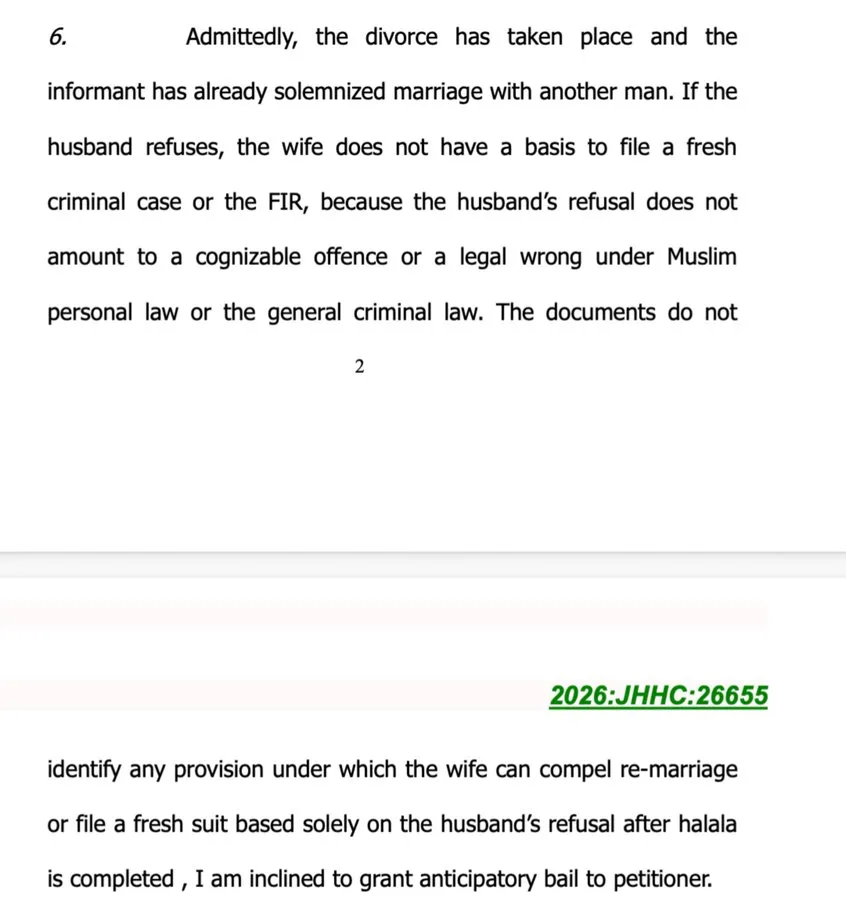
The court observed that, “Admittedly, the divorce has taken place and the informant has already solemnised marriage with another man.”
It then held that, “If the husband refuses, the wife does not have a basis to file a fresh criminal case or the FIR, because the husband’s refusal does not amount to a cognisable offence or a legal wrong under Muslim personal law or the general criminal law.”
The High Court said that the criminal law cannot be used merely because a former husband refuses to perform nikah with his former wife again.
Court says there is no provision to force Hussain into nikah
The High Court then looked at whether there was any legal provision that could compel Hussain to perform nikah with the woman again.
Justice Dwivedi said the documents before the court did not identify such a provision.
The order states, “The documents do not identify any provision under which the wife can compel re-marriage or file a fresh suit based solely on the husband’s refusal after halala is completed.”
The judge then said, “I am inclined to grant anticipatory bail to petitioner.”
What about the halala practice?
The case also puts the practice of halala into focus.
Halala is not simply another word for remarriage. It refers to a particular sequence in which a woman separated from her first husband enters into another nikah before she can return to that first husband.
In the present case, the High Court recorded the intervening nikah and subsequently referred to the situation as being after “halala is completed.”
Anticipatory bail granted to Imran Hussain
After considering the submissions, the High Court granted Hussain anticipatory bail.
Justice Dwivedi directed him to surrender before the concerned court within three weeks from the date of the order.
If he surrendered or was arrested, he was to be released on bail on furnishing a Rs 25,000 bail bond, along with two sureties of the same amount each.
The bail was made subject to the conditions under Section 482(2) of the Bharatiya Nagarik Suraksha Sanhita, 2023.
The proceedings relate to Dhanwar (Ghorthamba O.P.) P.S. Case No. 314 of 2025, arising from Complaint Case No. 684 of 2025 and pending before the Judicial Magistrate First Class at Giridih.