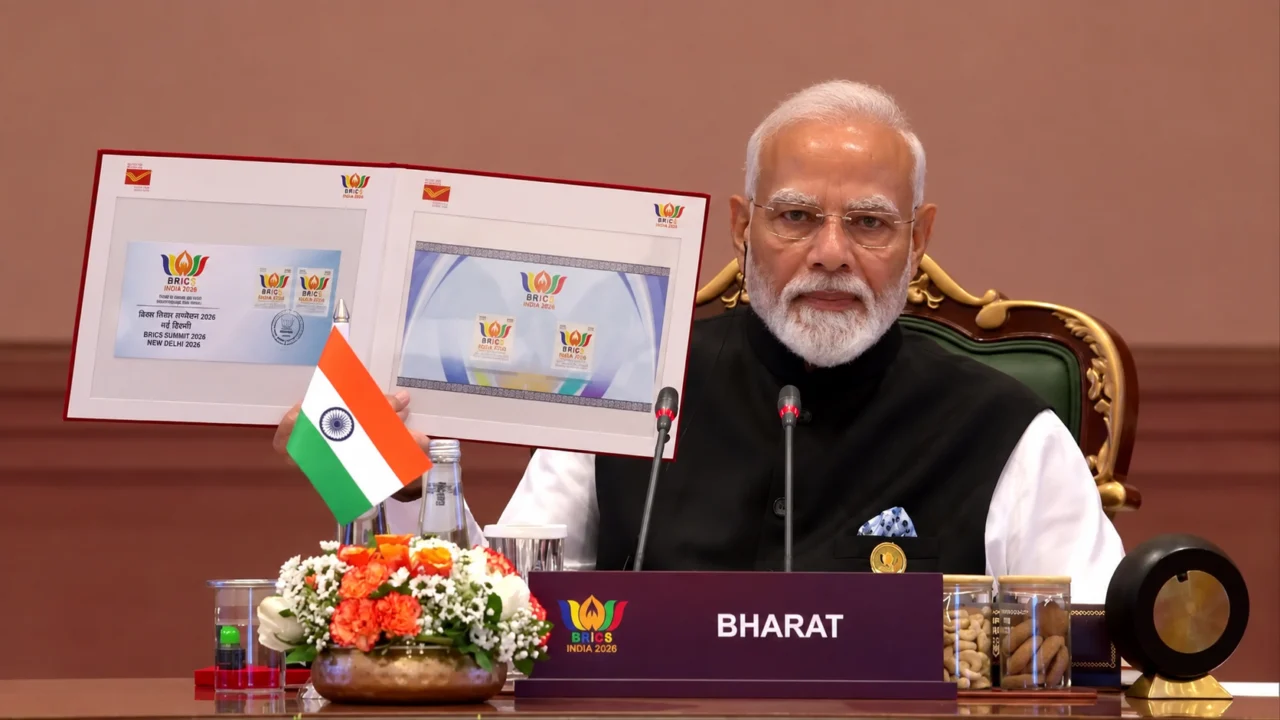
New Delhi: Prime Minister Narendra Modi on September 12, Saturday called for a more ambitious and action-oriented BRICS agenda as the grouping marked its 20th anniversary. He pitched the forum as a platform through which the Global South can move from the “back row” of global decision-making to the centre of shaping international rules.
Addressing the maiden session of the 18th BRICS Summit in New Delhi on “Inclusive Global Governance and Strengthening Multilateralism”, PM Modi called for reforms in global governance, greater representation for developing economies, stronger institutional continuity within BRICS and tangible outcomes from the grouping’s consensus-driven approach. He also charted a 20 year roadmap to strengthen BRICS as an institution for inclusive governance.
Here are the key highlights from PM Modi’s opening remarks.
Sharing my opening remarks during the BRICS Session on ‘Inclusive Global Governance and Strengthening Multilateralism.’
https://t.co/g31TharSOc— Narendra Modi (@narendramodi) September 12, 2026
1. BRICS at a ‘coming-of-age’ moment
Opening the summit, PM Modi described the 20th anniversary of BRICS as a historic milestone and compared the grouping’s journey to a person reaching the age of 20. He said that BRICS had established a distinct identity on the global stage over the past two decades and stressed that the grouping had now reached a “coming of age” moment marked by greater maturity and responsibility.
India’s 2026 chairship, he said, followed a “people-centric and humanity-first approach”, with resilience, innovation, cooperation and sustainability as its key priorities. More than 350 meetings were organised during India’s chairship, with BRICS delegations hosted across nearly 30 Indian cities, he said.
2. From unity to tangible outcomes
PM Modi stressed that BRICS must now translate its internal unity and consensus into concrete outcomes on the global stage. “We respect each other’s perspectives and move forward through consensus”, he said, adding that the grouping’s approach was not directed against any country but focused on “taking everyone along”.
He called for a new and ambitious agenda for the next 20 years, saying BRICS must strengthen its internal mechanisms while simultaneously playing a greater role in global affairs.
3. BRICS ‘Troika’ for continuity; Digital repository for greater cooperation
One of PM Modi’s key proposals was the creation of a BRICS continuity and implementation mechanism to ensure that the annual rotation of the presidency does not disrupt institutional momentum. Under the proposed framework, the previous, current and incoming BRICS chairs would coordinate through the Troika arrangement to ensure follow-up of initiatives and summit decisions.
PM Modi also proposed creating a secure digital repository containing details of every decision, including its nodal point, timeframe and implementation status. The objective is to ensure that important initiatives do not lose momentum each time the BRICS presidency changes hands.
4. From privilage to partnership; Global South must be a rule-shaper
A central theme of PM Modi’s address was the changing role of the Global South. He argued that developing nations are often at the forefront of global crises but remain under-represented in the institutions where major international decisions are taken.
“Today, the Global South stands in the front row of global crises but in the back row of decision-making”, PM Modi said. He called for transforming the existing “pyramid of privilege” into a “platform of partnership”, where every country has a voice and a stake.
He further urged BRICS nations to work towards transforming the Global South from a “rule-taker” into a “rule-shaper”, particularly as emerging technologies reshape the global economy and international governance.
5. UNSC reforms can ‘no longer be postponed’
PM Modi made a strong pitch for time-bound reforms of global multilateral institutions, placing United Nations Security Council reform at the centre of his proposal. He said that the negotiations on UNSC reform must be linked to a definite timeframe and clear outcomes, asserting that the issue could no longer be postponed.
He also called for voting power, leadership positions and policy priorities within international financial institutions to reflect contemporary economic realities. “Countries that drive global economic growth should also play an appropriate role in shaping global economic governance”, he said.
6. Three pillars: Representation, Responsiveness and Rule-making
PM Modi proposed a three-pillar framework for the future of global governance:
- Representation
- Responsiveness
- Rule-making
Under this approach, BRICS would seek greater representation for developing nations, more responsive international institutions and a larger role for the Global South in framing global rules.
He also proposed preparing a 10-point roadmap for global governance reforms, with the aim of finalising it by the next BRICS Summit.
7. Emerging technologies cannot be governed without the Global South
PM Modi also highlighted the strategic importance of emerging technologies, including artificial intelligence, cyberspace, outer space and biotechnology. He stressed that these technologies would not only generate future economic opportunities but also influence the rules governing the global economy and society.
Against this backdrop, he argued that developing countries cannot remain passive consumers of rules framed elsewhere. He proposed to use BRICS to equip young diplomats and policymakers from the Global South with negotiation skills, practical training and legal expertise to enable them to play a greater role in shaping international norms.
8. Seafarers’ Emergency Support Network
PM Modi also put forward a humanitarian proposal for a Seafarers’ Emergency Support Network. The proposed mechanism would connect maritime authorities and diplomatic missions to assist seafarers facing emergencies, including through distress alerts, medical assistance, family notifications and evacuation support.
The proposal assumes significance amid disruptions and conflicts affecting global maritime routes and the movement of international trade.
PM Modi’s address outlined a vision of BRICS that extends beyond traditional economic cooperation to encompass global governance reform, technological rule-making, institutional continuity, maritime security and the wider interests of the Global South.
As BRICS enters its third decade, India’s message is clear: an expanding grouping must not merely seek a larger place within the existing global order, but should contribute to reshaping that order to make it more representative, responsive and equitable.