Saudi-Taliban $200M energy deal puts Pakistan under pressure
September 11, 2026
  • Read Ecopy
  • Circulation
  • Advertise
  • Careers
  • About Us
  • Contact Us
Android AppiPhone AppArattai
Organiser
  • ‌
  • Bharat
    • Assam
    • Bihar
    • Chhattisgarh
    • Jharkhand
    • Maharashtra
    • View All States
  • World
    • Asia
    • Europe
    • North America
    • South America
    • Africa
    • Australia
  • Editorial
  • International
  • Opinion
  • RSS @ 100
  • More
    • World Hindu Congress 2026
    • Op Sindoor
    • Analysis
    • Sports
    • Defence
    • Politics
    • Business
    • Economy
    • Culture
    • Special Report
    • Sci & Tech
    • Entertainment
    • G20
    • Azadi Ka Amrit Mahotsav
    • Vocal4Local
    • Web Stories
    • Education
    • Employment
    • Books
    • Interviews
    • Travel
    • Law
    • Health
    • Obituary
  • Subscribe
    • Subscribe Print Edition
    • Subscribe Ecopy
    • Read Ecopy
  • ‌
  • Bharat
    • Assam
    • Bihar
    • Chhattisgarh
    • Jharkhand
    • Maharashtra
    • View All States
  • World
    • Asia
    • Europe
    • North America
    • South America
    • Africa
    • Australia
  • Editorial
  • International
  • Opinion
  • RSS @ 100
  • More
    • World Hindu Congress 2026
    • Op Sindoor
    • Analysis
    • Sports
    • Defence
    • Politics
    • Business
    • Economy
    • Culture
    • Special Report
    • Sci & Tech
    • Entertainment
    • G20
    • Azadi Ka Amrit Mahotsav
    • Vocal4Local
    • Web Stories
    • Education
    • Employment
    • Books
    • Interviews
    • Travel
    • Law
    • Health
    • Obituary
  • Subscribe
    • Subscribe Print Edition
    • Subscribe Ecopy
    • Read Ecopy
Organiser
  • Home
  • Bharat
  • World
  • Operation Sindoor
  • Editorial
  • Analysis
  • Opinion
  • Culture
  • Defence
  • International Edition
  • RSS @ 100
  • Magazine
  • Read Ecopy
Home World

After Makkah defence pact, Saudi signs $200M energy deal with Taliban, leaving Pakistan under pressure

Saudi Arabia has expanded its economic engagement with Taliban through a major oil and gas investment, adding a new dimension to its ties with Pakistan as Islamabad faces growing tensions with Kabul

Dr Vishnu AravindDr Vishnu Aravind
Sep 11, 2026, 07:30 am IST
inWorld, Asia, International Edition
Follow on Google News
Taliban's Mines and Petroleum Minister Hedayatullah Badri and Delta CEO Shaher Al-Taqi sign an exploration agreement in the presence of Zalmay Khalilzad, former US special representative for Afghanistan, in Kabul on Sept. 7, 2026

Taliban's Mines and Petroleum Minister Hedayatullah Badri and Delta CEO Shaher Al-Taqi sign an exploration agreement in the presence of Zalmay Khalilzad, former US special representative for Afghanistan, in Kabul on Sept. 7, 2026

Facebook
Twitter
WhatsAppTelegramEmail

NEW DELHI: Barely a month after Saudi Arabia, Pakistan and Turkey signed the Makkah Joint Defence Agreement on August 7, 2026, Riyadh has entered into a major energy partnership with Taliban government, raising questions over how far the much-publicised three-nation security alignment can translate into a common strategic position when the interests of its members diverge.

Saudi oil and gas company Delta International Energy has signed a $200 million contract with Taliban government to explore and extract hydrocarbons from the Kushk-Tirpul basin in the western part of the country. The agreement was signed in Kabul on September 7, 2026 by Taliban’s Mines and Petroleum Minister Hedayatullah Badri and Delta CEO Shaher Al-Taqi in the presence of senior Taliban leadership and former US special representative for Afghanistan Zalmay Khalilzad.

Read More: From 1993 Mumbai blasts to Portugal extradition: SC rejects Abu Salem’s bid for early release

The contract covers seven blocks spread across around 22,000 square kilometres in the Herat and Badghis provinces. The exploration period will run for eight years, while the overall contract is for 25 years. Kabul has described the project as an important step towards developing Afghanistan’s domestic energy resources and attracting foreign investment.

Badri said exploitation of the basin could eventually make Afghanistan self-sufficient in oil and gas. The Taliban authorities also presented the investment as part of a broader effort to use the country’s natural resources to generate employment, improve living standards and support economic growth.

The timing raises questions

The timing, however, gives the deal a wider geopolitical significance. On August 7, 2026, Saudi Arabia, Pakistan and Turkey signed the Makkah Joint Defence Agreement, pledging to strengthen collective deterrence and defence cooperation. The agreement states that an armed attack against one of the three countries would be regarded as an attack against all three. The pact has subsequently been described in some quarters as an “Islamic NATO”, although its formal framework is the Makkah Joint Defence Agreement.

Yet the Saudi-Taliban energy agreement comes at a particularly sensitive moment in Pakistan-Afghanistan relations. Islamabad and Kabul have been at odds over security and border issues, making Riyadh’s decision to deepen economic engagement with Afghanistan an uncomfortable development for Pakistan.

The contrast has become even sharper following the recent Houthi attacks on Saudi Arabia. On September 9, 2026, Pakistan’s Defence Minister Khawaja Asif said the Makkah pact could become operational if the Yemen conflict spilled over into Saudi territory, reiterating that an attack on one member could be treated as an attack on all.

🇸🇦🤝🇦🇫
Afghanistan: Un contrat a été signé entre une entreprise pétrolière saoudienne et le gouvernement afghan pour l’exploration de gisements de pétrole et de gaz en Afghanistan.pic.twitter.com/5b9LgQ077A

— Restitutor Orientis 🇱🇮 (@restitutorII) September 7, 2026

However, Islamabad appeared more cautious the following day. On September 10, 2026, Foreign Office spokesperson Sajjad Haider Khan said there were no discussions at present about a military response under the Makkah agreement to the Houthi attacks, while insisting that Pakistan would act when the time came.

That hesitation comes as the pact faces its first serious test even before questions surrounding Afghanistan emerge. If the agreement’s collective-defence principle remains subject to political interpretation in the case of attacks on Saudi Arabia, its practical significance could be considerably narrower than the “Islamic NATO” label suggests.

An uncomfortable question for Islamabad

The Saudi-Afghan energy deal adds another complication. For Taliban, the agreement offers a potentially significant source of foreign capital and a long-term pathway towards developing its energy sector. Khalilzad called the investment an indication that Afghanistan was “ready for business”, while Taliban officials presented the project as evidence of the country’s potential as an energy and trade bridge between Central and South Asia.

For Pakistan, however, the development presents an uncomfortable strategic question. If tensions with Taliban were to escalate into a military confrontation, would Saudi Arabia’s new economic partnership with Kabul influence Riyadh’s position? Conversely, if Pakistan were attacked by Taliban, would the Makkah defence framework require Saudi Arabia to support Islamabad militarily, even while Saudi-linked companies maintain major long-term investments in Afghanistan?

The Makkah pact does not publicly provide an answer to such a scenario. That ambiguity exposes a potential weakness in portraying the agreement as a unified Sunni military bloc. Saudi Arabia can simultaneously deepen defence cooperation with Pakistan and Turkey while pursuing economic interests in Afghanistan. The energy agreement therefore suggests that Riyadh’s foreign policy may be driven less by a single ideological or military alignment and more by separate strategic, economic and regional calculations.

For Pakistan, the message is uncomfortable that the Makkah pact may provide security assurances, but it does not necessarily give Islamabad a veto over Saudi Arabia’s engagement with its regional rivals. The $200 million Afghan energy deal could therefore become an early test of how cohesive the much-touted Makkah alliance really is.




Topics: TalibanPakistan’s Defence Minister Khawaja AsifIslamic NATOMakkah Joint Defence AgreementMakkah defence pact
Dr Vishnu Aravind
Dr Vishnu Aravind
Dr Vishnu Aravind is a researcher, political commentator and writer based in New Delhi, with a PhD from Jawaharlal Nehru University (JNU). His areas of interest include international politics, Indian foreign policy, electoral politics, election analysis, political developments, and cultural affairs. [Read more]
Share
Tweet
SendShareSend
✮ Subscribe Organiser YouTube Channel. ✮
✮ Join Organiser's WhatsApp channel for Nationalist views beyond the news. ✮
Previous News

Two September 11s: Vivekananda’s message of universal brotherhood and shadow of fanaticism

Related News

Representative Image

The northern Afghanistan challenge for Taliban government in Kabul

Saudi Arabia’s first test of the “Islamic NATO” exposes the alliance’s weakness as Pakistan backs away from the Houthi threat.

Sunni NATO Vanishes in Days? Pakistan runs away from Houthi fire, leaving Saudis helpless and humiliated

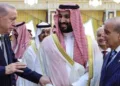
Turkey’s President Recep Tayyip Erdogan, Saudi Crown Prince Mohammed bin Salman, and Pakistan Prime Minister Shehbaz Sharif

Islamic NATO or Sunni Bloc? Saudi-Pakistan-Turkey pact faces question over Islam and sectarian divide

For Afghan women, the life under Taliban rule has turned into a nightmare of fear, silence and lost freedoms

Life of Women Under the Taliban: How Afghanistan turned into the world’s harshest gender apartheid regime

After Tulsi Gabbard flagged Pakistan as a nuclear threat, a deeper unease emerges as doubts grow over whether Islamabad could become the next strategic target for the United States after Iran

After Iran, Pakistan in Focus: Is the next nuclear flashpoint taking shape?

Uttar Pradesh: Hindu youth Nishant Singh killed in brutal attack, Mohammad Naushad accused of Taliban-style murder

Load More

Latest News

Taliban's Mines and Petroleum Minister Hedayatullah Badri and Delta CEO Shaher Al-Taqi sign an exploration agreement in the presence of Zalmay Khalilzad, former US special representative for Afghanistan, in Kabul on Sept. 7, 2026

After Makkah defence pact, Saudi signs $200M energy deal with Taliban, leaving Pakistan under pressure

Two September 11s: Vivekananda’s message of universal brotherhood and shadow of fanaticism

BRICS Summit 2026: Bihar’s culinary, Odisha’s coffee & Gujarat’s craft; Media kit echoes India’s heritage & soft power

Karnataka HC clears way for probe into BDA land allotment scam linked to Kharge family-backed Siddhartha Vihar trust

Thiruvananthapuram Mayor VV Rajesh (File Photo)

Keralam: Thiruvananthapuram Mayor VV Rajesh directs multiplexes to provide free drinking water, allow children’s food

DUSU Elections: ABVP probable candidates file nomination; Campaign intensify to address student concerns

Mr. Sunjoon Hong, Team Lead, Global Business Team, HD KSOE, Korea, along with his team, met the Tamil Nadu Minister for Industries Ms. Keerthana and Additional Chief Secretary, Industries, Dr.S. Vijayakumar, IAS, along with senior officials of the Government of Tamil Nadu, at the Secretariat on September 9, 2026.

Tamil Nadu govt backs HD Hyundai’s Thoothukudi shipyard, project advances to detailed technical, infrastructure studies

Balakrishnan Ji’s life reflected selflessness & complete immersion in spirit of nation-building: Dr Mohan Bhagwat

PM Modi hails ISRO as 430 satellites from 34 nations are launched on Indian rocket; Calls for safe & sustainable space

Shaheed Bhagat Singh Essay Competition 2026 Begins

Shaheed Bhagat Singh essay competition 2026 begins: Check last date, theme and participation details

Load More
  • Privacy
  • Terms
  • Cookie Policy
  • Refund and Cancellation
  • Delivery and Shipping

© Bharat Prakashan (Delhi) Limited.
Tech-enabled by Ananthapuri Technologies

  • Home
  • Search Organiser
  • Bharat
    • Assam
    • Bihar
    • Chhattisgarh
    • Jharkhand
    • Maharashtra
    • View All States
  • World
    • Asia
    • Africa
    • North America
    • South America
    • Europe
    • Australia
  • Editorial
  • Operation Sindoor
  • Opinion
  • Analysis
  • Defence
  • Culture
  • Sports
  • Business
  • RSS @ 100
  • Entertainment
  • More ..
    • Sci & Tech
    • Vocal4Local
    • Special Report
    • Education
    • Employment
    • Books
    • Interviews
    • Travel
    • Health
    • Politics
    • Law
    • Economy
    • Obituary
  • Subscribe Magazine
  • Read Ecopy
  • Advertise
  • Circulation
  • Careers
  • About Us
  • Contact Us
  • Policies & Terms
    • Privacy Policy
    • Cookie Policy
    • Refund and Cancellation
    • Terms of Use

© Bharat Prakashan (Delhi) Limited.
Tech-enabled by Ananthapuri Technologies