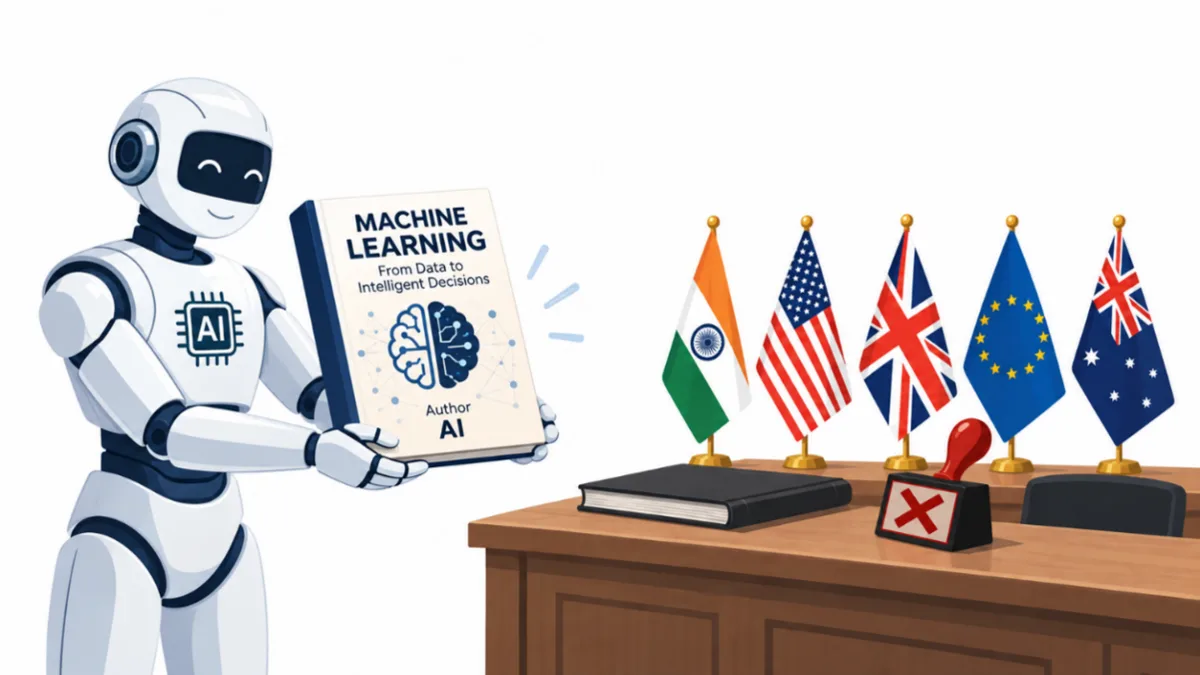
NEW DELHI: The Registrar of Copyrights has rejected an application that named an artificial intelligence system as the author of an artwork, holding that an AI system is neither a natural nor a juristic person, thus it cannot be entitled as an author under the Copyright Act, 1957. It also holds the linage of ancient tradition of Maulikatā, a Sanskrit word for “originality” in the everyday sense from an original idea, an original work to original thinking.
In the same order, the Registrar held that the artwork itself satisfies the requirement of originality under Section 13 of the Act, and that the human who built and operated the system is the person capable of being identified as its statutory author.
The order dated August 31 was passed by Prof (Dr) Unnat P Pandit, Registrar of Copyrights. It disposes of an application filed by US-based computer scientist Dr Stephen L. Thaler for registration of an artistic work titled A Recent Entrance to Paradises and marks the Indian version of a campaign Thaler had run before registries and courts in several countries since 2018.
The global record so far
The Indian order arrives after a sequence of refusals abroad, some concerning the same artwork and others concerning patent applications that named the same system as inventor.
In the United States, Thaler applied in May 2019 to register A Recent Entrance to Paradise, listing his AI system as sole author and himself as claimant. The Copyright Office refused registration under its human authorship requirement, a position it restated in its January 2025 report on copyright and artificial intelligence. The refusal was upheld by the District Court for the District of Columbia and then, on March 18, 2025, the district court in Thaler v. Perlmutter, which held that the Copyright Act of 1976 requires eligible works to be authored in the first instance by a human being, according to case summaries published by Loeb & Loeb and Skadden. The Supreme Court declined to review the decision on March 2, 2026, Mayer Brown reported, leaving the appellate ruling in place. In that proceeding the system was described as the Creativity Machine rather than DABUS.
In the United Kingdom, the dispute concerned two patent applications filed at the UK Intellectual Property Office in 2018 in which Thaler named DABUS as inventor and claimed entitlement by virtue of owning the machine. The UKIPO refused the applications in December 2019 on the ground that DABUS could not be regarded as an inventor under the Patents Act 1977, a decision upheld by the High Court and by a majority in the Court of Appeal, as recorded by the Kluwer Patent Blog. On December 20, 2023 the Supreme Court unanimously dismissed the appeal, the judges observing that DABUS is not a person, let alone a natural person, according to an Associated Press report carried by international outlets. Gowling WLG noted that the Act, in its current form it confers no right to a patent on a product or process generated autonomously by a machine and none on a person claiming that right purely through ownership of the machine.
At the European Patent Office, the two DABUS applications were refused on the ground that the European Patent Convention requires the designated inventor to be a natural person and that an AI machine cannot assign patent rights to an applicant. The Legal Board of Appeal gave its preliminary view in June 2021 and rejected Thaler’s appeal after an oral hearing on December 21, 2021, IP STARS reported. In Germany, the Federal Patent Court took a partially different line, holding that the named inventor must be a natural person while allowing the AI system to be named in addition, Pinsent Masons reported through its Out-Law service.
In Australia, a single judge of the Federal Court initially accepted that an inventor under the Patents Act could be an AI system. That finding was overturned on appeal by the Full Court, and the High Court declined to intervene. Pinsent Masons noted at the time that Australia was the first jurisdiction to reach a final, non-appealable decision, leaving any change to Parliament. South Africa remains the only jurisdiction to have granted a patent listing DABUS as inventor, through its Companies and Intellectual Property Commission in 2021.
The application in India and Procedural history
Thaler filed the Indian application on May 3, 2022 under Section 45 of the Copyright Act read with Rule 70 of the Copyright Rules, 2013. The statement of particulars described the work as an artistic work first published in the United States in 2016, named Thaler as publisher and owner. It also entered as author the Device for the Autonomous Bootstrapping of Unified Sentience or DABUS.
According to submissions recorded in the order, DABUS comprises interconnected artificial neural network modules that generate and evaluate concepts through stages described as training, association formation, perturbation, monitoring and detection, stabilisation and reinforcement and output generation. The visual inputs were photographs taken by Thaler. The linguistic inputs were curated thesaurus entries and English sentences. Thaler also supplied textual descriptions linking the two.
The applicant case was that his contribution was antecedent and upstream, confined to creating the conditions in which the work could be generated and that DABUS was the immediate and operative cause of the final image.
On examination, the Copyright Office found that the application did not identify a natural or juristic person as author and issued a discrepancy letter on July 31, 2023. The applicant replied on August 25, 2023. The Office was not satisfied and issued a hearing notice on April 8, 2026 under sub-rule 12 of Rule 70.
Further objections were raised on May 7, 2026 under Sections 2(d)(vi), 13 and 17. Hearings were held on April 29, May 25 and in June 24, 2026 physical and video conference mode was held. Ms Rajeshwari Hariharan, Senior Advocate, was appointed amicus curiae on May 13, 2026 to assist the Office on a pro bono basis. Order was reserved after the June 24 hearing. Appearing for the applicant were Mr Ankit Sahni, Mr Chirag Ahluwalia, Mr Aman Sinha and Mr Goldie Dhama, along with Dr Rayan Abbott as authorised representative.
Findings of on originality
The Registrar framed four questions for determination, covering originality, authorship, ownership and whether DABUS could be noted in the Register as the generating system. On originality report, the order records that the Copyright Act does not define the term original, but it applies the standard’s laid down by the Supreme Court in Eastern Book Company v. D.B. Modak, which requires independent creation and a minimal degree of creativity rather than novelty or inventiveness.
Applying that test, the Registrar found that the work contains a particular arrangement of visual forms, colours, tonal variations and spatial relationships, that it was not supplied to the system in its final form, and that it was not shown to reproduce any identified pre-existing work. The order states that a work is not deprived of originality merely because technology played an indispensable role in its production.
The objection on originality was accordingly answered in favour of the applicant. On this question the Indian outcome differs from the American one, where the same image was held ineligible for registration altogether.
Findings on authorship
On authorship, the order turns on Section 2(d)(vi), under which the author of a computer-generated work is the person who causes the work to be created. The Registrar held that the provision directs attention to the person responsible for the origination of the work rather than to the mechanism through which the output is generated.
The order draws on the mastermind or effective cause reasoning in Aalmuhammed v. Lee and Burrow-Giles Lithographic Co. v. Sarony, while noting that these decisions arise under a different statute and are treated as persuasive only.
On the applicant’s own account, the order records, Thaler conceived and created the system, configured its operation, supplied the visual and linguistic inputs, and initiated the process. No other person was identified as having undertaken those acts. The Registrar concluded that Thaler is the person who caused the particular work to be created.
Rejecting the argument that autonomous operation makes the system the author, the order states that autonomy in execution is not synonymous with conception of a work and that the law recognises the mastermind behind the creation rather than the autonomy of the tool.
The Registrar also declined the applicant’s analogy to Section 2(d)(v), under which a producer, which may be a company, is the author of a cinematograph film, holding that each clause of Section 2(d) is self-contained. An analogy to Hindu idols and other juristic persons was rejected on the ground that legal personality precedes representation and is not created by it.
Ownership of the title
The order holds that naming DABUS as author while claiming ownership for Thaler cannot be reconciled with Sections 17 to 19. If DABUS were the author, it would be the first owner under Section 17, but it lacks capacity to hold or assign copyright under Sections 18 and 19. No statutory exception was established.
The Registrar noted that the Register serves a public function of providing legal certainty on authorship, first ownership and the chain of title and that a prospective licensee must be able to identify who is competent to grant a licence.
Windows for an opportunity to amend
At the June 24 hearing the applicant was offered the opportunity to amend the particulars to identify Thaler as author under Section 2(d)(vi). The order records that the applicant declined and maintained that DABUS must continue to be named. An alternative request, that Thaler be entered as author subject to DABUS being recognised as generator, was not presented as an unconditional correction.
The order states that rejection follows not because the application initially contained incorrect particulars but because the incorrect identification of the author remained the applicant’s continuing case despite notice, hearing and an express opportunity to amend. Thaler is not precluded from pursuing remedies available in law on the basis of corrected particulars.
A separate request to record DABUS in the remarks column of Form XIII solely as the technological system was not pressed as a distinct application. The Registrar left the maintainability and merits of any such future request open.
The order concludes that whether legal personhood or authorship should ever be extended to autonomous artificial intelligence remains a policy decision reserved for Parliament and cannot be introduced through administrative reinterpretation.