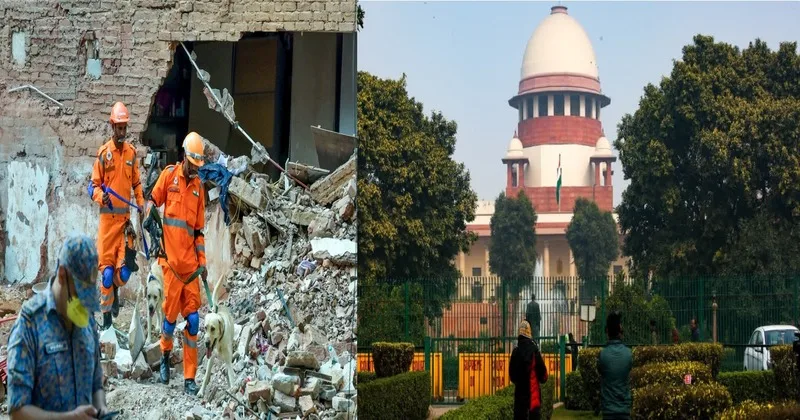
NEW DELHI: The death of seven persons, including five students, in the collapse of a five-storeyed paying-guest building at Delhi’s Satya Niketan has now reached the Supreme Court, which on September 8 indicated that the tragedy may require intervention extending far beyond the national capital.
A Bench of Justices Ahsanuddin Amanullah and R Mahadevan said it would consider the issue on September 10 and indicated that proceedings already initiated by the Delhi High Court could be transferred to the Supreme Court. “We already have something in mind. It has to be on a pan-India basis,” Justice Amanullah observed when the matter was mentioned.
The significance of the intervention lies in the case in which the Satya Niketan collapse has been placed before the Court. It forms part of Loganathan v. State of Tamil Nadu, an ongoing Supreme Court proceeding concerning rampant unauthorised construction, violation of building bye-laws and conversion of residential properties for commercial use across the country.
On March 25, the Court had already described the situation as alarming and expanded the proceedings nationwide, directing municipal bodies in State and Union Territory capitals to identify residential areas being illegally used for non-residential purposes. Senior Advocate Ajit Kumar Sinha was appointed amicus curiae to assist the Court.
The warning became even more pointed in May. The amicus informed the Court that buildings in parts of Delhi had been constructed far beyond sanctioned limits and that foundations designed for smaller structures were being made to bear several additional floors. The Court recorded the submission that, considering the heavy public footfall, “a calamity is only waiting to happen.”
That apprehension has now acquired a grim immediacy.
At around 1.30 pm on September 6, the building at P-14, Satya Niketan, opposite Delhi University’s South Campus, collapsed. It housed a boys’ PG known as “Hostel Daze”. Five students and two others lost their lives, while several were rescued from the debris. The five deceased students came from different parts of Uttar Pradesh, Chhattisgarh and Madhya Pradesh—young men who had come to the national capital for their education.
The property stood on a plot of barely about 55 square yards. Municipal officials’ preliminary assessment reportedly found that the structure had no sanctioned building plan, while questions have also arisen over basement alterations and construction activity preceding the collapse. The precise cause remains under investigation.
The MCD has since suspended five South Zone officials, including a Deputy Commissioner and engineering officials. The building owner Hariram Gupta, his wife Urmila and son Mahesh have also been arrested.
Significantly, Satya Niketan itself had witnessed another building collapse in April 2022, killing two persons. Yet the locality was not part of the inspection exercise subsequently ordered by the Supreme Court for areas including Saket, Malviya Nagar and Lajpat Nagar. The amicus has now sought a time-bound audit of PGs, private hostels and student accommodations around educational institutions across Delhi.
The Supreme Court had in July made clear that unauthorised structures cannot survive merely because civic authorities failed to act in time. It also warned that municipal officials themselves could face accountability where statutory duties were ignored.
The September 10 hearing may therefore move the debate beyond one collapsed building and one set of suspended officers. Before the Court is the larger question of whether illegal construction and official inaction have been allowed to become an accepted feature of Indian cities until another building falls and lives are lost.