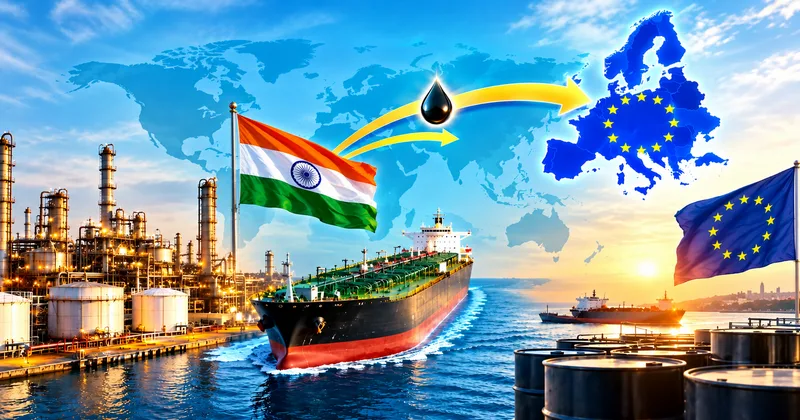
New Delhi: India is emerging as a crucial pillar of Europe’s diesel supply chain amid mounting global energy disruptions. The traditional fuel flows from Russia is reduced as Europe intends to isolate Moscow & cut its revenue sources as an impact of the Ukraine conflict. The US-Iran war & ruptured West Asian landscape further strains the hitherto energy conundrum. Amidst such supply chain shocks, Indian refiners funneled around 60 per cent of the diesel and gasoil to Europe via the Bab-el mandeb maritime passage in August 2026. This underscores the growing importance & footprint of India in the global energy security architecture.
According to energy analytics firm Vortexa, around 2,00,000 barrels per day (bpd) of diesel and gasoil crossed the strategic Red Sea chokepoint bound for Europe in August. Among them, Indian refineries accounted for roughly three-fifths of the volume, making New Delhi an increasingly important source of refined fuel for Europe’s eastern supply routes & energy security.
India’s oil supply to Europe also acts as a testament to India’s enhanced refining capabilities underpinned with advanced technologies. New Delhi emerges as a credible oil exporter & bridges the supply chain gap in the global energy security map. Thus, India has marched a long way from being a major oil importer to energy exporter and a resilient player to fulfill global energy needs.
This energy strategy of India to supply refined oil to the globe, despite being a net crude importer, pitches the country as a major link in the global energy market. It imports crude oil and exports refined products, thus evolves as a significant stakeholder in the international oil market.
India fills the void in the Europe’s energy security
India’s growing role comes as Russian diesel exports remain severely constrained. Russia was once a major supplier of diesel to European markets, but refinery disruptions, Ukrainian drone attacks and export restrictions have sharply reduced its contribution.
Vortexa data showed that Russian seaborne diesel and gasoil exports averaged only around 1,50,000 bpd during the first 25 days of August, down approximately 6,10,000 bpd year-on-year and 81 per cent below the five-year seasonal average.
The scheduled easing of Russia’s diesel export restrictions was not expected to immediately restore supplies. Repeated Ukrainian attacks on Russian energy infrastructure have continued to affect refining and export capabilities. Vortexa recorded 32 Russian refinery attacks during July and August.
The 2,60,000-bpd Perm refinery, for instance, was left operating at only around 28 per cent of its crude distillation capacity following an attack. Export infrastructure has also been affected, with no diesel cargoes reportedly leaving the Black Sea port of Tuapse since a strike in May.
The Black Sea accounted for roughly 44 per cent, or about 3,80,000 bpd, of Russia’s diesel and gasoil exports last year. Continued disruptions have therefore further ruptured Europe’s traditional sources of supply. India thus fills this gap and acts as a key, credible energy security partner of Europe.
US shipments also diminishes
The United States has stepped into compensate for part of the Europe’s energy shortfalla amid cut in Russian supplies. In August, the US supplied approximately 5,20,000 bpd, or around half of Europe’s seaborne diesel imports from outside the region.
However, American shipments have also begun to weaken. US diesel flows to Europe peaked at nearly 5,40,000 bpd during the first half of August, before falling to approximately 3,50,000 bpd in the second half — a decline of about 35 per cent in just a few weeks.
With Russian supplies depressed and US shipments losing momentum, Europe is increasingly dependent on alternative suppliers. This is where India’s export-oriented refining system has assumed greater significance.
India’s refining strength powers global fuel exports
India is the world’s fourth-largest refining nation, with an installed refining capacity of approximately 258.1 million tonnes per annum, significantly higher than domestic fuel demand. The country exported around 61.5 million tonnes of petroleum products in FY 2025-26, reinforcing its position as a major global supplier of refined fuels.
India’s sophisticated and export-oriented refineries are capable of processing a broad range of crude grades and producing high-value petroleum products for international markets. This model allows India to remain a major exporter of refined products even though it is heavily dependent on imported crude oil. India’s crude import dependence reached around 88.7 per cent in 2025-26.
Importing most of its crude while exporting large volumes of refined petroleum products — is central to India’s growing role in global energy markets. Indian refiners add value by processing imported crude into diesel, petrol, jet fuel and other products, which can then be directed towards global markets where demand and prices are stronger.
Europe entangled in energy supply disruption
Europe is entering a critical period, with diesel demand expected to rise during winter while inventories remain relatively low. Refineries in Europe and North America are also heading into autumn maintenance after operating at elevated rates. This further escalates supply disruptions to the continent.