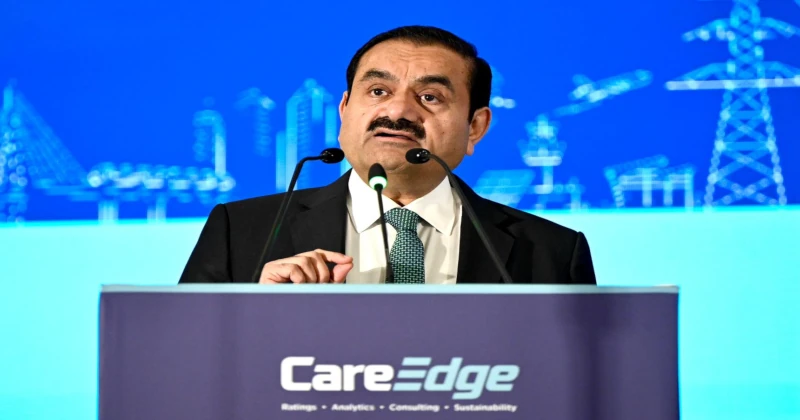
Mumbai: India’s infrastructure ambitions are entering a phase where conventional financial models may no longer be sufficient to measure the scale of transformation underway, Adani Group Chairman Gautam Adani said, challenging credit-rating institutions to rethink how they assess projects that could reshape entire economic ecosystems.
Addressing the CareEdge Group Annual Summit in Mumbai, Adani argued that India does not need easier credit ratings or diluted scrutiny, but “wider lenses” capable of recognising the strategic, economic and ecosystem value of large infrastructure platforms.
His message was direct, the infrastructure of tomorrow cannot always be evaluated using the assumptions of yesterday. “India does not need lower standards. India needs wider lenses,” Adani said, while stressing that his argument was not a call to compromise rating independence or approve projects that were financially unviable.
Instead, he urged rating agencies to develop more dynamic frameworks that account for ecosystem multipliers, strategic resilience and the additional value created when different infrastructure assets converge.
‘A rating is not just a letter or number’
Adani placed the responsibility of rating agencies in a broader social and economic context.
According to him, every rating decision has consequences beyond balance sheets and spreadsheets. A rating attached to a port, renewable-energy project or other infrastructure asset can influence whether capital flows into projects that create employment, improve connectivity and expand access to energy.
“A rating is not just a letter or a number. It is a judgement of trust,” he said.
For Adani, this makes the evolution of rating frameworks particularly important at a time when India is rapidly expanding its infrastructure capacity.
He pointed to the country’s expanding roads, ports and airports, rapidly growing renewable-energy capacity and digital infrastructure as evidence of an India that is operating with a significantly greater degree of confidence than it did decades ago.
From ‘Limited Resources’ to ‘Belief in India’s Potential’
Reflecting on his own entrepreneurial journey, Adani said that when he began building businesses around the period of India’s economic transformation in the early 1990s, the country’s infrastructure ambitions were constrained by limited resources, capability and confidence.
According to him, the situation has fundamentally changed. India now possesses resources and has demonstrated its ability to execute large projects, but the most important transformation has been the country’s growing belief in its own potential.
He argued that this change in confidence must also be reflected in the institutions that evaluate India’s infrastructure ambitions.
Mundra: When one port becomes an entire economic ecosystem
Adani used three projects from the Adani Group’s journey to illustrate what he believes traditional rating models may fail to capture. The first was Mundra Port in Gujarat. When development began decades ago, Adani said a conventional assessment could have focused on the absence of a mature industrial ecosystem, speculative demand, execution risks and long-term assumptions that were difficult to validate.
But Mundra eventually developed into much more than a standalone port. It became connected to railways, logistics centres, power generation, industrial zones, manufacturers and traders.
Adani described this as a “multi-layer network”, in which different infrastructure components reinforce and de-risk one another. His argument is that a conventional standalone cash-flow model can struggle to capture this compounding effect.
“If we build only for the demand we can see today, India will always be late for the opportunities of tomorrow,” he said.
Vizhinjam: ‘The greatest risk was India continuing to believe that it could not’
Adani’s second example was the Vizhinjam port in Kerala, which he presented as a case where strategic importance could not be fully captured through conventional financial assessments. For decades, India had faced the challenge of handling container cargo close to major international shipping routes while relying heavily on foreign transhipment hubs.
Adani argued that the project faced repeated obstacles, including engineering complexity, deep-water construction challenges and substantial capital requirements. Yet, after being built, Vizhinjam demonstrated rapid operational growth.
Adani said it became the fastest Indian port to reach two million TEUs within eighteen months, presenting the project as evidence of how strategic infrastructure can create value beyond immediate financial returns.
“The greatest risk was never in building Vizhinjam. The greatest risk was India continuing to believe that it could not,” he said.
His broader argument was that infrastructure assessments should account for “sovereign resilience”—the economic and strategic value created when a country develops capabilities that reduce dependence on external infrastructure.
Khavda and the bigger bet on energy, AI and Manufacturing
His third example came from the Rann of Kutch, where the Adani Group is developing the massive Khavda renewable-energy project.
Adani said that viewed purely as a power project, Khavda could appear to carry substantial challenges: geographical isolation, harsh climatic conditions, execution complexity and uncertainties surrounding future demand. But he argued that its potential significance goes far beyond electricity generation.
According to Adani, Khavda represents a broader platform where energy, artificial intelligence, manufacturing and digital infrastructure can converge. He suggested that the clean energy generated there could support India’s future computing infrastructure and contribute to an emerging AI manufacturing ecosystem.
“Measured simply as a power project, Khavda will be under rated for decades. But when measured as a transformational platform, it will be one of India’s most important strategic assets,” he said.
Adani draws a line between risk and ambition
Importantly, Adani repeatedly stressed that his argument should not be interpreted as a demand for favourable ratings. He said India does not need rating agencies to lower their standards or overlook execution risks.
Instead, he called for analytical frameworks capable of assessing the full economic architecture surrounding major projects. He divided infrastructure into three broad categories. Replacement infrastructure, he said, involves maintaining or replacing established assets where conventional rating frameworks are generally effective.
Growth infrastructure involves expanding capacity in established sectors where demand and economics are relatively visible. Here, he argued, rating methodologies should increasingly account for ecosystem effects and multiplier value.
The third category is what he called “platform infrastructure.” These are projects that do not merely satisfy existing demand but create new capabilities, generate new demand and reshape the economics around them. Mundra, Vizhinjam and Khavda, he argued, belong to this category.
‘Infrastructure that makes the economy smarter’
Adani then connected this infrastructure transformation to what he described as the next major economic frontier: artificial intelligence. AI may appear to be primarily a software revolution, he said, but its expansion ultimately depends on physical infrastructure.
AI requires enormous amounts of electricity, data centres, cooling systems, transmission networks, land and increasingly clean and reliable power. This means that the countries capable of building the physical infrastructure necessary to scale AI could gain a significant strategic advantage.
According to Adani, the competition in AI will therefore not be limited to who develops the most advanced algorithms.
It will also involve who can build the infrastructure required to power them. This, he argued, makes projects such as Khavda potentially important components of a much larger economic transformation.
A challenge to CareEdge
Adani ended his address by placing a direct challenge before CareEdge Group. He asked why India should not develop the world’s first comprehensive credit framework for integrated platform infrastructure.
Such a framework, he suggested, should account for:
- Ecosystem multipliers
- Adjacency value
- Strategic resilience
- Multi-dimensional infrastructure
- The compounding effects created by interconnected assets
He argued that such a framework could eventually become a benchmark for other emerging economies. The challenge reflects the larger theme of his address: India’s infrastructure ambitions are changing, and the institutions that allocate trust and capital must change with them.
The bigger message
Adani’s speech was ultimately less about asking rating agencies to take more risks and more about asking them to understand where risk actually lies. A project that appears risky in isolation may create resilience, industrial capacity and economic opportunity when viewed as part of a larger platform.
Conversely, an apparently safe standalone asset may have limited transformative value if it does not create new capabilities. or Adani, the distinction will become increasingly important as India moves toward its 2047 development ambitions.
“The India of 2047 will not be built by ambition alone,” he said. “It will be built when ambition earns trust, when trust unlocks capital and when capital builds national capability.” His central message to India’s rating and financial institutions was therefore unmistakable, Do not lower the bar. Change the way you see the horizon.