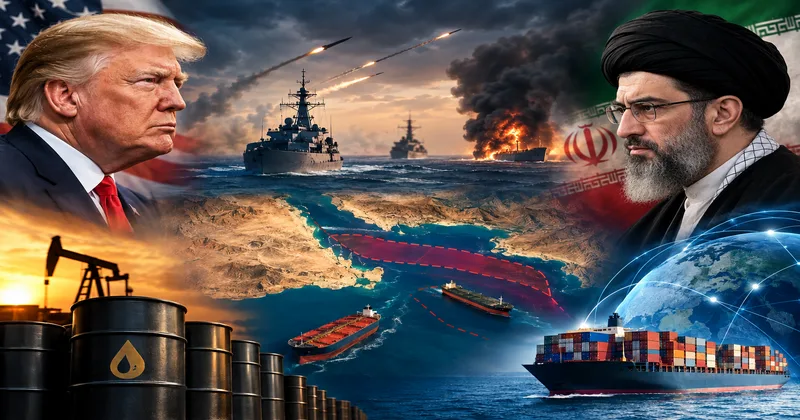
As the hard-nosed geopolitical wildfire of West Asia soars & peace process between US-Israel & Iran hits a deadlock, amid renewed confrontation, Tehran has threatened to expand restrictions on maritime traffic beyond the Strait of Hormuz & warned strong retaliation. The latest escalation comes after the US military reportedly targeted three Iranian oil tankers and Iran claimed it launched ballistic missiles at two US Navy warships.
Warring parties trade sharp accusations, exchange catastrophic strikes and issue competing accounts of the conflict. Meanwhile, the safety of commercial ships & seafarers traversing through the strategic waterway, global energy security and supply chain resilience remains jeopardized and the geopolitical chessboard of West Asia remians deeply fractured.
Iran plans new “exclusion zone” beyond the Strait of Hormuz
Iran’s Supreme National Security Council Secretary Mohsen Rezaei said that Tehran plans to announce a new restricted or exclusion zone outside the Strait of Hormuz in the coming days. Thus, Iran aims to potentially extend restrictions & its influence on the movement of commercial vessels deep inside the Persian Gulf.
Speaking to Iranian state broadcaster Islamic Republic of Iran Broadcasting (IRIB), Rezaei said that the proposed exclusion zone would begin from what Tehran describes as the line of the US naval blockade and extend towards the Strait of Hormuz and into the Persian Gulf. “Any ship entering this new area will be placed on the sanctions list,” Rezaei said, according to IRIB. If Tehran materializes this string of maritime influence & assertion, it will further complicate the global maritime trade & energy security. It will further fuel the flames of the West Asia conflict, which is hitherto burning rigorously.
BREAKING: Iran announces it will implement a new restricted zone outside the Strait of Hormuz in the coming days, starting from the US Navy’s blockade line and into areas of the Persian Gulf, per Iran's SNSC chief Rezaei.
Iran says any ship that enters this new zone will be… pic.twitter.com/XD8dUCUSEo
— The Hormuz Letter (@HormuzLetter) September 6, 2026
Iran’s emphasis on “exclusion zone” comes amid heightened tensions over commercial shipping through the Strait, which is one of the world’s most important energy corridors. Iran has repeatedly warned the unchecked movement of commercial vessels in the Strait. As a littoral state, Tehran intends to exert & instrumentalise its influence across the maritime chokepoint and reiterates no passage of vessels without its permission. Meanwhile, US aims to continue its naval blockade in the Strait & thwart IRGC presence & Iranian vessels in the waterway. Thus, US & Iran tend to remain at odds, funnel competing interests to control the strategic waterway and are reluctant to break the stalemate in the peace process. This has led to spiking & intense face-off in West Asia.
Trump claims Strait of Hormuz as fully open & operational; Iran rejects it as “big lie”
Iran’s Supreme National Security Council Secretary Rezaei also rejected US President Donald Trump’s assertion that the Strait of Hormuz remains open and operational, describing the claim as “a big lie”. He said maritime traffic had fallen sharply compared with pre-conflict levels.
According to Rezaei, more than 100 vessels previously passed through the waterway carrying more than 100 million tonnes of goods, whereas only around seven or eight vessels were currently moving through it, primarily carrying essential goods for Iran.
The Iranian official further claimed that Tehran had identified and attacked some US-linked vessels attempting to move through the area. However, he said Iran had refrained from sinking some oil-carrying vessels because of concerns over environmental damage. The competing claims have added uncertainty over the actual level of maritime traffic and the extent to which the waterway remains operational.
Iran claims ballistic missile attack on the US warships
The latest confrontation intensified after Iran’s Islamic Revolutionary Guard Corps (IRGC) Aerospace Force claimed it fired several ballistic missiles at a US aircraft carrier and a guided-missile destroyer. The IRGC said the two US Navy vessels were targeted because they were allegedly harassing Iranian ships and participating in a naval blockade.
The Iranian force further claimed that both vessels sustained damage and subsequently left the conflict area because they feared additional attacks. “If the hostile and aggressive actions continue, the US regime must expect fierce responses from the armed forces of the Islamic Republic of Iran”, the IRGC said.
However, refuting the Iranian claims, the US military has provided a different account of the incident.
US says warships evaded Iranian attacks & disabled Tehran’s oil tankers
US Central Command (CENTCOM) said that Iranian forces launched ballistic missiles towards two US Navy warships patrolling regional waters. According to CENTCOM, a US aircraft carrier and a guided-missile destroyer successfully evaded multiple Iranian attacks and no American personnel were injured. However, the US military subsequently announced strikes against three Iranian crude oil carriers on September 5.
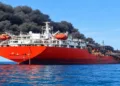
CENTCOM said that US forces permanently disabled the M/T Downy near Kharg Island and the M/T Stark 1 near Jask. It also said the M/T Kylo, also known as the Noxen, was completely destroyed in the Gulf of Oman after its crew were instructed to abandon the vessel. CENTCOM later released footage showing the Kylo engulfed in flames before sinking.
The US military said the three vessels were linked to a multibillion-dollar “shadow network” that allegedly generates revenue for the IRGC and its regional partners. CENTCOM commander Admiral Brad Cooper said the strikes were intended to impose an economic cost on Iran following the alleged attacks on US warships.
It’s simple: if Iran shoots at U.S. ships, we will destroy (and sink) their oil tankers. All they have to do is not shoot at @USNavy.
Iran’s oil tanker fleet is defenseless — Iran has no navy or air force. Our planes, ships & subs can strike them all, in @CENTCOM & @USPACOM. https://t.co/lr5TaxloBw
— Pete Hegseth (@PeteHegseth) September 5, 2026
US War Secretary Pete Hegseth separately warned that Washington would destroy Iranian oil tankers if Iranian forces attacked US Navy vessels. “It’s simple: if Iran shoots at US ships, we will destroy (and sink) their oil tankers”, Hegseth said in a post on X.
On the other hand, Iran has condemned the US strikes on its commercial vessels and rejected Washington’s justification for the attacks.
Tehran accuses US of naval blockade
Amid competing claims & trading accusations, Iran’s IRGC said that the US military had earlier attacked three Iranian oil tankers, causing damage and accused Washington of attempting to close the Strait of Hormuz.
In response, the IRGC Navy claimed it targeted three oil tankers travelling through what it called an “unauthorised route” in the Strait, as well as three vessels affiliated with the United States in other areas. The force also warned ships operating near the Strait which were deemed to be suspicious or unauthorised movements.
Iran’s Foreign Ministry also described the US attacks on commercial vessels as illegal and irresponsible. In a September 5 statement, the ministry accused Washington of continuing military aggression, imposing a naval blockade and conducting economic warfare against Iran.
Tehran said the attacks violated Article 2(4) of the United Nations Charter and constituted a war crime, while warning that the consequences of continued attacks on commercial shipping would fall on the United States and its allies. The US, however, has maintained that its military actions are aimed at defending American forces and imposing costs on Iranian activities that support the IRGC.
Shipping risks rise in the Strait of Hormuz
The latest exchange has further increased concerns over maritime security in and around the Strait of Hormuz. The waterway connects the Persian Gulf with the Gulf of Oman and the Arabian Sea and is a critical route for global oil and liquefied natural gas shipments.
US officials have said Washington is working with regional and international partners to facilitate commercial traffic. US Energy Secretary Chris Wright said that ships that coordinate with the US Navy could transit the Strait, although he acknowledged that traffic remained below pre-conflict levels.
Wright said that the United States was working with Gulf countries to increase the number of vessels passing through the waterway. However, he stopped short of declaring the Strait completely safe for merchant shipping without US military support.
Iran, meanwhile, has continued to warn commercial vessels against entering areas it considers restricted. The competing positions have left shipping companies and energy markets facing uncertainty over the security and reliability of one of the world’s most critical maritime energy routes.
Trump rejects fresh talks
The maritime confrontation has unfolded alongside a widening diplomatic impasse. Trump has repeatedly maintained that the Strait of Hormuz is open and operating and has claimed that water mines(explosives hidden in the sea to destroy vessels) have been removed or detonated. At the same time, Trump has said that Washington is not currently engaged in talks with Tehran and has no negotiations scheduled.
The US President has also raised the possibility of the United States taking control of the Strait, arguing that Washington effectively controls the waterway through its naval presence and blockade. However, Iran has rejected US demands concerning the Strait and a deal on Tehran’s nuclear programme.
Switzerland talks failed to produce permanent truce
The latest military escalation follows the collapse of diplomatic efforts that began with an interim understanding reached in June. US and Iranian representatives had engaged in negotiations, including talks in Switzerland, with mediators such as Qatar involved in efforts to establish a framework for ending the conflict.
The two sides subsequently accused each other of violating the terms of the temporary arrangement. The 60-day truce framework expired without producing a permanent settlement and hostilities subsequently intensified.
US Vice President JD Vance has previously described the Switzerland discussions as providing a potential foundation for a final agreement, while Iranian Foreign Minister Abbas Araghchi has said that mediation efforts involving countries such as Pakistan, Qatar and Oman had made progress on diplomatic channels.
However, Washington and Tehran remain divided over two central issues: Iran’s nuclear programme and control of maritime traffic through the Strait of Hormuz and both sides remain reluctant to reach a common ground and establish permanent peace in West Asia.
The diplomatic track has also been complicated by the wider regional conflict and the involvement of multiple state and non-state actors.
Oman & Qatar seek de-escalation
Oman has been involved in discussions with Iran over alternative arrangements for commercial shipping through the Strait, while Qatar has played mediation roles in efforts to bring the broader conflict towards an end. However, Iranian officials have indicated that future diplomacy would require stronger guarantees. Qatar has urged both sides to exercise restraint and return to negotiations, while escalation continue on the battlefield.
With Iran threatening to establish a new maritime exclusion zone, Washington maintaining its naval blockade and both sides exchanging strikes and warnings, with no sign of a permanent truce and broader peace agreement being punctured amid hegemonic ambitions, West Asia increasingly evolves as a volatile geopolitical zone, jeopardizing global energy security, maritime safety with increasing human costs!