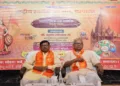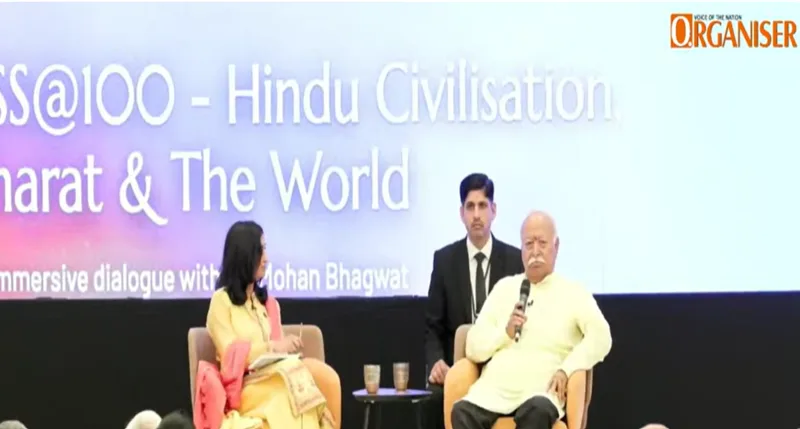
LONDON: Addressing questions surrounding the civic responsibilities of the Indian diaspora, Dr. Bhagwat articulated a unambiguous stance on allegiance, declaring that a person’s primary loyalty must always belong to their Karma Bhumi—the land where they live and work. Clarifying that Hindutva never asks an individual to betray their nation of residence, the RSS Chief stated that if a conflict of interest were ever to arise, British Hindus must naturally stand with Britain. “Your Janma Bhumi or land of origin provides you with core values, but those values must be lived in service to your Karma Bhumi,” Dr. Bhagwat noted, adding that an unwavering commitment to local civic duty aligns seamlessly with the universal message of “Think Globally, Act Locally”
Nature of a Hindu
- If I have to mention a single principle, I would mention “Apnapan” — pure, Sattvik love for everybody. That is the traditional nature of a Hindu.
- A Hindu is not an individual alone. A Hindu is connected with family, community, society, and humanity. A Hindu not only worships, but also loves nature.
- Hindus can provide a balanced view of the world.
- Hindus have solution for simultaneous progress of everything.
- Historically Hindus have provided solutions to the world, not the time to give responses in modern models for the modern society.
- Respect for diversity is Hindu Dharma and Hindu Culture – the history of Hindu society.
- Hindu cannot be understood by religion or just way of life, but a view that believes that all diversities should be accepted and respected as they lead to the same God.
- “We are also right; you are also right” that is Hindu view.
- A Hindu is not an individual, a Hindu is family, community, nature.
- Hindu thought is based on one single thing: diversity is natural. So, we have to accept and respect it. We have to deal with diversity, keeping in mind that these are the various decorations of the unity of existence.
- If we look at unity, we can respect all diversity. That is the history of Hindu society and Bharat.
- When we say Hindu, it is not a religion and it is not about worship alone. From Bharatvarsha, every kind of thought has come out, from atheist to theist.
- Before 7th generation, work of organising Hindu society should be completed.
- Individual attitude and family atmosphere to be changed to allow the society to align.
- Hindutva: Everybody is one; therefore, everyone is ours.
- Diversity is natural. So, we accept and respect it. We have to deal with diversity, keeping in mind that these are the various decorations of the unity of existence. This is Hindu Thought.
- The word Hindu is very broad. It cannot be understood only on the basis of any particular religious practice or lifestyle. Hindu is a natural society. This nature accepts and respects all diversity and believes that all paths lead to the same goal.
रुचीनां वैचित्र्यादृजुकुटिल नानापथजुषां
नृणामेको गम्यस्त्वमसि पयसामर्णव इव॥
(Meaning: Just as water from different sources, flowing through different paths, ultimately reaches the same sea, people may follow different paths, but their ultimate goal is one.)
Nation State
- Nation is not a translation for Rashtra.
- Conflict management becomes very easy when we think about a solution. If we think with enmity, we say, “I will not give anything to anyone.” So, live and let live, and let others live
- Nation is where people come together due to similarity of language or culture and they enforce rules to make people stay together.
Future Generation
- I trust the future generations more as they have urge to make this world a better place. Give them the goal and not the method. They will achieve the goal of universal morality and prosperity rapidly.
- Young people are not worried about the consequences, therefore if we give the purpose of global brotherhood without imposing anything, they will take it forward.
- New generation will have to continue its traditional values and adapt to the changing times.
- The older generation has experience, but the younger generation, if they feel that something is right, they simply do it. They are not bothered about the consequences because they are young.
- So, if we give the purpose and our experience to the younger generation, rather than imposing it on them, and define the base and set the goal, they will do it in a more beneficial way.
Message to World
- Everybody is one. Everybody is ours. We should share this message with the world.
- Traditions of worshipping nature have been there for hundreds of years. We should learn from all the ancient traditions.
- Artha and Kama go together with the goal of liberation. Society and humanity progress together with nature.
- Sharir, Man, and Buddhi — the body, mind, and intellect — are all for the progress of the Atman. The world is connected. All are one. We have to wake up and give this solution to the world in the modern condition.
- If people follow this way, there would never be war. It would create peace, bliss, and prosperity. It would create brotherhood in humanity and humanity in nature.
Rashtra
- The purpose of “Hindu Rashtra” is to give this message to the world: Diversity is Natural, and Unity is Truth.
- The meaning of Rashtra is that we should live a life such that people of all nations look to us and derive a way to live their own lives for the fulfilment of the purpose of their own nation.
Karmabhoomi
- There is no conflict. If, at all, such a situation arises, it is obvious that British Hindus will go with Britain. Exceptions may happen, but Hindutva is clear on this. Your karmabhumi is where your loyalty lies. Your janmabhumi, or the land of your origin or birthplace, and your Punyabhumi are where you receive your values. You have to live those values in your Karmabhumi, serving the land where you live.
- Be Loyal to your karmabhoomi. Hindutva never ask to betray your karmabhoomi.
- If British Hindus are such Hindus, then there will be no conflict between British Hindus and Bharat Hindus. If that happens, British Hindus will obviously go with Britain.
- The world has already started using terms such as “global” and “one world.” We can remain honest to our Karmabhoomi and at the same time serve humanity all around.
- The lesson of the day is: “Think Globally, Act Locally.”
Swayamsevaks
- If you become a swayamsevak, you will have a relative in every development work, whom you don’t know yet.
- Swayamsevaks are active in virtually every sphere of human life, making it difficult to summarize the full extent of their work. Even those who oppose us for political reasons recognize the value of our work and the contribution of swayamsevaks. From time to time, they seek our cooperation and engage in dialogue with us. This reflects the broad acceptance of our work across society.
- Even those who oppose us for the sake of politics, know our worth, qualities of Swayamsevaks, so they also accept Sangh and in crucial matters support Swayamsevaks.
- RSS is open to cooperate if you too are doing good work.
- If you are doing good work for society, we will consider you to be part of RSS.
- If you are working honestly and selflessly for the good of society, we consider you a swayamsevak—even if you have no dialogue or association with us, do not work with us, and do not even know what RSS stands for.
- Sajjanshakti should network and everybody should work for the betterment of the national. Work of RSS is to gather the Sajjanshakti and us for the advancement of humanity.
Seva
- Seva is not something that makes you great. It is not Upakara, and it is not something that you are giving as compensation to humanity.
- Seva is your chance to get near to God. They are giving you the chance to serve; you are not doing anything for them. So, Seva should be done with this attitude.
- A poem in Marathi goes like this, “One who gives should keep on giving, one who receives should keep on receiving; while receiving, one fine day, you should receive the hands of the giver and become a giver yourself.”
- Societal models would change with times. There are several old models that can be changed to suit the present times.
- By doing seva you are not doing anyone a favour. Instead, you should feel privileged that you have the opportunity to serve
- The one giving should keep giving and the one receiving should keep receiving and the one who receives should also become giver.
Pancha Parivartan
● To bring about change in the life of people, there are two things we are doing. We are doing Panch Parivartan. We have to change the behaviour of society, with respect for others and help for each other, so that society runs in an interdependent way.
Dr. Bhagwat concluded his address by placing firm trust in the rising generation, urging leaders to provide youth with clear moral purpose and global brotherhood rather than rigid methodologies. Calling for the implementation of Pancha Parivartan (five societal transformations) to foster civic responsibility and family values, he redefined selfless service (Seva) not as an act of condescension, but as a privileged opportunity to draw closer to the divine. By asserting that any individual working selflessly for the betterment of society is inherently a swayamsevak, Dr Bhagwat’s centenary address presented a blueprint for social harmony—one where unwavering local loyalty and universal human values combine to build a peaceful, interconnected world