New Delhi: The Union Public Service Commission (UPSC) exam will conduct the Combined Geo-Scientist (Preliminary) Examination 2027 on January 10, 2027. This gives candidates several months to build a structured preparation plan. The application forms can be filled till September 22, 2026. Candidates should begin by going through the official syllabus and previous years’ question papers. This will help them understand what needs to be studied and avoid spending too much time on less important topics. A subject-wise strategy can help in identifying important topics, strengthen concepts and gradually improve speed and accuracy.
UPSC Geo-Scientist 2027 Preparation: Know the exam first
The Combined Geo-Scientist examination is conducted in three stages:
- Preliminary Examination
- Main Examination
- Personality Test/Interview.
The Preliminary Examination is objective in nature and is like a screening stage for candidates appearing for the Main Examination.
The preliminary stage: Includes General Studies and a discipline-specific paper. Depending on the stream, candidates have to prepare subjects such as Geology/Hydrogeology, Geophysics or Chemistry. Therefore, first identify the paper applicable to their chosen post and download the detailed syllabus from the UPSC website.
Paper-I of Stage-I (General Studies)
It is common for candidates from all streams and will be at about the level expected of a science graduate. Paper-II of Stage-I will be based on the candidate’s chosen stream. In Stage-II, candidates have to appear for three compulsory papers in their respective subject, with the difficulty level roughly equivalent to an M.Sc. degree from an Indian university. The questions will mainly test candidates’ understanding of basic concepts and fundamentals. There will be no practical examination in any subject.
Step 1: Understand the UPSC Geo-Scientist Syllabus
The first step should be to divide the syllabus into manageable sections. Candidates can make three lists:
- Topics they already know well
- Topics that need revision
- Topics that are completely new
The discipline-specific paper should receive the maximum preparation time because it carries substantial weight in the Preliminary Examination. Avoid studying multiple books for the same topic. One reliable source, followed by repeated revision and question practice, is generally more useful than collecting several study materials.
Step 2: Build strong subject fundamentals
Candidates from Geology, Geophysics, Chemistry and Hydrogeology should focus on understanding the subject rather than relying only on memorisation. After studying a topic, practise questions based on it to check understanding.
The preparation can be divided into:
- Concept building: Read the basic theory and understand important concepts
- Short notes: Prepare concise notes containing formulas, definitions, diagrams, classifications and important facts
- Revision: Revise completed topics at regular intervals
- Question paper practice: Solve questions immediately after completing a topic
Step 3: Give special attention to general studies
General Studies is common to the Preliminary Examination and should not be left for the final weeks.
Divide General Studies preparation into areas such as:
- Current affairs
- Indian history and culture
- Geography
- Polity
- Economic and Social Development
- Environment
- General science
- Important national and international developments
Daily newspaper reading or a reliable current-affairs source can be combined with monthly revision. Make short notes instead of repeatedly reading the same material.
Step 4: Solve UPSC Geo-Scientist previous year papers
Previous years’ question papers are one of the most useful resources for understanding the examination. The UPSC website provides previous question papers for the Combined Geo-Scientist Preliminary Examination, including General Studies, Chemistry, Geology-Hydrogeology and Geophysics papers.
Try solving these papers after completing the relevant topics. Later, attempt complete papers under exam-like conditions.
While analysing a paper, make sure to check:
- Which topics produced the most questions
- Which questions were answered incorrectly
- Whether the mistake was conceptual or due to careless reading
- How much time was required
- Which topics need another revision
Step 5: Start mock tests gradually
Don’t wait till the very end to give mocks. Initially, take topic-wise tests. Once a substantial portion of the syllabus has been completed, move to full-length mock tests. The objective should not simply be to increase the score.
Use every mock test to improve:
Accuracy + Speed + Question Selection + Time Management
A mistake notebook can be maintained to record incorrect questions and concepts that repeatedly cause problems.
Step 6: Follow a practical daily timetable
Candidates preparing full-time can divide their day between the technical subject, General Studies and question practice. A sample routine could be:
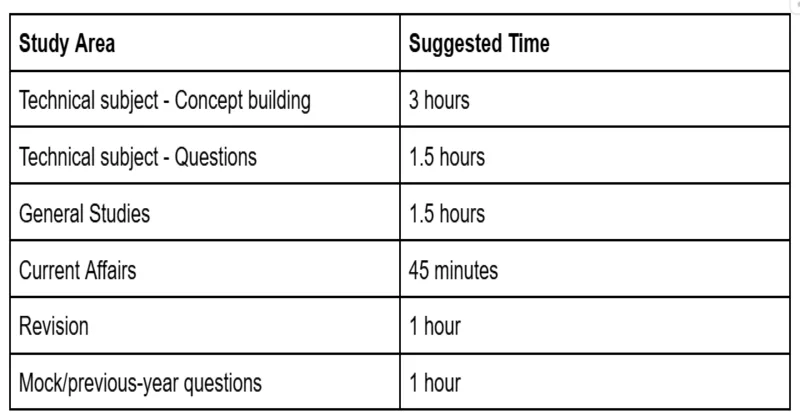 The timetable can be changed according to academic background and strengths. The important point is to maintain consistency rather than follow an unrealistic schedule for a few days.
UPSC Geo-Scientist 2027 preparation timeline
September-October 2026: Build the base
Complete the syllabus analysis and begin studying the core concepts of the technical subject. Start General Studies preparation alongside it.
November-December 2026: Complete the syllabus
The target should be to finish the first reading of the syllabus and begin intensive question practice. Previous years’ papers should become a regular part of preparation.
December 2026-January 2027: Revision and mock tests
Focus on revision, full-length tests and error analysis. Avoid starting large new topics during the final days unless they are particularly important.
Final 10-15 Days: Revise, don’t experiment
The final stage should focus on short notes, formulas, important concepts, previous mistakes and mock-test analysis. Candidates should avoid changing their entire study strategy at this stage.
How to prepare for UPSC Geo-Scientist 2027 from zero?
Candidates starting from scratch should first understand that completing the syllabus in one go is not the objective. Preparation should happen in cycles.
- First cycle: Understand the concepts
- Second cycle: Solve questions and identify weak areas
- Third cycle: Revise and improve speed
- Final cycle: Attempt mocks and focus on accuracy; don’t start new topics
This approach makes preparation more manageable and prevents candidates from feeling overwhelmed by the size of the syllabus. With the examination date already announced, use the available preparation window to build concepts first and then shift towards intensive revision and mock-test practice.