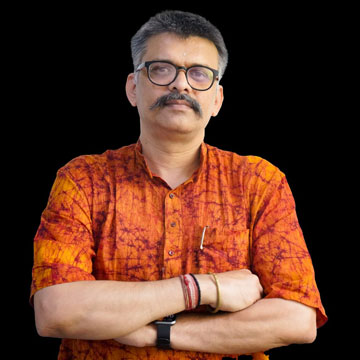
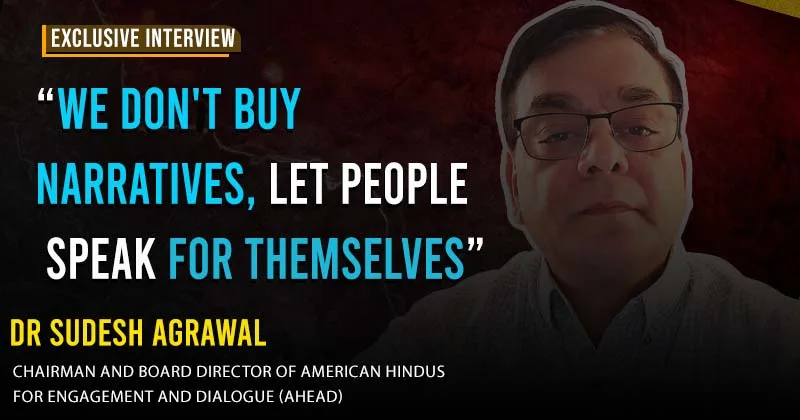
In conversation with Organiser Editor Prafulla Ketkar, Dr Sudesh Agrawal, Chairman and Board Director of American Hindus for Engagement and Dialogue (AHEAD), explains why the organisation wanted Hindus to engage directly with mainstream America, why Dr Bhagwat was invited, how Raksha Bandhan was transformed into a symbol of universal fraternity, and why the Janmabhoomi-Karmabhoomi message
particularly resonated with the Indian diaspora. Excerpts:
What exactly is AHEAD, and what was the thinking behind creating such a platform?
AHEAD stands for American Hindus for Engagement and Dialogue. It is comparatively new as a registered organisation, but the idea behind it is much older. The objective is to create a table for dialogue – a platform where different faiths and communities in America can come together, exchange ideas, understand one another’s cultures and civilisations, and where Hindus can speak for themselves. In America, you find Bharat-origin physicians, scientists, businessmen, CEOs and professionals making significant contributions. Yet the understanding of Bharat and Hindus remains limited and often distorted. I also take American students, professors and staff to Bharat through an Bharat study programme. Through my interactions with them, I have seen enormous curiosity about Bharat, particularly as India has risen over the past 15-20 years. AHEAD is trying to bridge that knowledge gap, to help people understand Bharat, Hindus, their civilisation and their contribution.
An event of this scale must have required enormous preparation. How was it put together?
We began serious preparations around January. More than 550 volunteers became involved, including around 250 young students from 23 universities across the United States. We also reached out to hundreds of civic, cultural and community organisations. The response became so overwhelming that, on the morning of the event, I literally stopped counting the letters of support coming in.
We had a 17-member steering committee and a 14-member reception committee comprising community leaders, civic leaders, business leaders and professors.
The event happened because of this collective effort.
Why did you decide to invite RSS Sarsanghchalak Dr Mohan Bhagwat as a keynote speaker, knowing his presence would attract controversy?
We discussed this several times before deciding on the speakers. Universal Oneness was conceived as a non-political and non-partisan cultural and civic dialogue. We had representatives of 17 faith groups from 29 countries. So we asked ourselves: who is actually demonstrating the idea of universal oneness on the ground, rather than merely speaking about it?
We looked at Dr Mohan Bhagwat’s dialogue—to different generations, tribal communities, Christians, Muslim leaders, Buddhists, Jains, Sikhs, women and different sections of society. Our conclusion was that here was someone not merely talking about dialogue but actually walking on the path of universal oneness.
We knew there were controversies and perceptions surrounding the RSS. But we believed Dr Bhagwat should be given the opportunity to share his thoughts directly.
Were you prepared for the criticism and protests that followed?
Yes. We knew there were narratives surrounding the RSS in sections of American academia and media, so we expected questions and controversy. But AHEAD’s approach is simple: we do not want to judge organisations on somebody else’s narrative. We want to hear from the horse’s mouth. That principle does not apply only to the RSS. It applies equally to Muslim groups, Christian groups or anyone else. Bring people together, allow them to explain themselves, and let the public decide what is true and fair. We were clear that AHEAD is non-political. We are not agents of any political party, organisation or leader. Despite the controversy, around 5,600 people attended from 853 cities and 39 US States. People of different faiths came together. Madison Square Garden was literally dancing that day.
Bringing together Bharatiya communities divided by language, region and organisational identities is itself difficult. How did you manage it?
The appeal of the programme transcended those divisions. It was not about language, State, business community, minority or majority, or economic status. It was about Hindus and the need to address misconceptions about them. Our message was: this is a Hindu platform, and Hindus are proposing a dialogue. We want to demystify Hindus and show mainstream America who Hindus are, what their thoughts are and what they contribute. That appeal brought different linguistic, regional and economic groups together. Our team contacted Telugu groups, BAPS, ISKCON, Marathi organisations, Punjabi groups and many others, asking them to take the concept to their communities. We reached out across all 50 States, and
eventually participants came from 39 States and more than 850 cities.
One of the most striking images was of different faith leaders tying rakhis to each other. How did Rakhi become part of this interfaith message?
Raksha Bandhan was not celebrated only inside Madison Square Garden. Our volunteers took it outside to the walkways and even towards Times Square.
They approached ordinary people who were walking, shopping or eating and explained the message of universal oneness: we stand together in times of need.
That is how we interpreted the original idea of Raksha Bandhan—the responsibility to stand with and protect one another. The response was overwhelming. Friendship bands are already familiar in America, so people could relate to the gesture. We explained that this band symbolised: “I am standing with you when you need me.”
Nobody was forced to participate. If somebody did not want it, we respected that. But the overall response was extremely positive.
Is the Universal Oneness Celebration a one-off event, or does AHEAD plan to continue this process?
This is just the beginning. We have started our journey. The first achievement was creating awareness and establishing a Hindu platform capable of bringing different faiths together. The faith leaders themselves told us that this should not end with one event. We are now discussing several possibilities and will announce them after detailed deliberations within AHEAD. So this is certainly not the end. We are going forward with the AHEAD agenda.
How do you ensure that the declaration does not remain merely another resolution but becomes an action programme?
That concern was expressed by many faith leaders themselves. I also asked myself whether the action plan will work. But after listening to Dr Bhagwat and the different faith leaders, I am confident.
Even if all 182 leaders do not participate, imagine if half of them come together. We can develop programmes for youth, work for the destitute or celebrate at least one programme or festival together. Suggestions are already coming from faith leaders, and we are charting them out.
One faith leader has already offered his venue for the next gathering. He told us, “Next is mine; let’s come there.” For me, that was a very joyful moment because it showed that people are taking this seriously. We should not try to leap forward. Let us take baby steps—one problem at a time. First, let people become comfortable with each other. Let us come together and then move forward. This event was the first step: we came together under one umbrella. Now, let us walk from here.