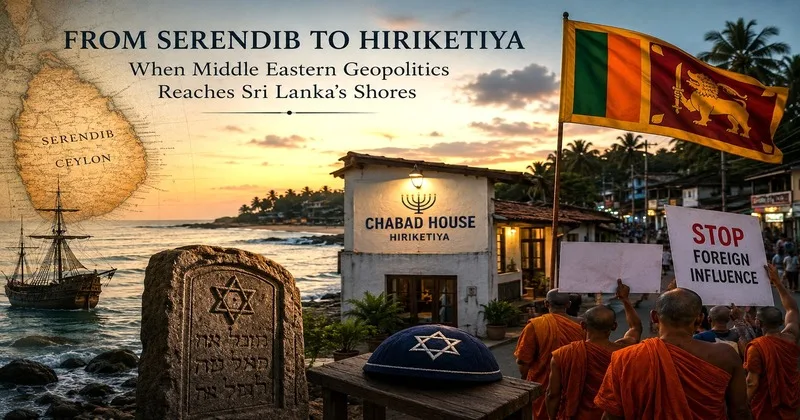
The stones and firecrackers reportedly hurled at a newly opened Chabad House in Hiriketiya, on Sri Lanka’s southern coast, have exposed an uncomfortable paradox. A country with a long history of religious pluralism and centuries-old links with Jewish traders is now witnessing a confrontation involving Jewish travellers, Israeli tourists, Buddhist monks and local residents.
The immediate controversy is being presented through competing narratives. Some residents and protesters have questioned the legality of the new establishment, its impact on local tourism and the growing Israeli presence in Hiriketiya. Chabad representatives, meanwhile, have described threats, harassment and violence, alleging that antisemitism is driving the protests. Sri Lankan authorities now face the task of determining where legitimate local grievances end and religious or ethnic intimidation begins. But the episode cannot be understood solely through the lens of contemporary Israel-Gaza politics. Sri Lanka’s Jewish history is much older.
Jews and Serendib: An Indian Ocean connection
Sri Lanka—ancient Serendib—has been part of the maritime trading world connecting the Arabian Peninsula, the Persian Gulf, the Malabar Coast and Southeast Asia for centuries. Jewish merchants participated in these commercial networks.
The Jewish Virtual Library, drawing upon Encyclopaedia Judaica, traces references to Jews in Sri Lanka to at least the ninth century. The Muslim traveller Abu Za’id al-Hasan Sirafi referred to Jews on the island, while the twelfth-century geographer al-Idrisi reportedly mentioned Jews among members of a council appointed by the Sri Lankan king.
There are also traditions linking Galle with the biblical Tarshish, the distant trading destination associated with King Solomon. That identification, however, remains a tradition rather than established historical fact and should be treated accordingly.
The medieval Jewish traveller Benjamin of Tudela is also associated with a reference to Jews in Sri Lanka. But the often-repeated figure of 3,000 should not be treated as definitive: the surviving passage is obscure and may refer to either 3,000 or 23,000.
What can be said with greater confidence is that Jewish-Sri Lankan connections formed part of the wider Indian Ocean commercial system long before the emergence of modern nationalism. That history matters today.
From a community to a historical footprint
The distinct Jewish community in Ceylon subsequently diminished. Portuguese rule in the sixteenth century brought restrictions upon Jews, while some are believed to have migrated towards the established Jewish communities of Cochin in India. Conditions improved under Dutch rule, when Jewish religious practice became more secure. The Commonwealth Jewish Council records that synagogues were established in Colombo and Jaffna during this period.
By the British period, however, the Jewish population remained extremely small. The 1911 Census of Ceylon recorded only eight Jews. This is particularly striking when compared with the much more substantial Jewish communities in neighbouring India.
Yet demographic size does not necessarily determine historical significance. Jewish individuals left a disproportionate imprint on aspects of Ceylon’s public, intellectual and economic life. Sir Sidney Abrahams served as Chief Justice of Ceylon. Leonard Woolf served in the Ceylon Civil Service between 1904 and 1911 before becoming an influential writer and political thinker. The German-Jewish poet Anne Ranasinghe, a Holocaust survivor, later made Sri Lanka her home and wrote extensively about both the Holocaust and her adopted country.
Perhaps the most intriguing economic connection concerns Maurice Benedict de Worms. In 1841, de Worms and his brother Gabriel acquired a large estate in Ceylon that became known as the Rothschild Estate. Historical sources associate de Worms with the introduction of tea seedlings from China and with the development of plantation agriculture in the island.
The Jewish contribution to Sri Lanka was therefore never simply a religious story. It was also a story of commerce, agriculture, administration, literature and intellectual life.
A historical irony: antisemitism without a large Jewish population
Sri Lanka’s Jewish history contains another important and less comfortable dimension. Historian Shamara Wettimuny’s research in Modern Asian Studies shows that antisemitic language circulated in colonial Ceylon even though the island did not possess a significant Jewish population. During the late nineteenth and early twentieth centuries, sections of Sinhalese society and colonial actors used stereotypes associated with Jews to describe the island’s Muslim Moor community. This is historically significant. It demonstrates that antisemitism does not necessarily require sustained direct interaction with Jewish communities. Ideas, stereotypes and prejudices can travel across borders through literature, imperial networks, political rhetoric and popular culture.
In other words, hostility towards Jews can exist even where Jews themselves are scarcely present.
That historical insight makes the events at Hiriketiya particularly worthy of attention.
Hiriketiya: local grievance or imported geopolitics?
The newly established Chabad House in Hiriketiya opened as part of a broader network serving Jewish travellers in Sri Lanka. Chabad describes its centres as providing Jewish travellers with religious and community services, including Shabbat meals, prayer facilities, kosher food and other forms of assistance. Its Sri Lankan network now includes centres in Colombo, Ella, Arugam Bay, Weligama and Hiriketiya. The Hiriketiya controversy, however, did not emerge in isolation.
Israeli tourism has become increasingly visible in Sri Lanka’s surfing destinations. Some local residents have raised concerns about the behaviour of Israeli tourists, the effect of foreign businesses on local communities and allegations that some establishments may not comply with local regulations. These are legitimate questions for any sovereign country.
A foreign-owned establishment should comply with Sri Lankan law. A local community has every right to ask whether planning, licensing and commercial regulations are being followed. The state should investigate such claims impartially. But the method of protest matters just as much as the grievance.
Reports from August 14–16 describe demonstrations outside the Hiriketiya Chabad House, with stones and firecrackers reportedly thrown towards the premises and Jewish or Israeli visitors allegedly threatened or prevented from reaching the centre. Chabad representatives have characterised the incidents as antisemitic and claimed that the demonstrations were organised and financed. Those latter allegations require independent investigation and should not simply be treated as established fact.
The appropriate question, therefore, is not whether every protester is antisemitic.
It is whether legitimate objections to foreign tourism or regulatory compliance are being transformed into collective hostility towards Jews and Israelis.
That distinction is crucial.
Criticism of Israel is not hostility towards Jews
The Israel-Gaza war has generated intense global political mobilisation. Sri Lankans, like people elsewhere, are entitled to criticise Israeli government policy, military operations or the conduct of the war. But political criticism has limits when it becomes collective punishment. A Jewish traveller is not the Israeli government. A rabbi is not the Israeli Defence Forces. A kosher restaurant is not a military installation. A synagogue or Chabad House is not an embassy.
And an Israeli tourist cannot reasonably be treated as personally responsible for every action of the government of Israel. This is the fundamental distinction between anti-Israel political criticism and antisemitism.
The two are not synonymous. But when Jewish identity itself becomes the target of intimidation because of events in the Middle East, political disagreement has crossed into religious prejudice.
Sri Lanka’s Buddhist heritage and the question of pluralism
The involvement of Buddhist monks makes the episode especially consequential. Sri Lanka is overwhelmingly shaped by Theravada Buddhist civilisation. Its religious identity is central to its national consciousness. But Sri Lanka’s history is also one of interaction—with Hinduism, Islam, Christianity and smaller religious communities.
No serious assessment should generalise the actions of a group of monks or protesters to Sri Lankan Buddhism as a whole. Indeed, Chabad representatives themselves have stressed that many local residents remain welcoming.
The deeper question is whether religious majorities can protect the rights of small minorities and foreign religious visitors while simultaneously defending the legitimate interests of local communities. That is not a Western question. It is a test of democratic maturity.
What Sri Lanka can learn from India
The comparison with India is instructive. The Indian subcontinent has one of the world’s longest histories of Jewish settlement. Jewish communities in Kerala, Maharashtra and elsewhere developed enduring relationships with their surrounding societies. They retained their religious identity while becoming part of the social, economic and cultural fabric of the places in which they lived.
Sri Lanka’s own history fits into this larger Indian Ocean pattern. The lesson is not that Sri Lanka must imitate India. It is that the Indian Ocean has historically been a space of coexistence and exchange rather than rigid religious separation.
The Jewish presence in this region was not created by the State of Israel. It predates Israel by centuries.
That historical fact should be remembered when contemporary politics threatens to reduce every Jew to a representative of the Israeli state.
The strategic and diplomatic stakes
For Colombo, this is also a foreign-policy issue. Sri Lanka depends heavily on tourism for economic recovery. Its attractiveness rests partly on the perception that the island is hospitable to international visitors. If foreign tourists begin to believe that their nationality, religion or political identity can expose them to intimidation, Sri Lanka’s tourism brand could suffer.
Israelis are only one category of foreign visitors. The larger question is whether Sri Lanka can guarantee security to visitors whose identity has become politically controversial elsewhere.
The government’s response therefore needs to be even-handed. Investigate the allegations concerning permits and local regulations. Investigate the reports of threats and violence. Protect residents. Protect foreign visitors. Protect religious freedom.
And enforce the law without regard to whether the complainant is Buddhist, Jewish, Israeli, Muslim, Christian or any other identity.
That is the only sustainable position for a sovereign democracy.
From Serendib to Hiriketiya
There is a powerful historical irony in the present crisis.
Jewish traders once travelled to Serendib through the great maritime networks of the Indian Ocean. Jewish individuals later contributed to Ceylon’s judiciary, agriculture, literature and intellectual life. Over time, the Jewish population became tiny, almost disappearing from the island’s public consciousness.
Now Jewish travellers are once again visible on Sri Lanka’s shores. Their presence is contemporary, but the Jewish connection is not.
Sri Lanka does not have to choose between its local communities and Jewish or Israeli visitors. Nor does it have to endorse the policies of the Israeli government in order to protect Jewish people.
It simply has to uphold one principle consistently:
The law must protect both the local community’s legitimate interests and the visitor’s right to live, worship and travel without intimidation. Hiriketiya should therefore not become a miniature battlefield for the Israel-Gaza conflict. Sri Lanka’s Jewish history offers a better alternative. From Serendib’s ancient maritime exchanges to the multicultural society of modern Sri Lanka, the island’s history has been shaped by encounter rather than isolation. The challenge before Colombo is to ensure that contemporary geopolitics does not destroy that tradition. The test is ultimately larger than Chabad House.
It is whether Sri Lanka can remain a country where disagreement is settled by law rather than by the mob—and where the politics of the Middle East do not become a licence for religious prejudice on the shores of the Indian Ocean.