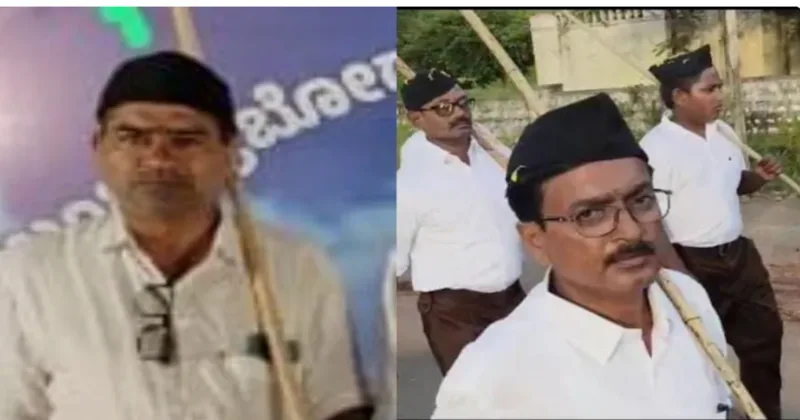
The attempt to mechanically place the Rashtriya Swayamsevak Sangh in the same bracket as a political party has met with a significant judicial check in Karnataka. The Karnataka State Administrative Tribunal (KSAT), Kalaburagi Bench, has stayed the suspension of a government school teacher who was proceeded against for participating in an RSS programme.
In Gururaj v. State of Karnataka, (Application No. 20425 of 2026), a Bench comprising Judicial Member S.Y. Watawati and Administrative Member Dr Amita Prasad was considering the case of Gururaj, an Assistant Teacher at Government Girls High School, Hunasagi. The State had suspended him on August 20, 2026, pending enquiry for participating in activities of the RSS.
There was no dispute that Gururaj had attended the programme. Significantly, the event had taken place on October 12, 2025 — a Sunday. His contention was simple: participation in a programme organised by the RSS could not by itself be treated as participation in the activity of a political party.
The Tribunal examined Rule 5 of the Karnataka Civil Services (Conduct) Rules, 2021. It prohibits a government servant from being a member of, or otherwise associating with, a political party or an organisation which takes part in politics, and from participating in or assisting a political movement or activity.
It is here that the order assumes wider significance.
The Tribunal recorded that Gururaj had participated in an event organised by a non-political association and held that his act did not violate Rule 5. It further noted that the Karnataka Government had issued no specific order or notification prohibiting government officials from participating in such an event.
There is a larger national context to this question.
In July 2024, the Union Government removed the decades-old restriction on Central Government employees taking part in RSS activities. The restriction traced its origin to November 1966, during Indira Gandhi’s tenure. Akashvani reported at the time that the Ministry of Personnel had withdrawn it after 58 years. It also noted that States including Haryana, Himachal Pradesh, Madhya Pradesh and Chhattisgarh had already removed restrictions concerning government employees’ association with the RSS.
The Karnataka case, of course, turns on Karnataka’s own Conduct Rules and not on the Central Government’s decision. But the broader trajectory is unmistakable: the old habit of treating participation in Sangh activities as though it were synonymous with party politics is increasingly being subjected to legal and administrative scrutiny.
For a century, the Sangh has worked through shakhas, sewa, samajik samarasta, character-building and Rashtra Nirman. Swayamsevaks may individually enter politics, administration, academia, the armed forces or countless other spheres of national life. That cannot, by itself, transform every Sangh activity into party-political activity.
The suspension order also relied upon Rule 7 of the Conduct Rules. The Tribunal noted that the provision referred to by the authorities had already been omitted.
Finding that Gururaj had made out a prima facie case, the Tribunal stayed the suspension until the next date of hearing. The application remains pending, and the order is therefore interim rather than a final adjudication.
Yet, the immediate principle emerging from the order is clear: the State cannot simply label participation in a Sangh programme as political activity when the governing service rule does not support such an assumption and no specific governmental prohibition exists.
For an organisation entering its centenary after generations of work in Bharatiya society, that distinction is both legally elementary and historically significant.