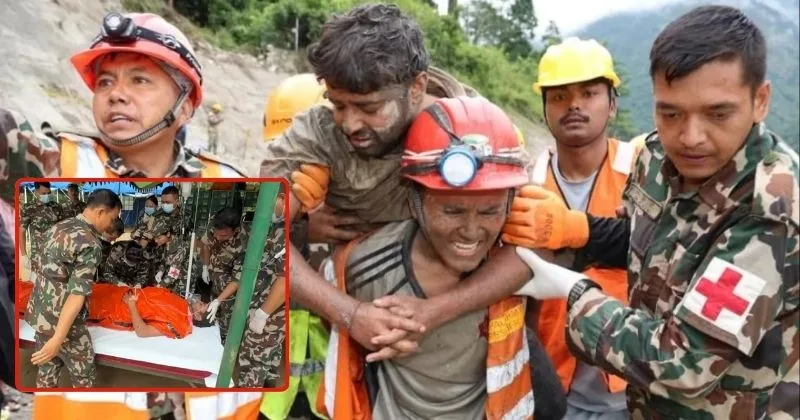
Kathmandu (Nepal): As an almost miraculous rescue of two trapped workers at a collapsed power station tunnel in Nepal emerged, netizens are equally stunned by the near divine angle to the event. Trapped inside the Trishuli 3A hydropower tunnel after Nepal’s catastrophic floods, Sanjay Sah says the Hare Krishna Mahamantra kept his faith alive. Sah and fellow worker Kabir Maharjan were rescued on Krishna Janmashtami, as search teams continue looking for others missing in the disaster.
Sanjay Sah, a 30-year-old mechanical foreman at Nepal’s Upper Trishuli 3A hydropower project, was among two workers pulled alive from a debris-filled tunnel on Friday, after spending nine days trapped underground amid the catastrophic Himalayan floods.
Sah, who was rescued from… pic.twitter.com/PhrftRrWqG
— Mojo Story (@themojostory) September 4, 2026
For nine days, deep inside a tunnel buried under mud, rock and debris, Sanjay Sah had no way of knowing whether he would ever see daylight again.
The 30-year-old mechanical foreman was among workers caught inside the Upper Trishuli 3A Hydropower Project after a catastrophic flood and landslide tore through Nepal’s Rasuwa district on August 26.
The flood buried the entrance to the tunnel and cut off communication with the outside world.
Sah waited. And he prayed. To Lord Shri Krishna. And, according to accounts of his ordeal, he repeatedly chanted the Hare Krishna Mahamantra.
🇳🇵 A nation in mourning finally has a reason to hope.
After 10 days trapped inside a completely blocked hydropower tunnel, a survivor has been rescued alive.
On Krishna Janmashtami, Nepal received a miracle. 🙏🦚#Nepal #flood pic.twitter.com/Zh4TtzLAeJ
— MrBull (@MrBull8057) September 4, 2026
Hare Krishna Mahamantra
Hare Krishna Hare Krishna
Krishna Krishna Hare Hare
Hare Rama Hare Rama
Rama Rama Hare Hare
Then, on September 4, came the breakthrough. Rescuers reached the trapped workers and pulled Sah alive from the tunnel, approximately 170 metres inside the underground complex.
What makes his survival particularly extraordinary is not only that he endured nine days underground after one of the most destructive disasters in Nepal’s recent history.
It is the day on which he emerged. Sah was rescued on Krishna Janmashtami, the day Hindus celebrate the birth of Lord Krishna.
🚨🇳🇵 BREAKING NEWS | A Miracle in Nepal After 9 Days!
Two workers have been rescued alive after 9 days from a tunnel at the Trishuli-3A Hydropower Project. 🙏❤️
Sanjay Sah and Kabir Maharjan were trapped around 170 meters underground. After voices were heard from inside the… pic.twitter.com/Klgr0YeKDS
— Sahil chabra (@sahii199) September 4, 2026
For devotees and many social-media users, that timing has transformed an extraordinary rescue into something they are calling a Janmashtami miracle.
The question being asked repeatedly online is simple: Can this really be a coincidence?
There is no scientific way to establish that chanting the Mahamantra caused Sah to survive or caused rescuers to reach him. His rescue was the result of extraordinary work by Nepal’s military, police, engineers and technical specialists.
But Sah’s own account makes faith an inseparable part of his survival story. He stayed behind while helping his colleagues escape the imminent danger. Sah was not simply an unfortunate worker who happened to be trapped. According to his account, when the danger became apparent, he tried to help colleagues escape.
The control room, normally occupied by only a handful of workers, had between 40 and 45 people at the time, according to Reuters. Sah warned people to get out.
But the window for escape closed quickly. Water and debris surged into the project with enormous force, blocking the routes out.
Sah later explained why he had stayed behind. “I simply could not bring myself to flee alone and leave the others behind.” That decision ultimately left him trapped.
The flood had transformed the hydropower project into a maze of mud, rock, and water and together – all of those elements damaged the infrastructure.
Outside, rescuers did not even know for certain how many people were inside and how many of those trapped could still be alive now.
Inside, Sah had only darkness. And the Mahamantra. Reuters reports that Sah said he survived in darkness by reciting mantras and had only limited contact with a few others.
The rescue team heard voices
The rescue itself was extraordinarily difficult. The entrance to the tunnel had been blocked by an enormous volume of debris. Rescuers had to work out where the surviving workers might be located, how the underground passages connected and which route could be excavated without causing further collapse.
Excavators were deployed. Debris was removed. Pumps were used to deal with water. Controlled blasting was undertaken where necessary.
Satellite imagery, topographical information and engineering drawings helped rescuers understand the altered landscape.
And then came the crucial moment. Voices were heard from inside. The discovery immediately changed the operation from a recovery effort into a race to save lives.
devastating Floods In Nepal
lasted Update :
Sanjay Shah, who was rescued today after being trapped in a tunnel for 9 days, said: I was sitting inside chanting the Mahamantra, chanting Hare Krishna. #Nepal pic.twitter.com/1Du9ye5i2h— Kiran Joshi ( Follow Back 100%) Live #Ukraine (@Kiranjoshi900) September 4, 2026
After days of work, rescuers reached the two men. Sah was brought out first. Weak but conscious, he was carried from the tunnel and taken for medical treatment.
For the rescuers, it was a remarkable technical and human achievement. For Sah, it was the moment he had been praying for.
Kabir Maharjan’s family had almost lost hope
Sah was not the only man rescued. Forty-five-year-old mechanical supervisor Kabir Maharjan (also spelt as Maharajan at some places), who had also been trapped inside the tunnel, was brought out alive.
Kathmandu, Nepal: Nil Kumari Maharajan, a relative of Kabir Maharajan, says, "We are extremely happy… Thank you so much to God…" https://t.co/3scLecovp0 pic.twitter.com/ie9Ntal3cK
— IANS (@ians_india) September 4, 2026
His rescue has its own extraordinary story. For 10 days, his sister Bidya Dangol did not know whether she would see her brother again. The family had almost lost hope.
His mother continued praying for his safe return and, according to the family, refused to accept suggestions that he might not survive. Then, on Friday morning, Dangol performed puja.
She prayed specifically for her brother’s safety. After completing the puja, she sat down to have tea and checked her phone. There was the news. Her brother had been found alive.
#WATCH | Kathmandu, Nepal | The family of Kabir Maharajan, one of the people rescued from the Trishuli 3A tunnel after 10 days and admitted to a hospital, have reached the hospital to meet him.
Kabir Maharajan’s sister says, “We are very happy; we are here to meet him. We do… pic.twitter.com/fzqDD0lxE0
— ANI (@ANI) September 4, 2026
“I saw the news on my phone. I became extremely happy and immediately called my younger sister,” she said.
“I told her, ‘Maya, this has happened, right?’ She said, ‘Yes, sister.’ We were so happy. I just said, ‘Oh God, thank you a million times.’” For Maharajan’s family, the timing was deeply emotional.
His mother had prayed for his return. His sister had performed puja that morning. And then came the message that he was alive.
Maharjan was flown to Kathmandu for treatment. Reports indicate that his condition was more serious than Sah’s and that he required intensive medical care. Reuters reported that he was unable to move his limbs when rescued.
Kathmandu, Nepal: Roshni Maharajan, relative of Kabir Maharajan, says, "It was very hard to believe; I am extremely happy. I want to thank the Nepal Army very much. I want to thank them from the bottom of my heart… This is a miracle that happened due to Lord Krishna. Today is… https://t.co/3scLecovp0 pic.twitter.com/Tb1QhnTVdB
— IANS (@ians_india) September 4, 2026
The two men are now receiving treatment in Kathmandu. But there was also heartbreak
The rescue of Sah and Maharajan initially raised hopes that other workers might also still be alive inside the hydropower tunnels. Those hopes have not yet translated into further rescues.
Search teams went back into the tunnel after the two men were brought out. Nepal Army personnel, police, armed police and technical teams continued searching the damaged underground structures.
But no further survivors had been found in the subsequent search reported Friday. One worker’s body was also recovered from the tunnel.
And the operation is becoming more dangerous.
The tunnels have been destabilised by the flood, mud and debris. Sections remain hazardous, access is difficult and further movement of material can threaten rescuers themselves.
That means the successful rescue of Sah and Maharjan has not brought the wider search to an end. It has, however, demonstrated something crucial: survival underground for days was possible. That is why families of missing workers are still hoping for another miracle.
What Happened in Nepal and What Happens Next?
What the Himalayan nation has been dealt is a disaster far larger than a tunnel accident. The Trishuli 3A rescue is only one chapter in a catastrophe that has devastated large parts of Nepal.
The August 26 disaster was not a conventional monsoon flood. Scientists and geologists investigating the event say the most likely trigger was a massive glacier and ice-rock collapse near the Nepal-China border.
The collapse sent an enormous quantity of ice, rock and debris into the river system, producing a sudden and exceptionally powerful flood downstream. Reuters reported that geologists examining the event identified an ice-rock avalanche as the cause, while AP likewise described the disaster as likely triggered by a glacier collapse.
The important point is that this was a cascading natural disaster. A high-altitude glacier or ice-rock mass collapsed. That material entered the river system.
Water, ice, mud and enormous boulders were propelled downstream. The resulting surge destroyed roads, bridges, buildings and hydropower infrastructure.
In some areas, the flood reportedly rose hundreds of metres above normal levels. Reuters described entire settlements in the Trishuli valley being effectively obliterated, while hydropower installations were buried under vast quantities of debris.
About Glacier collapse
This is where scientists are being cautious. The immediate trigger can be identified more readily than the deeper causes.
Experts are examining the role of unusually high temperatures, changing ice conditions, glacier-bed warming, fresh snow accumulation and meltwater penetrating beneath ice.
The broader scientific concern is that a warming Himalayan environment can destabilise mountain systems. Glaciers retreat. Permafrost can thaw. Ice and rock that previously helped stabilise slopes can become less secure. Meltwater can accumulate in vulnerable locations.
And when an unstable mass finally collapses, the consequences can travel far beyond the original point of failure.
Scientists have therefore increasingly warned that Himalayan hazards cannot be treated independently.
A glacier collapse can trigger a landslide. A landslide can block a river. A temporary natural dam can then fail. And the resulting flood can become vastly larger than the original event.
The Nepal catastrophe is a devastating example of precisely this kind of cascading risk.
The scale of the human loss
The numbers are still being revised. The latest figures cited by Nepal’s disaster authorities put the death toll at approximately 1,287, with more than 5,000 people still missing.
AP reported at least 1,287 deaths and more than 5,000 missing in Nepal, while Reuters’ latest reporting put the toll at more than 1,294 and the missing figure above 5,600, reflecting the continuing difficulty of reconciling deaths and missing-person reports across devastated areas.
The disaster also affected neighbouring Tibet. China has reported dozens of deaths and hundreds of people missing on its side of the border.
Nepal’s National Disaster Risk Reduction and Management Authority has estimated property, housing and infrastructure losses at approximately 387.5 billion Nepalese rupees, or $2.56 billion.
At least 7,500 homes were destroyed, with around 20,000 homes expected to require rebuilding.
The first four months of recovery alone are expected to require about $52.6 million, particularly for roads, temporary shelters, drinking water and electricity restoration. Hydropower has taken a massive hit
The disaster has also exposed the vulnerability of Nepal’s hydropower ambitions. The country has invested heavily in hydropower and sees electricity generation as a major engine of economic development and an important export opportunity.
But the August 26 disaster struck directly through one of the country’s major hydropower corridors. Reuters reported that the floods wiped out approximately 10% of Nepal’s electricity generation capacity.
Around 900 people are believed to have been trapped or missing at six hydropower projects, according to Reuters. Many were construction or technical workers working underground.
At Upper Trishuli 3A, rescuers had to negotiate a particularly difficult situation because the disaster had changed the physical landscape around and inside the project.
The successful rescue of Sah and Maharjan therefore offers lessons for the entire hydropower industry. Emergency exits, communications, tunnel mapping, evacuation procedures and underground monitoring systems will all come under renewed scrutiny.
Technology is now at the heart of the rescue
One of the more remarkable aspects of the current operation is the way modern technology has been combined with traditional rescue work. More than 500 engineers and technical experts have been coordinating through a WhatsApp group, according to Reuters.
They have shared tunnel drawings, plant layouts and technical information with people physically conducting the rescue. That information is particularly valuable because many of the tunnels are inaccessible or have been dramatically altered by the flood.
Rescuers are also using satellite imagery, helicopter reconnaissance, excavation equipment, pumps and controlled blasting.
The Upper Trishuli 3A operation has effectively become an underground engineering problem as much as a conventional search-and-rescue mission.
Australia sends specialist drone operators
Australia has now added another layer of technology. Canberra has deployed a 15-member Disaster Assistance Response Team, including specialist emergency drone operators, to assist Nepal’s search.
The drones can survey large areas and operate in confined or difficult-to-access spaces, potentially giving rescue teams information without immediately exposing personnel to unstable terrain.
Australia is also sending seven disaster victim identification specialists from the Australian Federal Police. The assistance comes as Australia continues to search for its own citizens missing after the disaster. Reuters reported that 36 Australians remained missing as of September 4.
The Australian government has described the drone deployment as part of an expanded humanitarian and search-and-rescue response.
India expands humanitarian assistance
India has also significantly expanded its response. The Indian government has sent military transport aircraft carrying relief supplies to Nepal, with the assistance including emergency supplies, medicines, shelter material and equipment.
By the latest official updates, India had supplied 68.5 tonnes of humanitarian relief, while also deploying technical expertise and forensic assistance for the disaster response.
On Friday, India sent two more aircraft carrying 21.5 tonnes of relief material, further expanding the emergency assistance to Nepal. The response is particularly significant because India and Nepal share a long, highly interconnected Himalayan region where disasters can rapidly affect movement, trade, infrastructure and communities across borders.
Nepal now plans a new warning system
Perhaps the biggest lesson from the disaster is that Nepal needs to know about these events before the flood reaches populated areas. Nepal is now planning to rebuild an early-warning system along its border with China.
The proposed system will incorporate seismic sensors, cameras and satellite communications, including VSAT connectivity. The objective is to create a monitoring system that can continue functioning even when ordinary telecommunications infrastructure is destroyed.
That is crucial because one of the problems exposed by the disaster was the vulnerability of conventional communications. Reuters reported that several monitoring stations were themselves destroyed by the flood.
The new system is therefore intended not merely to detect dangerous changes but to ensure that the warning can still reach people downstream.
The next challenge: getting warning to people fast enough
There is, however, a fundamental difficulty. A glacier collapse or ice-rock avalanche can happen extremely rapidly. The resulting flood can travel downstream faster than authorities can sometimes communicate with communities.
That means Nepal needs more than a sensor. It needs an entire warning chain:
- Detection
- Analysis
- Automatic alert
- Sirens and mobile warnings
- Local evacuation
- Safe shelters
The disaster has already shown why each link matters. A sophisticated sensor that detects an event is of little use if the warning never reaches a village. Similarly, a warning that reaches a village only after the flood has arrived is not a warning at all.
Experts are therefore calling for stronger integration of glacier monitoring, river gauges, seismic systems, satellite observation, telecommunications and local evacuation planning.
The bigger Himalayan warning
The tragedy has implications far beyond Nepal. The Himalayas contain some of the world’s fastest-changing glaciers and are home to communities, roads, hydropower projects and major river systems downstream.
The August 26 disaster demonstrated how events occurring at high altitude can unleash destruction far downstream. It also showed that climate risk is not simply about rising temperatures. It is about instability.
A warming mountain environment can change the behaviour of ice, water, rock and slopes. The challenge for governments is therefore to anticipate combinations of hazards rather than preparing for each one separately.
Nepal now faces the enormous task of rebuilding homes, roads, bridges, schools and power infrastructure while simultaneously making those systems more resilient to the next disaster.
The immediate search for missing people remains the priority. And somewhere within that effort are families still waiting for a phone call like the one that changed Bidya Dangol’s life on Friday morning.
They know now that survival underground for nine days is possible. They know that rescuers can reach people buried deep inside damaged tunnels.
And they know that, sometimes, the impossible happens. For Sanjay Sah, that hope was carried through nine days of darkness by a mantra. Hare Krishna Hare Krishna, Krishna Krishna Hare Hare.
He came out alive on Janmashtami. For believers, that timing may be Krishna’s grace. For others, it may be an extraordinary coincidence. But the rescue itself has given Nepal something it desperately needs after this catastrophe: hope.