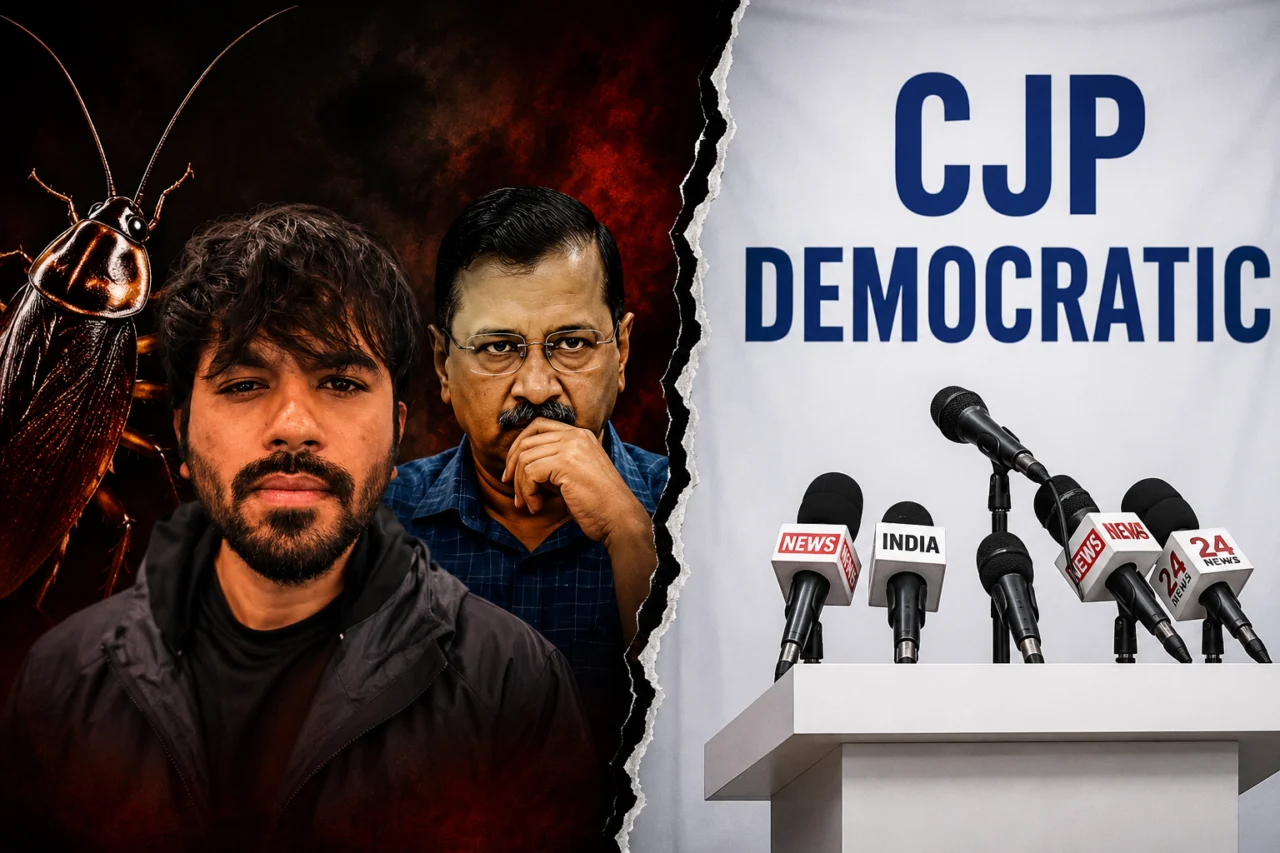
The Cockroach Janta Party (CJP) has suffered an internal split, with a faction led by Manish Brahmbhatt announcing the formation of Cockroach Janta Party-Democratic (CJP-Democratic).
The rebel faction has accused the original CJP leadership of abandoning the volunteer-driven character of the movement and turning it into a politically controlled organisation. Brahmbhatt claimed that the movement, which initially drew support from students, protesters and social-media volunteers, was later taken over by a small group operating without wider consultation.
The allegations have not been independently established, and the original CJP leadership has rejected claims that it is functioning as the “B team” of any political party.
Rebel faction accuses CJP leadership of ‘Hijacking’ movement
Announcing the split, Brahmbhatt alleged that after the CJP movement gained momentum, founder Abhijit Dipke and 11 others created a 12-member national team without consulting volunteers, protesters or people who had supported the campaign through social media platforms.
He accused the leadership of becoming a “paper mafia”, arguing that those who had participated in the movement were being excluded from important decisions.
According to Brahmbhatt, CJP-Democratic has been formed to bring together the volunteers, protesters and supporters who were involved in the movement from its early stages.
The rebel faction reportedly wants the national organisation to include representatives from across the country, with Brahmbhatt proposing five protesters or volunteers from every state.
He opposed what he described as a selection process controlled by a central “high command” or an arbitrary authority.
Brahmbhatt claimed that this proposal was rejected and that the original national team was instead constituted without adequate consultation.
Allegations of AAP influence
One of the most serious allegations made by the rebel faction concerns the alleged political influence behind the original CJP leadership.
Brahmbhatt claimed that eight members of the 12-member team were associated with the Aam Aadmi Party, while others were personal or college acquaintances of the leadership.
He also alleged that Arvind Kejriwal was attempting to take control of the nationwide movement and claimed that the CJP leadership had reached an understanding with him.
Brahmbhatt went as far as describing the organisation as “Team Kejriwal”, alleging that political considerations had begun influencing decisions within the movement.
These are allegations made by the rebel faction and have not been independently verified.
Rebels question composition of national team
Brahmbhatt also questioned the composition of the CJP’s national core team.
He claimed that the group did not include a single student and alleged that several communities and political groups that had supported the movement were not adequately represented.
According to him, there was no Muslim male representative or representative from the Sikh community, while people associated with other communities and organisations were also excluded.
He further claimed that political workers from parties including the Rashtriya Janata Dal (RJD), Samajwadi Party (SP), Shiv Sena and Nationalist Congress Party (NCP) had supported the movement but were subsequently sidelined.
Brahmbhatt alleged that some political workers had even considered leaving their respective parties to associate with the movement.
‘Kejriwal tried to hijack the movement’
The rebel faction has also directly targeted Kejriwal.
Brahmbhatt accused the former Delhi chief minister of attempting to “hijack” the nationwide movement, arguing that it had initially been driven by young protesters rather than established political parties.
He alleged that the CJP’s national leadership was following a political strategy designed around Kejriwal’s interests.
Brahmbhatt further claimed that the leadership deliberately stayed away from the student movement in Jharkhand despite travelling to other locations.
According to his allegation, this was because Kejriwal had advised the leadership not to travel there while political negotiations were taking place with opposition and ruling parties in states where the BJP was not in power.
Dipke rejects ‘B team’ allegations
CJP founder Abhijit Dipke has rejected allegations that the organisation is functioning as the “B team” of either the Congress or AAP.
Responding to the competing political allegations, Dipke said that political leaders and critics had variously described the CJP as the B team of different parties.
He maintained that the organisation considers itself an independent platform representing students and their concerns.
Dipke also said the CJP would continue raising questions about the condition of government schools and the educational qualifications of political leaders.
His response comes as the internal dispute threatens to shift attention from the movement’s original issues towards its leadership, political affiliations and organisational structure.
Sonam Wangchuk had earlier flagged political ambitions
The CJP split comes after climate activist Sonam Wangchuk had earlier commented on the political ambitions of some of the movement’s founders.
Wangchuk said he believed CJP founders had political ambitions but described such ambitions as normal for people involved in public movements.
Asked about Dipke, Ashutosh Ranka and Saurav Das, Wangchuk said they were not “saints” and that it would be unrealistic to expect people leading a public movement to have no personal political aspirations.
He said there was nothing inherently wrong with movement leaders eventually entering politics, whether by joining an existing political party or establishing their own political platform.
CJP split opens new chapter
The formation of CJP-Democratic marks a significant development for a movement that had rapidly expanded from an online campaign into street protests and political mobilisation.
The split now puts the organisation’s internal functioning under scrutiny, with the rebel faction alleging political interference and the original leadership rejecting claims that it is working as an extension of an established party.
The immediate challenge for both factions will be to establish their respective credibility among the volunteers and protesters who formed the movement’s support base.
More importantly, the split could determine whether the CJP remains primarily a protest movement focused on education and examination issues or evolves into competing political organisations with different agendas.
For now, the bitter public accusations between the two camps suggest that the movement’s internal battle may be only beginning.