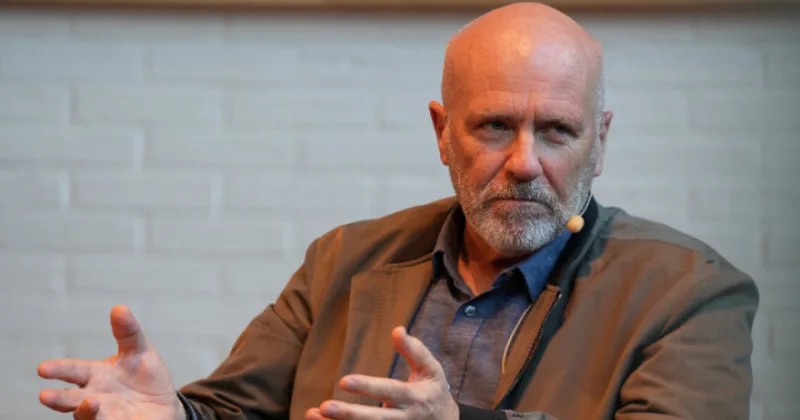
Award-winning Australian novelist Richard Flanagan has claimed that the deadly Islamist terrorist attack at Bondi Beach last year, in which Jewish Australians attending a Hanukkah celebration were targeted, was not an anti-Semitic attack. Speaking at the Festival of Dangerous Ideas in Sydney on 28 August, the leftist novelist argued that the massacre should not be portrayed as evidence of rising anti-Semitic hatred in Australia and instead accused the “Israel lobby” of politicising the tragedy.
The Bondi Beach terrorist attack, which Flanagan described as the work of two “murderous” gunmen, was inspired by the Islamic State, according to the material presented about the incident. Yet the leftist author questioned where anti-Semitism could be found in the Bondi Beach massacre. “Other than the murderous evil of the two gunmen, where was the antisemitism to be found at Bondi on that terrible day?” he asked, repeatedly answering, “Nowhere”.
Flanagan made the remarks while presenting a new essay inspired by his book Heresies. His speech focused heavily on Israel, Zionism and anti-Semitism, while portraying the response to the Bondi Beach terrorist attack as part of a wider political struggle over discussion of Israel and Gaza. The leftist novelist described claims that the Islamist terrorist attack reflected Australian anti-Semitism as a “destructive myth” constructed around the Bondi Beach massacre.
According to Flanagan, the response of Australians who rushed to assist victims demonstrated multicultural solidarity rather than anti-Semitism. He argued that people from “every creed, color, and background” came to the scene following the terrorist attack. For the leftist novelist, the response to the Islamist violence therefore represented a “refutation of antisemitism” rather than the culmination of a wider anti-Semitic wave.
Flanagan blames ‘Israel lobby’ for politicising Bondi attack
The leftist novelist went further by accusing the “Israel lobby” of using the Bondi Beach terrorist attack to silence discussion about Israel and Gaza. Flanagan claimed that the massacre had been immediately politicised and argued that attempts to describe the Islamist terrorist attack as a consequence of Australian anti-Semitism threatened freedom of speech and expression.
Flanagan questioned whether the “Israel lobby” itself could contribute to anti-Semitism by strongly supporting Israel’s war in Gaza and by, in his words, seeking to associate Australian Jewish people with Israel and the lobby’s actions. He asked whether the lobby’s own conduct could be “fueling antisemitism”, shifting attention from the Islamist terrorist perpetrators towards the political debate surrounding Israel.
Oxford educated Rhodes Scholar and Man Booker Prize winning author Richard Flanagan argues that the Bondi ISIS terrorist attack massacre of Jews was not anti-Semitism.
“Other than the two gunmen, where was the anti-Semitism on that day?”
It’s like asking: Other than the…
— Drew Pavlou 🇦🇺🇺🇸🇺🇦🇹🇼 (@DrewPavlou) August 31, 2026
He also criticised the Australian government’s response to anti-Semitism, describing Prime Minister Anthony Albanese’s government as having the “spine of a licorice stick”. Flanagan warned that attempts to implement the ambitions of Australia’s special envoy for antisemitism could, in his view, damage social cohesion and ultimately lead Australian Jews to be blamed for actions undertaken in the name of Israel.
The leftist author also argued that a number of incidents classified as anti-Semitic following the Hamas-led terrorist attack in southern Israel on October 7, 2023, should instead be regarded as legitimate protests over the situation in Gaza. He included the 2025 pro-Palestinian march across the Sydney Harbour Bridge in his argument, despite the presence at that event of some attendees waving flags supporting Al Qaeda and Islamic State, both designated terrorist organisations.
Anti-Semitism warnings contrast with novelist’s claims
Flanagan’s remarks come against the backdrop of what the material describes as a historic surge in anti-Semitic incidents across Australia following October 7, 2023. The Executive Council of Australian Jewry has documented the increase, while Australian intelligence has warned that the threat of anti-Semitism has escalated beyond harassment and intimidation towards physical attacks.
The contrast has placed the leftist novelist’s interpretation of the Bondi Beach Islamist terrorist attack within an increasingly contentious Australian debate over anti-Semitism, Israel and Gaza. While Flanagan rejected the description of the Bondi Beach massacre as an expression of Australian anti-Semitism, the attack itself involved Jewish Australians gathered for a Hanukkah celebration and has remained central to the national discussion over Islamist terrorism and anti-Semitic violence.
Flanagan also attacked the International Holocaust Remembrance Alliance working definition of anti-Semitism, arguing that it conflates criticism of Israel and criticism of Zionism with anti-Semitism. In his speech, he repeatedly compared Zionism with Nazism and other forms of extreme nationalism and authoritarianism.
He argued that Zionism emerged from the same European ethno-nationalist environment that produced Nazism, fascism and extreme nationalism, and characterised its nation-building model as one involving imperialism, conquest and violence. The leftist novelist also accused Israel and the “Israel lobby” of attempting to influence public life in Australia, alleging efforts to affect institutions ranging from public broadcasting and libraries to schools, universities, sports and medicine.
Flanagan, the first and only author to have won both the Booker and Baillie Gifford literary awards, has therefore placed the Bondi Beach terrorist attack at the centre of a broader argument about Israel, Zionism and Australian politics. His comments portray the Islamist massacre not as evidence of anti-Semitism but as an event that, in his interpretation, has been politically exploited. The controversy surrounding his remarks comes as Australia continues to grapple with the competing questions of Islamist terrorism, anti-Semitic violence, political protest and the boundaries of criticism of Israel.