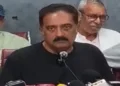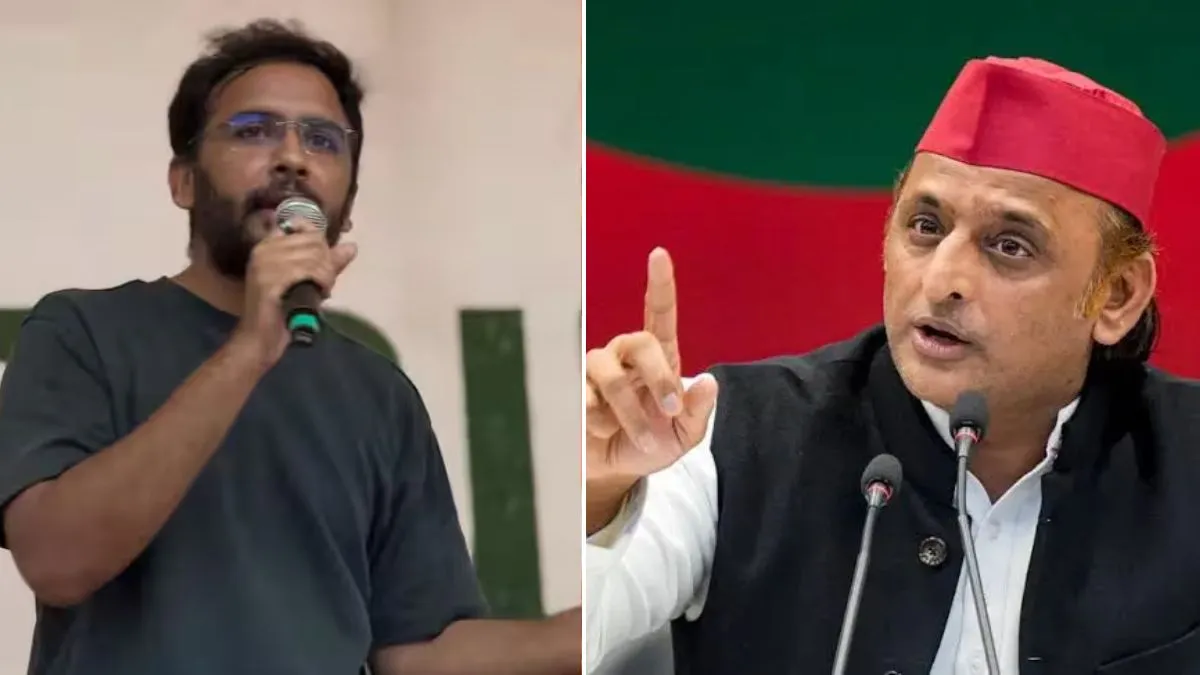
Samajwadi Party president Akhilesh Yadav met Cockroach Janta Party (CJP) national co-convener Ashutosh Ranka behind closed doors in Lucknow on September 3, in a meeting that has triggered speculation over the political calculations and possible next steps behind the interaction.
The meeting began around 4 pm at the Janeshwar Mishra Trust office near the SP headquarters and continued for approximately 90 minutes. Ranka left the premises without speaking to the media, while the SP did not publicly disclose what was discussed.
That silence is significant given the sequence of events surrounding Ranka and the CJP in recent weeks.
There has been no official announcement of an alliance between the SP and CJP, nor has either side confirmed that the meeting was about forming any political front. Yet the timing of the meeting comes after a series of high-profile protests, confrontations and campaigns associated with the CJP, making the question of what happens next particularly relevant.
Why did Ranka meet Akhilesh Yadav?
The obvious question is not simply why Akhilesh Yadav met Ranka, but why the meeting happened now.
Ranka is not a student leader, nor is he representing a student organisation. He is a political activist and national co-convener of the CJP. Akhilesh Yadav, meanwhile, is a senior politician and former Uttar Pradesh chief minister.
Their 90-minute private discussion therefore raises questions about whether the conversation was limited to education and examination issues or whether broader political and organisational matters were also on the table.
Neither side has provided a detailed account of the discussion.
The CJP has recently expanded its activities beyond protests over examination irregularities, with its members visiting government schools and challenging the functioning of education authorities in different states. The question now is whether Uttar Pradesh could become the next major arena for such activity.
From Jantar Mantar to government schools
The meeting comes after the CJP’s highly visible activities at Jantar Mantar in Delhi, including its July 20 protest over examination-related issues.
The protest witnessed clashes and disorder, with reports of violence and damage to public property during the Parliament march. The agitation subsequently intensified the political pressure surrounding then Education Minister Dharmendra Pradhan, who resigned on July 25.
Ranka later shifted his focus towards the ‘Fix the Schools’ campaign, through which he and his associates began visiting government schools and highlighting alleged shortcomings in the education system.
The campaign has since taken the group to states including Rajasthan and Maharashtra.
This raises another question: what authority, if any, does the CJP have to inspect or intervene in the functioning of government schools?
Government schools are administered by state governments and their education departments. Political parties and civil-society groups can raise concerns, conduct campaigns and document alleged deficiencies, but they do not automatically possess governmental authority to inspect schools, direct officials or enforce administrative changes.
That distinction becomes particularly important when an activist group moves from raising complaints to physically entering or attempting to assess government institutions.
Rajasthan episode adds to the questions
Ranka’s activities in Rajasthan also generated controversy.
On August 21, Ranka and members of his team visited a government primary school in Rampura Kanwarpura, Sitapura, as part of the ‘Fix the Schools’ campaign.
The visit ended in a confrontation with villagers. Ranka alleged that members of his team were attacked, their vehicles were pelted with stones and mobile phones and vehicle windows were damaged. He also alleged that a woman accompanying the team was assaulted.
Ranka blamed BJP workers for the incident.
Those allegations have been politically contested and should not be treated as independently established facts. What is undisputed from the account, however, is that the school visit became a flashpoint and subsequently drew political attention.
Akhilesh Yadav publicly reacted to the incident and criticised the Rajasthan government.
That earlier intervention now becomes relevant in light of Thursday’s private meeting.
Why is Uttar Pradesh the next question?
Uttar Pradesh is a very different political proposition from Rajasthan or Maharashtra.
It is Akhilesh Yadav’s principal political base and one of the country’s most politically consequential states. Any attempt to turn education, examination irregularities or alleged administrative failures into a sustained street campaign in UP could quickly acquire a political dimension.
Ranka had already warned the Uttar Pradesh government from Jantar Mantar that failure to stop paper leaks in the state would lead to a larger movement.
Now, weeks later, he has held a lengthy private meeting with Akhilesh Yadav in Lucknow.
The timing naturally raises the question: was the UP warning merely rhetoric, or is the groundwork now being laid for a larger campaign in the state?
There is no evidence yet to conclude that such a plan exists. But the possibility is worth watching.
Dimple Yadav’s earlier support also comes under the lens
The meeting cannot be viewed in isolation from the SP’s earlier engagement with the CJP’s protests.
During the July 20 demonstration at Jantar Mantar, Mainpuri MP Dimple Yadav and other SP MPs participated in the protest. Dimple was also seen at the forefront during the police action against protesters.
The SP’s public support for the agitation, followed by Akhilesh Yadav’s reaction to the Rajasthan incident and now a private meeting between Akhilesh and Ranka, represents a sequence that has inevitably attracted political attention.
CJP’s origins and its unusual political trajectory
The CJP itself emerged from a controversial episode involving remarks attributed to Chief Justice Suryakant during a court hearing on May 15.
Following the controversy, Abhijit Dipke launched the Cockroach Janta Party in the United States on May 16. The organisation subsequently established a social-media presence and began campaigns centred on education and examination issues.
An online petition demanding the resignation of then Education Minister Dharmendra Pradhan reportedly received more than eight lakh signatures.
The movement then moved from online mobilisation to street protests, culminating in the July 20 Parliament march and the subsequent resignation of Pradhan on July 25.
Ranka subsequently became one of the most visible faces of the organisation’s ‘Fix the Schools’ campaign.
A new political equation or a new flashpoint?
There is currently no confirmation of an SP-CJP alliance, and it would be premature to describe the meeting as proof of one.
But the sequence is difficult to overlook: a controversial street movement in Delhi, confrontations surrounding its activities, a school campaign spreading across states, political support from SP leaders, Ranka’s warnings over Uttar Pradesh and, finally, a 90-minute closed-door meeting with Akhilesh Yadav in Lucknow.
For now, both sides have chosen silence.
That leaves one central question hanging over the meeting:
After Delhi, Rajasthan and Maharashtra, is Uttar Pradesh now next on the CJP’s agenda and if so, what role could Akhilesh Yadav’s SP play in what comes next?