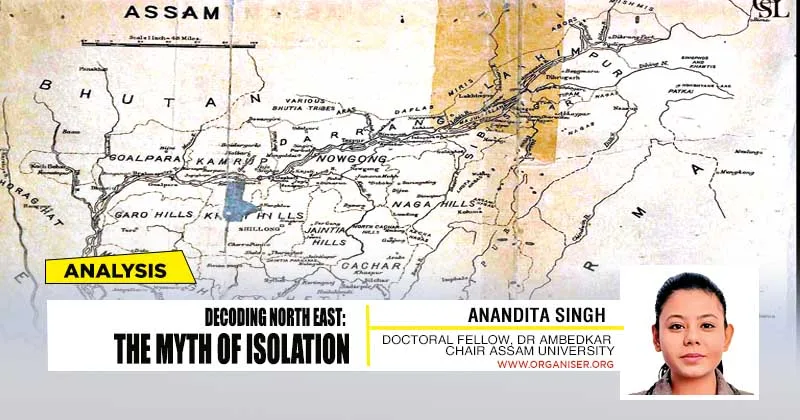
Isolation is often something we read backwards from a map. Draw a political boundary, close a corridor, rename a region as a “frontier”, and eventually it becomes easy to imagine that the people living within it must always have existed apart from the rest of the world. The history of North East India, however, tells us otherwise. Long before the borders of 1947 divided India, and the eastern frontier emerged as a seemingly separate political space; people, ideas, armies, merchants and travellers were moving through this landscape. Was the region difficult to traverse? Maybe; was it ever beyond contact? No.
Perhaps the clearest way to see this is to look at who was looking towards the region. In (302-298 BC), Greek writers had already placed communities and resources of the Eastern Region within their geographical knowledge. Megasthenes referred to communities associated with the area; Strabo noted its gold-working traditions and the great Eastern river; and Pliny described the Brahmaputra valley as part of a route through which silk travelled towards the Western world. These references matter not because every ancient writer possessed a precise map of Assam, but because they demonstrate that the heart of Jambudweep was already a part of the wider geographical and commercial knowledge nexus.
Centuries later, the Chinese travellers provide an even more revealing picture. Xuanzang did not stumble upon an unknown land. He was invited to Kamarupa by its ruler, Bhaskaravarman, in 642 CE. He found a kingdom whose people were regarded as learned and whose intellectual life attracted people from other regions. I-Tsing, writing in the same broad period, recorded the maritime connection between what is now India and China and associated its control with the rulers of Kamarupa. The significance is subtle but important: the Eastern Frontier was not merely receiving visitors; it possessed political authorities, intellectual institutions and strategic connections significant enough to be noticed beyond its immediate geography.
The more Europeans learned about the region, the more clearly its economic possibilities came into view. Thus, European interest becomes visible as knowledge production
The pattern continues through the medieval period. Persian chroniclers such as Minhaj-i-Siraj, Ghulam Hussain Salim, Al-Badaoni, Abdul Hamid Lahori and Shihab-ud-din Talish did not describe a society sealed off from the political life of the subcontinent. Their accounts bring Kamarupa, Kamata, Koch, Ahom and the Eastern Frontier into narratives of warfare, diplomacy, administration and political competition. The very fact that these chroniclers could write about the region as part of changing political circumstances is itself evidence of interaction.
Portuguese ships reached Chittagong in the sixteenth century; Later, Jesuit travellers such as Stephen Cacella and John Cabral travelled through Hajo and Pandu and onwards towards Bhutan, recording the Brahmaputra valley and its political world. French and Dutch interests followed, and figures such as Jean-Baptiste Chevalier entered this existing commercial and political landscape rather than creating it.
Discovering Assam
By the eighteenth century, the nature of this contact was becoming increasingly visible in commercial records. The East India Company found Assam accessible by both land and water and began investigating its commercial possibilities. Hugh Baillie identified lac, muga silk, black pepper and specie among the commodities available from Assam, while salt and woollen cloth moved in the other direction. George Bogle similarly noted the possibilities of trade and the availability of timber for constructing boats locally. The Europeans were therefore recognising value in an economic landscape that was already flourishing. They did not “discover” a “disconnected North East”. They entered a region that already had routes, rulers, markets and established relationships with neighbouring territories. Seen from this larger perspective, the phrase “isolated Northeast” begins to lose its meaning. The region certainly had formidable terrain, seasonal barriers and distinct political communities. But geographical difficulty is not the same as civilisational isolation.
What changed with the arrival of Europeans, therefore, was not the connectivity itself, but the nature of the connections being established.
Europeans Arrive
If the travellers of earlier centuries tell us that the Eastern Frontier was never beyond the reach of the outside world, the routes tell us how that contact actually happened. By the eighteenth century, Bengal and Assam were connected by four established routes: a river route running from Goalpara down the Brahmaputra and onward through the river systems to Calcutta and the Gangetic plains; and three overland routes through Murshidabad–Maldah–Dinajpore–Rangpur–Goalpara; Dacca–Jamalpore–Singimari–Goalpara; and Sylhet–Cherra–Nongkhlaw–Guwahati. The river journey alone could take between 25 and 35 days from Goalpara to Calcutta. These were routes shaped by terrain and the monsoon, but they were established corridors of movement. The Europeans who arrived in the region did not have to invent a way in. They entered through pathways that already existed.
The Portuguese were among the earliest Europeans to recognise the importance of these eastern gateways. Chittagong, already a major port on the Bay of Bengal, became a base for Portuguese commercial and maritime activity. From there, Portuguese soldiers, merchants and adventurers moved further into the political world of the Eastern Frontier. In Tripura, King Amar Manikya recruited Portuguese military personnel during his campaigns, and subsequent rulers granted land to Portuguese settlers, contributing to the establishment of Mariamnagar.
The Dutch presence was more indirect but equally revealing. In 1662, Dutch interests became associated with Mir Jumla II’s campaign against Assam. The campaign failed. The significance lies less in the Dutch military role itself than in what it reveals about the growing European interest in the Brahmaputra basin: European commercial and strategic competition was beginning to intersect with the political rivalries of the region.
The resources they noticed were equally telling. Van der Heiden wrote about the abundance of gold and recorded the wealth of Gargaon and the resources surrounding it. Other travellers noted cotton, ginger, areca nut, bamboo, timber, sugarcane and a remarkable variety of agricultural produce. Cacella, for instance, remarked upon the quality and abundance of fruits in Koch Behar. The same process can be seen in the growing European attention to the interior. The region’s gold, silk, timber, agricultural produce, rivers, cities, military arrangements and political structures repeatedly appear in European accounts. What began as travel and commercial contact was gradually becoming a systematic accumulation of information. These were not merely picturesque observations. They were observations of a sustained prestige economy. Jean-Baptiste Chevalier makes this shift particularly visible. Sent by the French East India Company in 1755, his mission was not simply to visit Assam but to secure land for a French factory. He travelled from Dhaka to the Ahom capital, while simultaneously gathering information about the country and the possibilities of reaching China, Tibet and neighbouring regions. James Rennell later noted that Chevalier had gathered geographical information, particularly concerning the Brahmaputra and its banks.Ports were examined, resources recorded, routes traced and political systems described. The knowledge was valuable precisely because the region was valuable. European travellers were therefore not merely leaving behind impressions of a distant land; they were gradually creating a body of practical knowledge about a region whose economic and strategic possibilities had begun to attract sustained attention.
This is why the European accounts should not be read simply as travel literature. They represent an early form of knowledge production around a region that European powers had begun to see as economically and strategically significant. And this interest itself tells us something about the region. People do not invest time, money, military expertise and intellectual effort in understanding a place they consider irrelevant. The repeated European attention to Assam and the surrounding eastern frontier was driven precisely by the opposite perception: that the region possessed resources, markets, strategic routes and political possibilities worth pursuing.
Decision making Societies
The history of early European contact with North East India reveals that the societies here were capable of making distinctions. They did not respond to every outsider in the same way. A traveller arriving with curiosity, a merchant arriving for trade, a specialist offering useful expertise and a power-seeking political influence were not necessarily treated as the same kind of presence. The same political systems that could welcome foreign travellers and participate in long-distance commerce could also completely reject an imperial force. The Ahom state’s treatment of Chevalier demonstrates precisely this distinction: he could enter the kingdom and pursue certain activities, but his ambitions to explore routes and establish a broader French presence were restricted. What emerges from these encounters is a political principle that can be expressed simply: we decide the terms of your presence. This was neither indiscriminate openness nor absolute isolation. It was political discernment-an assessment of who was entering, why they were entering, and what their presence meant for the community and the state. The distinction matters because what later colonial accounts would describe as an unwillingness to interact through the language of backwardness, isolation and barbarism was actually political autonomy. The distinction is important. A society that can determine whom it welcomes, what it adopts and when it says no is exercising agency, not demonstrating isolation.
The European presence in the eastern frontier thus began long before British political control, and it developed within a region that was already commercially active, politically organised and connected to wider worlds. What changed with the British was not the moment of “opening” an isolated region, but the gradual transformation of contact into colonial intervention. That transformation and the ways in which the British justified and pursued it-is a different story, and one that begins with understanding what was already there before they arrived. n