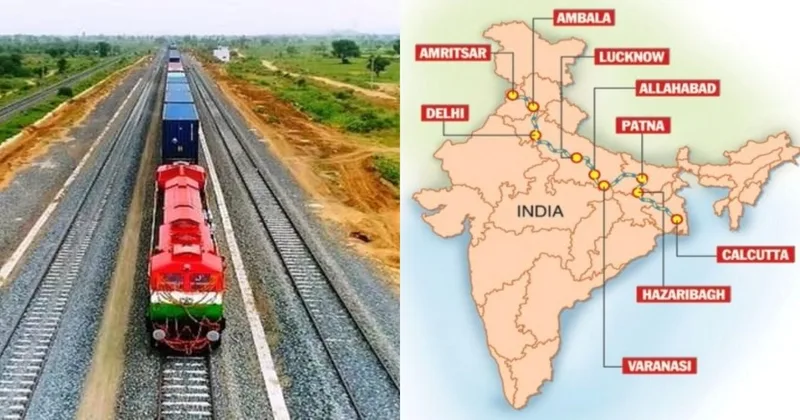
New Delhi: The Eastern Dedicated Freight Corridor (EDFC) stands as a stark example of the gap between announcing and sanctioning infrastructure and actually delivering it on the ground. Sanctioned in 2008 during the Congress-led UPA era, the ambitious 1,337-km freight corridor remained stuck for years, with zero kilometres commissioned by March 2014. After the Narendra Modi government assumed office in 2014, the project was accelerated, and the entire EDFC was completed in 2023.
Starting a New Series. Will drop Daily 1 new episode of CONgress Incompetence….Till 2029 GE.
🚨DAY 1: CONgress SANCTIONED. MODI DELIVERED.
EASTERN DEDICATED FREIGHT CORRIDOR— 1337 km
📌Sanctioned: 2008— UPA era
📌By March 2014: ZERO km commissioned
📌Modi Govt takes… pic.twitter.com/rJYvedf7lb
— BhikuMhatre (@MumbaichaDon) September 2, 2026
This is the first episode in a series examining major infrastructure projects that were sanctioned or initiated under previous governments but saw substantial execution only after the Modi government came to power.
Sanctioned in 2008, but no kilometre commissioned by 2014
The Dedicated Freight Corridor project was conceived as a transformational railway infrastructure initiative aimed at creating dedicated routes for freight traffic. The Eastern and Western Dedicated Freight Corridors together were intended to fundamentally improve India’s freight transportation network. The combined project received approval in 2008 with an initial estimated cost of Rs 28,181 crore. Yet the project struggled to move from approval to execution.
According to government data, zero kilometres of the Dedicated Freight Corridor had been commissioned by March 2014. This means that after several years since the project received approval, there was no operational stretch of the corridor for freight trains.
For the Congress-led UPA government, this became a glaring example of the difference between having an infrastructure project on the books and actually delivering it. The project existed. The plans existed. The approval existed. But the commissioned kilometres remained zero.
Then came the Modi government
The political transition in 2014 marked a major change in the pace of execution. After the Narendra Modi government assumed office, work on the Dedicated Freight Corridor was substantially accelerated. Land acquisition, construction, contracting and expenditure were pushed forward, allowing the project to move from years of limited physical progress towards actual commissioning. The contrast is particularly striking when viewed through the commissioning numbers. In March 2014, the figure was zero kilometres. By January 2023, 1,724 kilometres of the combined Eastern and Western Dedicated Freight Corridors had been commissioned. The EDFC itself, stretching approximately 1,337 kilometres from Ludhiana to Sonnagar, was completed in 2023. The project that had remained largely stuck during the UPA period had therefore become a functioning freight network under the Modi government.
From an unfinished promise to 1,337 kilometres of completed infrastructure
The EDFC is not a small railway project that could be dismissed as a routine construction exercise. It is a major piece of India’s logistics infrastructure.
The corridor runs through several important industrial and agricultural regions and is designed specifically for freight movement. By separating freight traffic from passenger routes, dedicated freight corridors can help reduce congestion on conventional railway lines while allowing freight trains to operate more efficiently.
The EDFC is particularly important for the transportation of commodities such as coal, steel, cement, food grains and fertilisers. Its completion therefore has implications beyond the railway system itself.
Faster freight movement can help improve supply chains, reduce transportation time and contribute to lower logistics costs. It can also support industrial development around freight terminals, logistics parks and other connected infrastructure. In other words, the EDFC is precisely the kind of infrastructure that can influence the broader economy. And that makes the years of delay before 2014 even more significant.
Why did the UPA leave it at zero?
The strongest criticism of the UPA’s record on the project is not that it failed to imagine the corridor. It did sanction it. The problem was execution. A government can approve a Rs 28,181-crore infrastructure project, issue announcements and prepare plans. But the value to citizens comes only when the project is physically constructed and commissioned.
By March 2014, that had not happened. The subsequent acceleration under the Modi government demonstrates that the project was not abandoned or permanently unviable. Instead, it was pushed through a much more intensive execution phase after 2014. The government later highlighted the dramatic increase in investment and construction activity after the change in government. Between 2009 and 2014, expenditure on the DFC project was considerably lower than the expenditure recorded in the years following 2014. This sharp increase in spending accompanied a corresponding acceleration in construction and commissioning. Thus, the EDFC provides a straightforward political contrast:
The cost of the project is another important part of the story, although it needs to be presented accurately. The original Rs 28,181 crore estimate in 2008 covered the combined Eastern and Western Dedicated Freight Corridors, not the EDFC alone.
Over the years, the estimated cost of the overall DFC project increased substantially. The government cited several factors behind the escalation, including higher land-acquisition costs, construction-cost escalation, changes in scope and specifications, interest during construction and taxes. The EDFC alone was eventually completed at a reported cost of around Rs 51,000 crore. This means the eventual cost of the EDFC by itself was substantially higher than the original estimate for the combined EDFC and WDFC project.
What India lost through years of delay
Infrastructure delays have consequences. When a major freight project remains incomplete, the country continues to depend heavily on existing railway routes for freight movement. Those routes simultaneously carry passenger traffic, creating congestion and limiting the efficiency of both passenger and freight operations.
A dedicated freight corridor can change that equation. The EDFC allows freight traffic to move on dedicated infrastructure, freeing capacity on existing routes and improving the overall efficiency of the railway network.
The corridor can also support the development of new logistics infrastructure and industrial activity along its route. Therefore, the years during which the project remained stuck were not merely years lost on a government file. They represented years in which the economic benefits associated with the completed corridor could not be fully realised. This is why infrastructure execution matters.
Modi government’s infrastructure push
The EDFC became part of a broader infrastructure push under the Modi government, which placed greater emphasis on large-scale railway, highway, port, airport and logistics projects. The Dedicated Freight Corridor was one of the flagship projects in this effort.
Instead of allowing the earlier delays to permanently stall the project, the government pushed ahead with construction and commissioning in phases. By 2023, the result was visible on the ground: 1,337 kilometres of the Eastern Dedicated Freight Corridor had been completed.
A project that had been sanctioned in 2008 and had zero commissioned kilometres by March 2014 had become a functioning freight corridor less than a decade after the change in government. That is the central contrast.
The EDFC story can therefore be understood through four dates:
2008: Eastern and Western Dedicated Freight Corridor project sanctioned under the Congress-led UPA government.
March 2014: Zero kilometres of the DFC commissioned.
2014: Narendra Modi government assumes office and accelerates execution.
2023: Entire 1,337-km Eastern Dedicated Freight Corridor completed.
The difference between these milestones is what makes the project politically significant. The UPA government deserves credit for sanctioning the project, but sanction alone does not constitute infrastructure delivery. The Modi government, meanwhile, inherited a project with years of delay and moved it through construction and commissioning to completion.
The Eastern Dedicated Freight Corridor has consequently become more than a railway project. It is a case study in India’s infrastructure transition, from projects that remained trapped in prolonged delays to projects that were pushed through to physical completion.