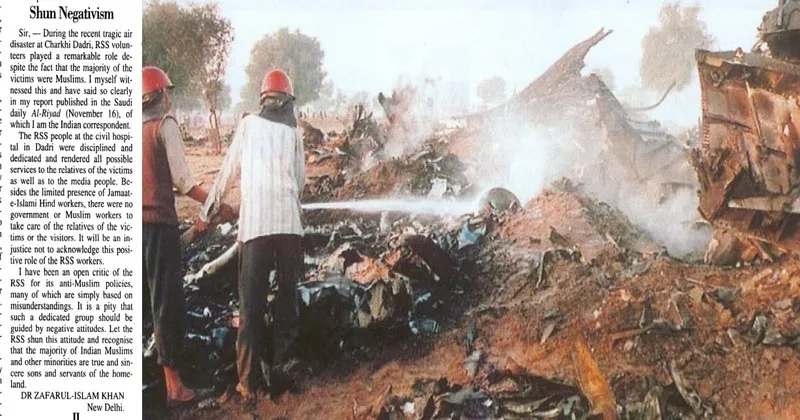
Charkhi Dadri: On November 12, 1996, Charkhi Dadri in Haryana became the site of one of the most horrific aviation disasters in history. Two international aircraft collided in mid-air, leaving 349 passengers and crew members dead. Saudi Arabian Airlines Flight 763, a Boeing 747 travelling from Delhi to Jeddah, and Kazakhstan Airlines Flight 1907, an Ilyushin Il-76 travelling towards Delhi, collided over the area, scattering wreckage and human remains across the fields near Charkhi Dadri.
The enormity of the tragedy presented an immediate challenge to the local administration. The disaster occurred at night, the wreckage was spread over a large area and the condition of the remains made identification and transportation exceptionally difficult. In these circumstances, RSS swayamsevaks and volunteers associated with various RSS-inspired organisations reached the site and began relief and assistance work.
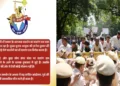
RSS swayamsevaks were among the first to reach the crash site. Under the leadership of Seva Bharati worker Jeetram Ji, arrangements were made for Petromax lights, generators, water and other basic requirements so that relief work could continue after darkness fell.
The Sangh Parivar, including RSS, Bajrang Dal, Vishwa Hindu Parishad and Bharat Vikas Parishad, was among the first to voluntarily offer services to the district administration, which was struggling to respond to the scale of the mid-air collision.
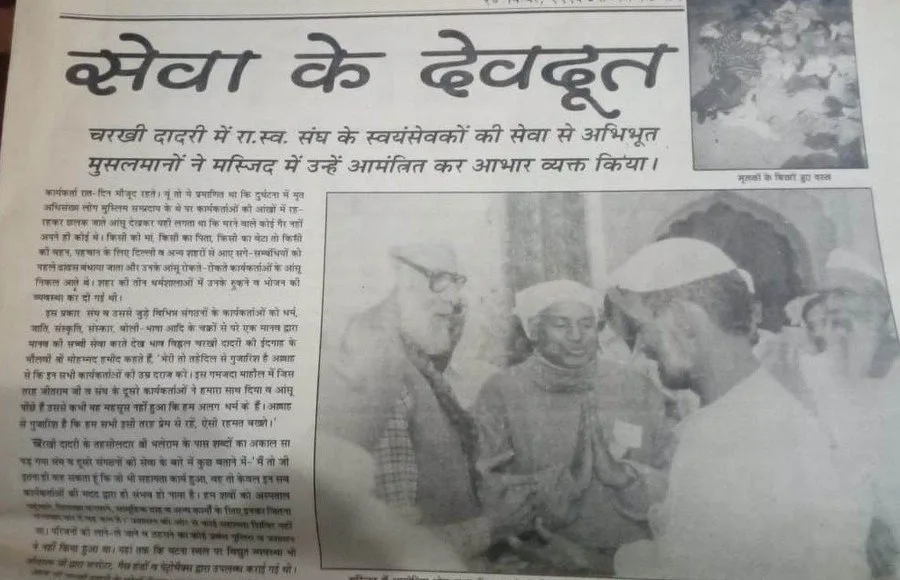
The first and perhaps most difficult task was the collection and transportation of the bodies and human remains. Villagers provided tractors, while swayamsevaks gathered the remains scattered across the crash site and transported them to the post-mortem facilities. They also assisted with the systematic arrangement and identification of the deceased.
The significance of this service becomes particularly striking because a majority of the passengers on Saudi Arabian Airlines Flight 763 were Muslim Haj pilgrims.
The work was not limited to transporting the dead. With the bodies exposed to the elements and identification becoming increasingly difficult, efforts were made to preserve the remains. Large slabs of ice were reportedly brought from Bhiwani, Jhajjar and Rewari so that the bodies could be kept safely until relatives arrived for identification. Local RSS swayamsevaks also collected the remains so that grieving families could identify their loved ones.
For the swayamsevaks involved, this was not merely an exercise in disaster management. It was an act of human service in which the identity of the victim did not become a barrier to assistance.
Since many victims were Muslim Haj pilgrims, arrangements were made for their burial according to Islamic rites. The material records that 76 bodies were buried under the supervision of a local maulvi, while Hindu victims were accorded cremation according to their traditions. Bharat Vikas Parishad, described also helped arrange the services of a local maulvi so that families wishing to perform religious rites according to their faith could do so.
RSS and its inspired organisation volunteers helped provide food, tea, water, shelter and lighting to the relatives of the victims arrived in Charkhi Dadri from Delhi and other places, often facing uncertainty and trauma while searching for their loved ones.
They assisted elderly people, women and children and helped families navigate the difficult process of identifying the remains. The volunteers also worked alongside the local administration and police, assisting with crowd management and maintaining coordination as relatives, journalists and officials arrived at the site and hospital.
A Saudi journalist wrote that RSS workers at the civil hospital in Dadri were disciplined and dedicated and provided assistance to relatives of the victims as well as members of the media. The journalist explicitly acknowledged that he had been a critic of the RSS but said that failing to recognise the organisation’s positive role in Charkhi Dadri would be unjust.
The response also drew appreciation from members of the Muslim community. One account records the words of Mohammad Hamid, who expressed gratitude for the support extended by Sangh swayamsevaks, saying that during the grief he did not feel separated from them by religion.
This reflected the Sangh’s emphasis on seva-service rendered without discrimination and without waiting for formal instructions.
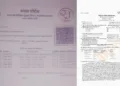
In 1997 Institute of Peace and Conflict Studies describes how RSS and Seva Bharati volunteers reached the site quickly and assisted with searching for bodies, post-mortem work, respect for religious customs and coordination with the administration.
Contemporary reports from 1996, including coverage by The New York Times, showed the huge challenge faced after the Charkhi Dadri plane crash, as families searched for and tried to identify their loved ones.
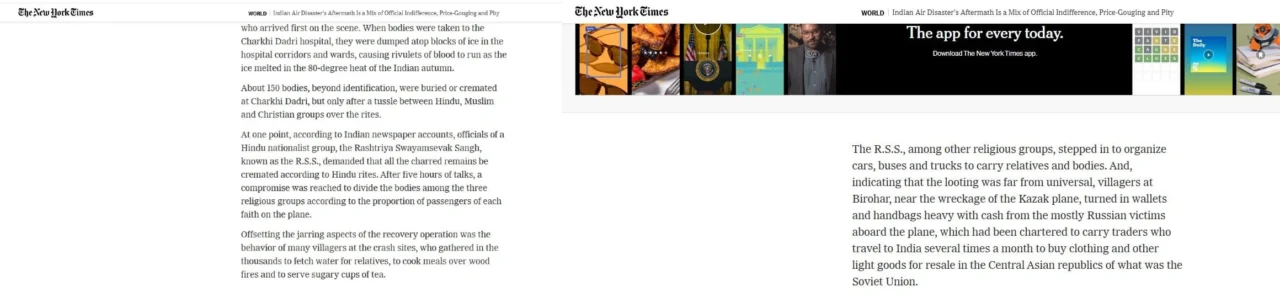
In this difficult situation, RSS swayamsevaks and volunteers came forward to help with the relief work. They assisted in collecting and transporting bodies, helping preserve the remains and supporting grieving families. They also worked with the local administration and helped provide basic assistance during the massive rescue and relief operation.