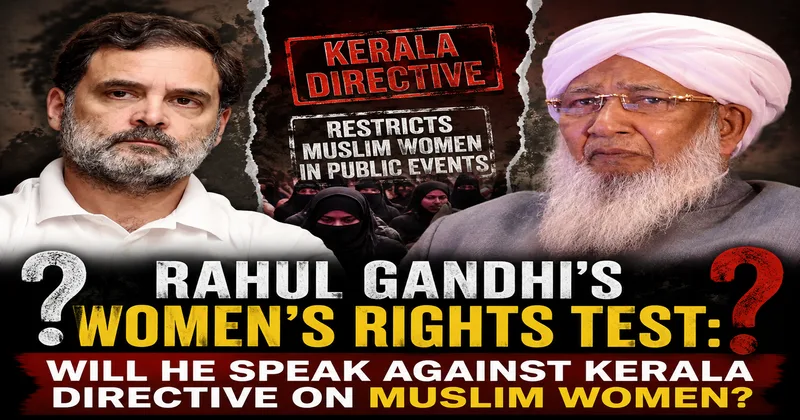
If women’s freedom is a principle of Rahul Gandhi’s politics, then why has he not raised his voice against this religious directive emerging from Keralam? The question goes beyond an organisation to the equality that the Congress repeatedly claims to champion in politics.
In fact, a religious directive that has emerged from Keralam today brings to the fore the double standard in Indian politics, in which the face of women’s freedom appears to change when it comes to Islam. The Kanthapuram faction of the Samastha Kerala Jamiyyathul Ulama has objected to Muslim women participating in public programmes, on stages and in such events where unfamiliar men are present. Heads of mosques, madrasas and Islamic institutions have been asked to ensure that Muslim women do not participate in events that are being considered contrary to Islamic norms.
Now the question is directly to Rahul Gandhi
Does the principle of women’s freedom change depending on religion? When Rahul Gandhi questions traditions or alleged patriarchal thinking in Hindu society, his voice remains outspoken. Women’s freedom, rights and equality become an important part of his political discourse, but when a religious organisation issues a public directive concerning the participation of Muslim women in public life, why is that same voice not heard?
The question is not about Muslim society, but about women’s freedom
The purpose of bringing this debate here is, let it be clear, not to turn it into a Hindu-versus-Muslim dispute. In fact, the real issue is much larger than that. The issue is: if an attempt is made to keep a woman away from public life on the basis of her religion and gender, rather than her choice, ability or civic rights, what should be the position of a democratic society?
If women face discrimination in any Hindu social system, it should be opposed. If a Muslim religious institution issues a directive restricting women’s public participation, questions should be raised about that too. This is what equality means: the yardstick must be the same. Otherwise, women’s rights will remain a tool of political convenience instead of a universal value.
Debate from Onam to Eid
The background to the controversy is also important. The debate intensified after videos emerged from the Malabar region of Keralam showing Muslim female students participating in Onam celebrations. This was followed by questions regarding the participation of Muslim women and female students in public functions and religious boundaries. This is where the conflict between modern democratic India and the social control imposed by Islamic religious extremism becomes visible.
On the one hand, the Constitution of India grants women equal civic rights. On the other hand, if a demand emerges to restrict their public presence in the name of a religious system, a natural question arises: is a woman’s civic identity smaller than her religious discipline?
The yardstick for ‘patriarchy’ must be the same
‘Patriarchy’ is an important term in Rahul Gandhi’s political discourse. Patriarchy should be identified not by its source, but by its impact. If, within any system, men decide whether a woman should appear on a public platform or not, whether she should participate in a particular function or not, or whether she should be seen in front of certain people or not, it is natural to ask: where does a woman’s own choice and independent citizenship stand?
If patriarchy is called patriarchy when it is Hindu, but religious propriety when it is Muslim, such different terminology cannot form the basis of democratic equality. If women’s empowerment is a genuine political and social commitment for him, the Congress should certainly ask its young leader Rahul Gandhi what his view is on such directives restricting the public participation of Muslim women.
Will he oppose them? If not, silence too can sometimes become an answer. True progressiveness means calling wrong wrong, whether it exists within a community that supports you or within a community that opposes you. Therefore, this incident in Keralam places an uncomfortable yet necessary question before Rahul Gandhi’s politics. If patriarchy is wrong, whose can it be?
If women’s freedom is a right, then for women of which religion is it a right? And the biggest question: will the door of the politics of ‘breaking the cage’ be open to all women, or will politics itself keep the key according to its convenience? This is the question that Rahul Gandhi, the young leader of the Congress, and the entire Congress party must answer, from Keralam to Delhi.