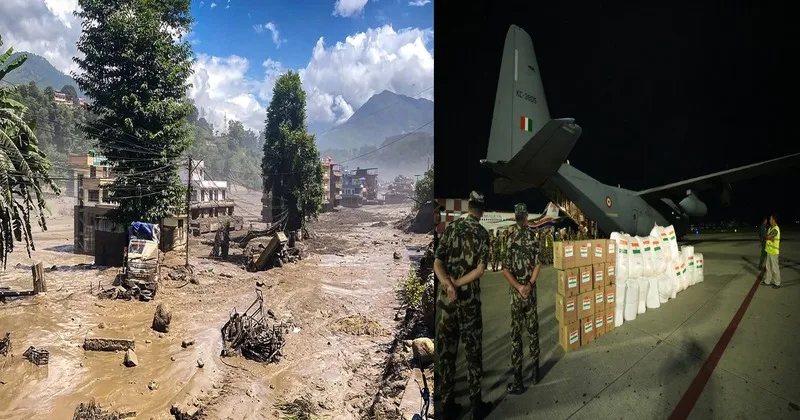
India remains the “First Responder” to any disaster relief operations in its neighbourhood. India quickly responded to the massive floods in Nepal on 26 August. Even though the weather was not very favourable, still India dispatched 10 tonnes of relief material to Nepal by IAF C-130 J aircraft late in the evening of 26 August. Since then, India has dispatched 47.5 tonnes in two flights, with the third flight loaded with relief material ready to move on orders. Though China also provided aid to Nepal on 27 August, India once again maintained the reputation of the first responder for Nepal’s humanitarian needs.
Humanitarian Assistance and Disaster Relief (HADR) is both a civilian and military term, which is used for search and rescue, airlifting or transporting relief material by road or through ships, providing medical aid, setting up temporary shelters, restoring basic connectivity after natural or man-made disasters, be it earthquake, floods, cyclone, building collapse etc. Indian Armed Forces are mandated to provide HADR within the country or abroad.
The armed forces personnel receive training for such a task and remain prepared to move for HADR at short notice. India’s Venezuela HADR was codenamed Operation Amistad (Amistad means friendship in Spanish) when India provided disaster relief to Venezuela after it was hit by two massive earthquakes on 24 June. India demonstrated that it is now a responsible first responder even beyond Indian Ocean. It was India’s farthest HADR ever, with our two IAF C-17 Globemaster flying 23 hours non-stop, travelling more than 14,000 km to South America, with relief material and personnel.
Under PM Modi, India has evolved a formal doctrine for HADR for the neighbours, built on three pillars. The first pillar obviously emanates from India’s Neighbourhood First Policy, which covers 8 immediate neighbours- Afghanistan, Bangladesh, Bhutan, Maldives, Myanmar, Nepal, Pakistan and Sri Lanka (names in alphabetical order). Even for Pakistan after 2022 floods, PM Modi offered aid but Pakistan did not accept the offer.
The second pillar is based on Security and Growth for All in the Region (SAGAR) which is now called MAHASAGAR. It defines India’s stand on human security, disaster resilience and being a net security provider in the IOR. The third pillar is based on India’s civilisational ethos of Vasudhaiva Kutumbakam-world is one family, where aid is provided to those in distress, without any preconditions. That means, India’s policy on HADR is non-transactional and India does not expect anything in return from its neighbours.
This question sometimes comes up that our neighbours do not always share the best relationship with India, even though India continues to help them every time they are in distress. It is important to understand that India follows a policy of not taking HADR from any country, including its neighbours. India under PM Modi has now assumed the status of Net Security Provider and First Responder in the region/neighbourhood. In fact, India has raised specialised disaster response force, both at the national and state level.
At the national level, we have National Disaster Response Force (NDRF) with 16 battalions (16,000 personnel). Each state has also raised State Disaster Response Force (SDRF), with varying strength of personnel. Even for the SDRF, central government provides 75% budget with state contributing just 25%. Thus, India has very high institutional capacity for disaster relief, supplemented the armed forces when necessary. For example, before any major cyclone warning, it is common for PM Modi to give a call to the CM of the affected state and take a stock of the preparations made to deal with the impending situation.
At a time when it is emerging that China failed to give advance warning to Nepal about the impending floods, the role of India in once again providing selfless humanitarian assistance as the first responder is noteworthy. Our neighbours, particularly their people would have noticed the spirit of Vasudhaiva Kutumbakam displayed by India, in each and every time of the crisis situation.
With every such HADR mission, the stature of India has grown in the region. India is rightfully recognised as a responsible power, with the well-deserved role as the leader of the Global South. India remains committed to the principles associated with Raksha Bandhan, where Bharat is tied (Bandhan) with a sense of safety and security (Raksha) for its neighbours in every disaster situation.