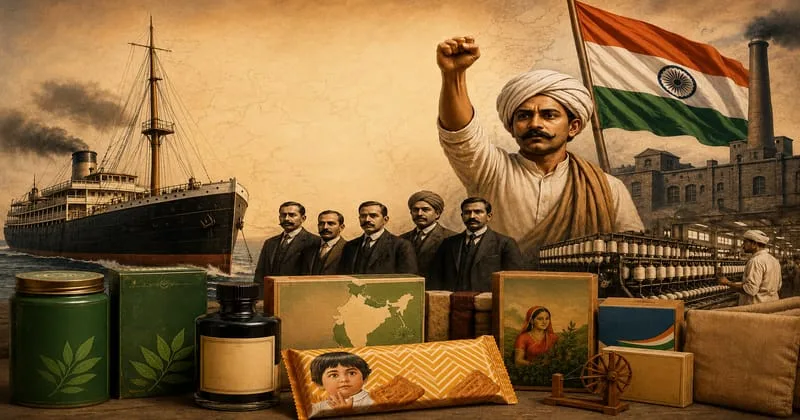
The Indian National Movement and the Swadeshi movement of 1905 were not merely political crusades led by speeches and boycott calls; they were economic uprisings grounded in self-reliance, cultural pride, and indigenous enterprise. At the heart of this revival was the conviction that political sovereignty (Swaraj) is meaningless without economic independence (Swavalamban). Grounded in the philosophy of native self-sufficiency and national dignity, visionary Indian industrialists stepped up to challenge the exploitative economic apparatus of the British Raj. They chose to build national wealth rather than submit to imperial economic hegemony.
During this era, pioneering nationalist entrepreneurs directly financed the Freedom Movement, sheltered underground freedom fighters, and created an industrial foundation capable of standing on its own feet. By manufacturing native goods-from steel, shipping, and textiles to soaps, cosmetics, and banking services-these indigenous enterprises served as vital engines of the freedom movement. They transformed Swadeshi from an ideological rallying cry into a tangible, economic force that broke the illusion of foreign superiority and reclaimed Bharat’s economic destiny.
Rooted in the ideals of Swavalamban and national pride, this report honours the top 10 indigenous enterprises that broke the chains of colonial economic hegemony. Driven by the spirit of economic nationalism, these visionary Indian pioneers built the industrial backbone of Swaraj and financed the historic struggle to reclaim Bharat’s sovereign destiny.
GD Pharmaceuticals: Healing the Nation with Swadeshi Pride
In 1929, Gour Mohan Dutta established GD Pharmaceuticals in Kolkata, turning his vision of native self-reliance into a tangible victory over foreign economic dominance. Deeply moved by the nationalist call to reject imported goods, he began manufacturing high-quality home-grown alternatives right from his residence. His iconic creation, Boroline antiseptic cream, emerged as a legendary symbol of Indian ingenuity, proving to the world that indigenous products could match and surpass foreign imports while serving the motherland with a healing touch.
Calcutta Chemical Company: Championing Native Ingredients with Margo
Inspired by the Swadeshi fervour following the partition of Bengal, Khagendra Chandra Das founded the Calcutta Chemical Company in 1916 to break the stranglehold of Western goods. Rooted in traditional Indian wisdom, he utilised neem-a time-tested native ingredient-to create Margo soap. This bold venture served as a proud declaration that Bharat’s rich heritage held the key to its own industrial and personal care needs, turning a daily essential into a household emblem of national self-respect.
Arvind Ltd.: Weaving the Fabric of Economic Sovereignty
Driven by the call for economic independence, the Lalbhai brothers-Kasthurbhai, Narottambhai, and Chimanbhai-founded Arvind Mills in Ahmedabad in 1931. Their enterprise aimed directly at dismantling foreign control over the Indian textile market by manufacturing world-class fabrics at home. Proving the superior capability of native enterprise, Arvind’s fine textiles were even exported to the UK and Switzerland by the late 1930s, demonstrating that Indian craftsmanship could assert its dominance on global soil.
Sulekha Works: Writing the Saga of Freedom in Indian Ink
Formed in 1934 by Shankaracharya and Nani Gopal Maitra, Sulekha Works arose directly from a nationalist directive to end dependence on British inks. Utilising a formula crafted by chemist Satish Chandra Dasgupta, the Maitra brothers launched ‘Krishnadhara’ and other native inks emblazoned with patriotic pride. Sulekha became a powerful weapon of self-reliance, ensuring that the words documenting Bharat’s struggle for liberation were written with purely indigenous ink.
Godrej: Molding Cultural Identity and Economic Resistance
Starting with native lock production in 1897, Ardeshir Godrej expanded into soap manufacturing in 1918 to challenge foreign monopolies that insulted Indian cultural values. In 1926, Godrej launched “Vatni” soap-named after the motherland-wrapped in green and white packaging that prominently featured the map of undivided India. Exposing foreign products for using animal fats, Godrej promoted pure, vegetable-based soaps, integrated native symbols like the lotus into its branding, and contributed a massive 30 lakh rupees to the Tilak-Swaraj Fund to directly empower the freedom cause.
Parle Products: Offering Homegrown Sustenance to the Masses
In 1929, Mohanlal Dayal Chauhan established the first Parle factory in Vile Parle, Mumbai, to counter the influx of expensive British confectionery. Armed with an unyielding spirit of self-determination and a small team, Chauhan built an enterprise that provided affordable, high-quality Indian biscuits to the public. Parle stood as a direct challenge to imperial commercial interests, eventually transforming into a beloved national institution through products like Parle-G.
Luxmi Tea: Breaking the Imperial Monopoly over Native Soil
In 1912, freedom fighter Paresh Chandra Chatterjee founded Indian Tea and Provisions (now Luxmi Tea) in Tripura to strike at the heart of the British-dominated tea cartel. At a time when Indian tea estates were systematically exploited for European gain, Chatterjee reclaimed control of the land’s bounty by cultivating and selling tea directly to Indian buyers. His vision shattered imperial control over the trade, laying the groundwork for an enduring, globally recognised Indian tea empire.
Swadeshi Steam Navigation Company: Challenging Imperial Power on the High Seas
In a daring act of economic defiance, V. O. Chidambaram Pillai launched the Swadeshi Steam Navigation Company in 1906 to break the oppressive British monopoly over maritime trade. Funded entirely by Indian capital, the company purchased two steamships, Gallia and Lowoe, to operate passenger and cargo services between Thoothukudi and Ceylon. Despite relentless colonial harassment and state-sponsored repression, Pillai’s maritime venture proved that Indian enterprise possessed the courage to challenge imperial naval hegemony directly.
Cipla: Safeguarding National Health through Indigenous Science
Founded in 1935 by Dr Khwaja Abdul Hamied, Cipla was born out of the vital need to make India fully self-reliant in lifesaving medicines. Rejecting the market dominance of European pharmaceutical cartels, Cipla manufactured affordable, high-quality native pharmaceuticals that sustained the nation through severe wartime supply shortages. Championing the spirit of Swaraj, the enterprise prominently featured the national tricolour in its campaigns, framing the adoption of Indian medicines as a vital patriotic duty.
Tata Oil Mills Company: Turning Everyday Necessities into Nationalist Action
Established in 1917 by Dorabji Tata, the Tata Oil Mills Company (TOMCO) mobilised consumer enterprise as a frontline defence against foreign economic exploitation. Through popular brands like Hamam and 501 soap, TOMCO offered superior native alternatives to British soaps like Lever’s Sunlight. Featuring imagery of traditional attire and the patriotic spinning wheel in its campaigns, TOMCO successfully linked everyday personal care to the Khadi movement, transforming simple domestic purchases into active support for Indian self-reliance.
The Swadeshi movement was not merely a political tactic, but a profound spiritual and economic awakening that laid the groundwork for Bharat’s national resurgence. By championing Swavalamban (self-reliance) and native enterprise, these visionary industrialists reclaimed the nation’s economic sovereignty from foreign domination. Their unwavering commitment to indigenous production, cultural values, and domestic capital proved that true national dignity and Swaraj can only be achieved when a nation stands firmly on its own feet.