New Delhi: Recently, in a decisive step to protect national security and curb illicit foreign influence, the Ministry of Home Affairs (MHA) notified the Foreign Contribution (Regulation) Amendment Rules, 2026, on June 22. The crucial reform tightens regulatory oversight on foreign funding, effectively clamping down on untraceable foreign money allegedly funnelled into predatory religious conversions and anti-national activities. Predictably, the crackdown has met with pushback from prominent Christian organisations-including the CBCI, KCBC, and UCF-which have labelled these vital national security safeguards as a targeted attack on their community.
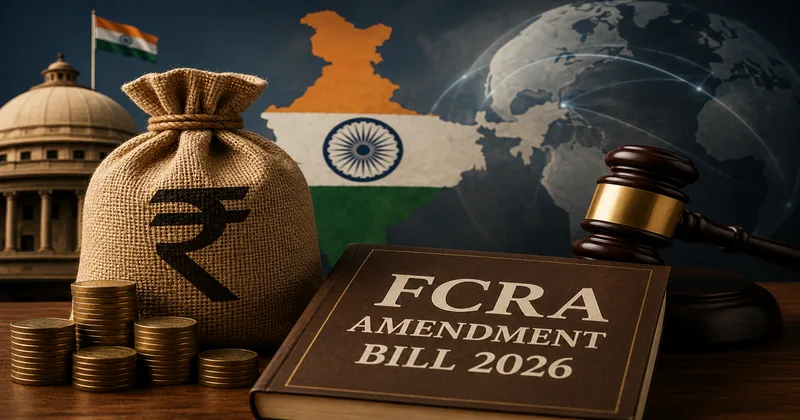
Introduced in the Lok Sabha on March 25, the FCRA Amendment Bill, 2026 represents a decisive step by the Union Government to plug critical operational loopholes and safeguard national security against unregulated foreign influence. To enforce strict financial accountability among NGOs, religious trusts, and associations, the bill mandates a Rs 10 lakh minimum funding threshold for renewal, stricter disclosure mandates, and the establishment of a “Designated Authority”. This centralised body will take charge of foreign contributions and assets of entities whose registrations are cancelled, surrendered, or non-renewed, preventing the diversion of foreign wealth into illicit or anti-national activities.
While the Centre emphasises that these reforms bring much-needed administrative certainty and transparency, predictable pushback has emerged from opposition parties, foreign-funded NGOs, and select Christian bodies seeking to resist executive scrutiny. International criticism, including comments from US Congressman Riley Moore, underscores Western discomfort with India fortifying its domestic financial borders.
The national necessity for these stringent measures is underscored by official data: 13,520 registered entities absorbed a staggering Rs55,741 crore in foreign funds between 2019 and 2022 alone. While 14,449 active FCRA registrations remain compliant as of July 15, 2026, thousands of fraudulent or non-compliant organisations have already been weeded out-with 22,498 registrations cancelled and 15,212 expired. Highlighting the scale of foreign inflows, Home Minister Amit Shah revealed that out of nearly Rs17,000 crore entering India in the previous year alone, approximately Rs3,000 crore was funnelled directly to Christian bodies, further validating the imperative for robust oversight.
This report provides a concise overview of ten key individuals and organisations opposing the FCRA Amendment Bill 2026. It outlines their roles, official statements, and institutional backgrounds, alongside their FCRA records and associated controversies.
Archbishop Anil J. T. Couto Opposes FCRA Bill 2026 and Challenges Regulatory Policies
Archbishop Anil J. T. Couto, the Metropolitan Archbishop of Delhi and Secretary General of the Catholic Bishops’ Conference of India (CBCI)-the apex body representing the Latin, Syro-Malabar, and Syro-Malankara Catholic rites in Bharat- has emerged as a major opponent of the FCRA Amendment Bill 2026. He particularly opposes its provisions regarding the automatic cessation of registration and government takeover of assets created from foreign contributions. Under his leadership, the CBCI submitted memoranda to Union Home Minister Amit Shah on 31 March, 10 July, and 6 August 2026, warning that the proposed rules violate constitutional protections under Articles 14, 19, 21, 25, 26, 29, 30, and 300A, while threatening Catholic-run schools, hospitals, orphanages, and charities. The CBCI maintains direct ecclesial links with the Vatican, the Apostolic Nunciature, and global bodies like Caritas Internationalis. Couto has a history of political engagement, having previously opposed anti-conversion laws in 2014 and sparking major political controversy in May 2018 when his call for a “prayer campaign” ahead of the 2019 Lok Sabha elections characterized the national climate as “turbulent” and threatening to India’s secular fabric, drawing harsh criticism from BJP leaders Rajnath Singh and Amit Shah while receiving support from opposition figures Mamata Banerjee and Sitaram Yechury.
Dr K. Reuben Mark Joins Delegations Against FCRA Amendments Amid Electoral Controversies
Dr K. Reuben Mark, Moderator of the Church of South India (CSI) and Bishop of Karimnagar, actively joined the Joint Action Forum on Minorities delegation that met Home Minister Amit Shah on 6 August 2026 to demand changes to the FCRA Amendment Bill. His primary objections focused on Section 14B’s proposed deemed cessation of FCRA certificates and the Designated Authority’s power to control foreign contributions and institutions’ assets, which he argued could severely hamper church-run schools, hospitals, and welfare networks. The CSI, whose foreign funds are managed centrally via the Church of South India Trust Association (CSITA) alongside individual diocesan accounts, operates within major global networks like the Anglican Communion, World Council of Churches, and Christian Conference of Asia. Mark’s elevation to Moderator in July 2025 followed significant legal upheaval, occurring after the Supreme Court voided former Moderator A. Dharmaraj Rasalam’s 2020 election in May 2025 due to constitutional age-eligibility violations, necessitating court-supervised elections.
Dr Paul Dhinakaran Seeks FCRA Bill Withdrawal Amid Past Income Tax Investigations
On 6 August 2026, evangelist Dr Paul Dhinakaran joined a Joint Action Forum on Minorities delegation led by MP P. Wilson to meet Home Minister Amit Shah, advocating for the immediate withdrawal or parliamentary review of the FCRA Amendment Bill 2026 due to its provisions on government management of foreign-funded assets. Dhinakaran leads Jesus Calls, an organisation tied to international prayer centres across the United States, Canada, the United Kingdom, Australia, Singapore, and South Africa, alongside educational and charitable operations including Karunya Educational Trust and SEESHA. His advocacy comes in the backdrop of significant financial scrutiny; in January 2021, the Income Tax Department raided 28 premises associated with Dhinakaran, Jesus Calls, and Karunya institutions in Chennai and Coimbatore, which uncovered suspected tax evasion, foreign-funding irregularities, an estimated Rs 118 crore in undisclosed income, and the seizure of 4.7 kg of gold.
Fr. Dr Mathew Koyickal Criticises Unconstitutional FCRA 2026 Rules
Fr. Dr Mathew Koyickal, Deputy Secretary General of the Catholic Bishops’ Conference of India (CBCI), has strongly condemned both the FCRA Amendment Bill 2026 and its newly notified implementation rules. He publicly described the notification of the FCRA Amendment Rules 2026 as “upsetting,” expressing serious concern over why executive rules were enacted while the primary amendment Bill was still actively under debate in Parliament. Denouncing the measures as unconstitutional, Koyickal argued that the regulations directly encroach upon individual freedoms and questioned why foreign funding regulations were being utilised by the state to monitor and restrict what individual citizens write or say.
Mizoram Chief Minister Lalduhoma Mobilises Regional Opposition to FCRA Bill
Lalduhoma, the Chief Minister of Mizoram, leader of the Zoram People’s Movement (ZPM), and a recognised church elder, took a strong state-level stance against the FCRA Amendment Bill 2026. On 24 July 2026, he declared key parts of the bill unacceptable to Mizoram, subsequently convening state officials and local church leadership on 25 July to draft a joint memorandum demanding amendments, before receiving verbal assurances from Home Minister Amit Shah on 6 August that the changes would not apply retrospectively. Lalduhoma’s political career is marked by notable milestones and controversies: he was the first Lok Sabha MP disqualified under the Anti-Defection Law in 1988, suffered a second disqualification from the Mizoram Assembly in November 2020 before winning his seat back in a 2021 by-election, and has drawn significant attention for his vocal stances on Mizo/Zo identity, the India-Myanmar border, the 1986 Peace Accord, Inner Line Permit regulations, and his active humanitarian support for Chin refugees.
Dr K. A. Paul Challenges FCRA Funding Restrictions Amid Past CBI Scrutiny
US-based Indian evangelist Dr K. A. Paul (Kilari Anand Paul), founder of the Global Peace Initiative (GPI), Gospel to the Unreached Millions (GUM), and Charity City orphanages in Hyderabad, has frequently clashed with foreign funding regulations. In January 2022, Paul’s NGO petitioned the Supreme Court to exempt humanitarian bodies from FCRA restrictions during COVID-19 relief efforts, though a bench headed by Justice A.M. Khanwilkar declined interim relief to organisations whose expired licenses were not renewed, directing them back to the Ministry of Home Affairs. This legal push followed a history of regulatory scrutiny; in March 2012, the MHA forwarded Agape Helping Ministries-with Paul named as its chief functionary-to the CBI for investigation into suspected FCRA violations and froze related accounts. Beyond his religious activities, Paul founded the Praja Shanti Party in 2008 (unsuccessfully contesting the 2019 Andhra Pradesh elections) and has frequently made unverified public claims of arranging Rs100 trillion in international funding and financing major political causes, including the Telangana statehood movement.
DMK MP P. Wilson Opposes FCRA Bill 2026 and Compares It to Enemy Property Act
P. Wilson, a DMK Rajya Sabha MP and chairperson of the Joint Action Forum on Minorities (JAFM), has been a vocal critic of the FCRA Amendment Bill 2026, labelling it “draconian” on April 4, 2026, and alleging that its property-divestment provisions target Christian missionaries, churches, NGOs, schools, colleges, hospitals, and orphanages. Speaking during a JAFM-led National Day of Fasting and Prayer, Wilson drew controversial parallels between the Bill and the Enemy Property Act of 1968, declaring that “the FCRA Bill treats minorities as enemies and is keen on snatching their properties” while announcing a nationwide signature campaign and a July 3 protest. Wilson’s legal stance on minority issues previously drew judicial reprimand in January 2023 when he represented Tamil Nadu before the Supreme Court in a religious-conversion case; while Wilson claimed the petition was politically motivated and denied the existence of forced conversion issues in the state, the Supreme Court criticised the political framing and sternly noted that forced and fraudulent conversions are serious issues that should not be politicised.
US Congressman Riley M. Moore Criticises Bharat’s FCRA Amendments Drawing MEA Rebuttal
Republican U.S. Congressman Riley M. Moore from West Virginia’s 2nd Congressional District and former West Virginia State Treasurer raised strong objections in August 2026 against Bharat’s proposed FCRA amendments, calling them “a clear attack against Christians” and warning that they could enable government control over churches and religious charities while damaging India–US bilateral relations. In response, India’s Ministry of External Affairs (MEA) firmly rejected Moore’s comments, affirming that FCRA legislation is purely an internal sovereign matter for India and highlighting that countries like the United States also strictly regulate foreign funding. The MEA further noted that while the Bill establishes a Designated Authority to manage foreign-funded assets following the cancellation, surrender, or lapse of FCRA registration, it explicitly mandates that places of worship retain their underlying religious character.
National Council of Churches in India (NCCI) Demands Parliamentary Scrutiny of FCRA Bill 2026
The National Council of Churches in India (NCCI), an ecumenical umbrella body established in 1914 representing Protestant and Orthodox churches across India, issued an open letter to Parliament on March 31, 2026, strongly opposing the FCRA Amendment Bill 2026. The organisation raised deep concerns regarding the proposed Designated Authority and its power to assume control over assets after FCRA registrations lapse or are cancelled, arguing that such measures jeopardise fundamental constitutional guarantees under Articles 25, 26, and 30, and demanding that the Bill be submitted for wider scrutiny through a Joint Parliamentary Committee or an expert commission. NCCI’s current opposition builds on a long history of challenging foreign-funding regulations, having previously submitted representations before the Parliamentary Standing Committee on the FCRA Bill in 2007, opposing regulatory tightening in 2016, and maintaining extensive global ecumenical ties with networks such as the World Council of Churches and the Council for World Mission and Evangelism.
Fr. Dr Michael Pulickal Condemns FCRA Amendment Bill 2026 Amid Regional Protests
Fr. Dr Michael Pulickal, associated with the Kerala Catholic Bishops’ Council (KCBC), has strongly criticised the FCRA Amendment Bill 2026, warning that its strict renewal conditions and government asset-control mechanisms threaten minority rights and could severely impact church-run schools, hospitals, and charitable institutions. His advocacy occurs alongside broader legal and social friction involving affiliated groups; in 2025, members of the Kerala Catholic Laity Association (KLCA) and local clergy were booked by police for unlawful assembly and obstruction during a 5,000-person Chellanam-Fort Kochi coastal-protection protest-charges the KLCA denounced as false and demanded be withdrawn. Furthermore, in December 2025, the KLCA’s Varapuzha unit spearheaded active demonstrations protesting alleged anti-Christian violence during Christmas across Assam, Chhattisgarh, Madhya Pradesh, Uttar Pradesh, and Jharkhand.
The widespread opposition from foreign-funded NGOs, ecumenical networks, and political figures reveals a persistent resistance to long-overdue foreign funding accountability. By framing essential administrative safeguards as an attack on religious institutions, critics overlook the core imperative of the FCRA Amendment Bill 2026: safeguarding national sovereignty, plugging financial loopholes, and preventing foreign capital from undermining domestic harmony. Ultimately, enforcing strict financial transparency and preventing the misuse of foreign funds are vital steps toward protecting Bharat’s internal security and national interests.