– By Manoranjana in New York
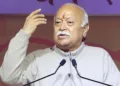
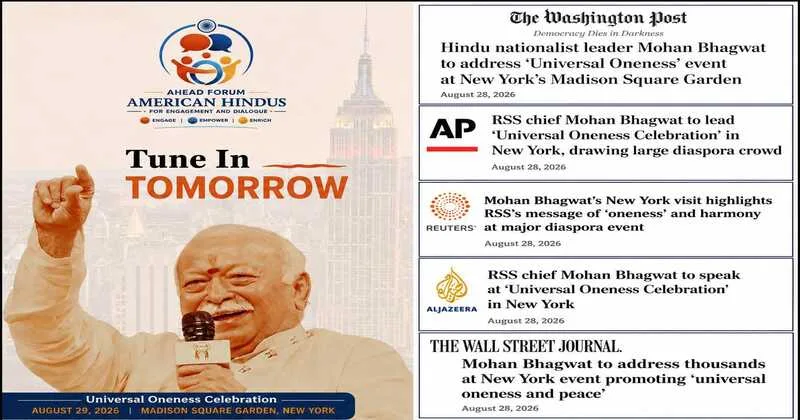
NEW YORK, August 28: Something curious has been unfolding in New York this week. Dr Mohan Bhagwat has not yet delivered his keynote address at Madison Square Garden; that happens on August 29 afternoon. Yet anyone following the American and international coverage of his visit could be forgiven for feeling that much of the argument over what his presence here means has already taken place.
I have been reading the reports as they have appeared through the week. They are not identical, nor do all of them reach precisely the same conclusions. Yet certain descriptions and associations recur with striking regularity: “Hindu nationalist”, Narendra Modi, the BJP, majoritarianism, minorities, protests, sanctions and international influence. By the time the Universal Oneness Celebration itself enters some of these accounts, the reader has already been given a fairly developed framework through which to understand it.
This does not make the reporting false. The Rashtriya Swayamsevak Sangh is a century-old organisation of enormous consequence in contemporary India, and questions about its philosophy, politics, relationship with the BJP, treatment of minorities and international networks are entirely legitimate. What interests me is something more fundamental to journalism: how does a disputed political characterisation, repeated across publications and over time, gradually acquire the authority of settled description?
AP: THE CONTROVERSY COMES FIRST
The Associated Press headline establishes its frame immediately: “Hindu nationalist leader spurs protests and calls for sanctions ahead of New York City speech.”
Its report describes Dr Bhagwat as heading a Hindu nationalist organisation “instrumental in putting India’s ruling party in power”. The RSS itself is described as a “right-wing paramilitary group”. From there, the story moves through New York Mayor Zohran Mamdani’s opposition, allegations of intolerance and human-rights violations involving minorities, USCIRF’s intervention and protests planned outside Madison Square Garden.
All of that belongs in the story. There is, however, another part of the New York story. About 5,000 people are expected at the Universal Oneness Celebration. Organisers say more than 200 Hindu-American organisations are collaborating in it. The programme is built around the Sanskrit formulation Vasudhaiva Kutumbakam—the world is one family—and the organisers say entrepreneurs, educators, artists, young people, faith leaders and representatives of temples and yoga centres will participate.
AP reports those facts and also carries the RSS position. But the order in which a story is told matters. By the time the reader encounters Vasudhaiva Kutumbakam and the organisers’ explanation of Universal Oneness, controversy has already established much of the lens through which those claims are likely to be viewed.
AP goes further by devoting a section to whether the RSS is on a “quest to engage and change its image”. It quotes Hudson Institute scholar Bill Drexel describing a “new chapter” in how the organisation relates to the outside world. That is a legitimate analytical proposition and Saturday may provide evidence with which to test it. But an analyst’s interpretation of RSS strategy is different from an established fact about why thousands of individual Hindu Americans are choosing to attend Madison Square Garden. The distinction should not disappear simply because one explanation makes for a more coherent narrative.
REUTERS AND THE SANCTIONS STORY
Reuters found an even more dramatic entry point: “US religious freedom panel urges sanctions against India’s RSS during chief’s US visit.”
The US Commission on International Religious Freedom has urged the Trump administration to consider targeted sanctions against RSS members and Indian officials it alleges are involved in religious-freedom violations. USCIRF chair Asif Mahmood has also called for Dr Bhagwat’s visa to be revoked. Unsurprisingly, the demand generated headlines in India and added an extraordinary dimension to a visit that was already politically contentious.
Continue reading the Reuters report, however, and another important fact appears. USCIRF’s recommendations are non-binding, and the US government has not acted on its recent recommendations.
That distinction changes the temperature considerably. There is a substantial difference between reporting that an American federal commission has recommended sanctions and leaving readers with the impression that the United States government has sanctioned the RSS or moved against Dr Bhagwat. The former has happened; as of Friday evening, I could find no announcement from the White House, State Department or Treasury indicating that the administration had adopted USCIRF’s demands.
Institutional distinctions rarely travel as rapidly as dramatic headlines, but this one is essential. USCIRF advises and attempts to influence policy; executive action is another matter. Dr Bhagwat remained in New York on Friday, moving through a programme of engagements and preparing to address Madison Square Garden on Saturday.
THE WALL STREET JOURNAL AND THE QUESTION OF AN RSS GOING GLOBAL
The Wall Street Journal approaches the visit from a broader angle. Its headline reads: “Indian Nationalist Leader Stirs Anger With U.S. Appearance.”
The Journal places the New York gathering within what it sees as a larger evolution: an RSS that has acquired enormous influence within India and is now seeking greater recognition and credibility abroad, particularly among the large and increasingly influential Indian-American community.
There is undoubtedly a legitimate story about the RSS outside India. The organisation is marking its centenary, the BJP has transformed Indian politics, and Indian Americans have acquired greater economic and political influence in the United States. It would be surprising if American journalists were not examining what the RSS represents, how it relates to the BJP and what organisations associated with the broader Sangh tradition are doing in America.
The more difficult question concerns motive. Increased international engagement can be observed and documented. Determining whether Madison Square Garden is principally an exercise in image-building, an attempt to internationalise the RSS, an expression of an increasingly confident Hindu-American community, or some combination of all three requires considerably more evidence. The question should remain open long enough for that evidence to emerge.
RELIGION NEWS SERVICE: PUTTING “ONENESS” TO THE TEST
Religion News Service has followed Dr Bhagwat’s visit closely. Its coverage places the RSS’s conception of Hindu unity under scrutiny while also reporting the organisers’ expectation that thousands will attend and that representatives of several religious traditions will participate.
At the same time, RNS has published sharply critical commentary about the visit, including an opinion piece headlined: “Let India’s Hindu nationalist leader speak about ‘oneness.’ Then let him answer.”
On that basic proposition, there should be little disagreement. If Dr Bhagwat speaks of Vasudhaiva Kutumbakam, journalists are entitled to ask what that means for an Indian Muslim or Christian. If he speaks of Hindu Rashtra, they should ask what place that conception leaves for Indians who do not identify as Hindu. If he speaks of civilisational unity, it is reasonable to ask how that unity accommodates disagreement, difference and dissent. These are not anti-RSS questions. They are precisely the questions greater international visibility should invite.
There is nevertheless an important distinction between a news organisation’s reporting and the conclusions of its opinion writers. RNS identifies commentary as commentary, as it should. Readers and those reproducing arguments from such pieces should preserve that distinction as carefully as the publication does. A news report establishes what happened; an opinion article advances an argument about what those facts mean.
AL JAZEERA AND THE MEANING OF ASSOCIATION
Al Jazeera goes further in its framing. Its headline asks: “Oneness or Hindu supremacy?”
Its report examines AHEAD Forum, the principal organiser of Saturday’s programme, using nonprofit filings and tracing relationships involving people connected with AHEAD and individuals or organisations associated with HSS and the wider Sangh ecosystem.
Those relationships are legitimate subjects for investigation. Who established AHEAD, who sits on its board, how is it funded and what relationships does it maintain with other organisations? A journalist is entitled to follow those trails as far as the evidence permits.
The difficulty comes in determining what the connections establish. Networks can be mapped relatively easily; proving what the lines between individuals and institutions actually mean is more complicated. A person can have an association with an organisation without taking instructions from it. Organisations can cooperate without one exercising control over another. Ideological affinity is not necessarily evidence of an institutional command structure.
If evidence establishes control, control should be reported. If it establishes association, association is the accurate word. That distinction may sound pedantic, but politically charged reporting is precisely where such distinctions become most important.
Al Jazeera says it sought AHEAD’s response to its findings and had not received one when the report was published. That qualification belongs in any assessment of its investigation, just as any subsequent response from AHEAD would itself have to be tested against the evidence.
A VOCABULARY TAKES SHAPE
Reading these reports together, I found myself repeatedly encountering the same cluster of ideas: Hindu nationalism, Modi, minorities, sanctions and influence. The publications deploy them differently, and some provide considerably more qualification than others. Collectively, however, these are becoming much of the vocabulary through which an American reader unfamiliar with the RSS first encounters Dr Mohan Bhagwat.
Some of those descriptions may withstand every examination. The question is whether they have undergone that examination before becoming journalistic shorthand.
Political reporting can acquire a circular quality. An organisation is described as controversial because prominent critics make serious allegations against it; those allegations subsequently acquire additional authority because they concern an organisation already routinely described as controversial. Over time, the origin of a characterisation becomes less visible while the characterisation itself becomes increasingly familiar.
This is hardly an RSS problem alone. It is a wider journalistic problem, particularly when complicated foreign political and cultural movements have to be explained quickly to audiences encountering them for the first time.
AND WHAT HAS BHAGWAT ACTUALLY BEEN SAYING IN NEW YORK?
There is another way to examine the narrative surrounding a controversial visitor: look at what he actually does and says while he is here.
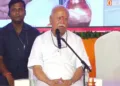
During his New York visit, Dr Bhagwat has spoken in a very different register from the vocabulary dominating much of the political controversy. At an ISKCON engagement, he spoke about a world fractured by diversity, duality and conflict and invoked an underlying consciousness capable of connecting human beings. He also participated in food distribution for homeless people.
There are at least two ways of reading such an appearance. Supporters will regard it as entirely consistent with the philosophical message of Vasudhaiva Kutumbakam that Dr Bhagwat is expected to develop at Madison Square Garden. Critics may see it as part of an effort to present a more universal face of the RSS to an international audience. Both interpretations can be argued. What journalism should resist is deciding between them before examining the larger record.
Something similarly revealing occurred during Dr Bhagwat’s interaction with business and technology figures in New York. The discussions ranged across telecommunications, space, clean energy, technology and quantum computing, while participants also raised practical questions about investment and manufacturing in India. When the conversation moved into matters properly belonging to government, Dr Bhagwat reportedly made clear that he was not speaking on behalf of the Government of India.
In the context of this week’s coverage, that is not an insignificant qualification. Much of the American reporting understandably explains the RSS through its relationship with the BJP and Prime Minister Narendra Modi. That relationship is politically consequential and deserves scrutiny. But the RSS, BJP and Government of India are not interchangeable institutions, and collapsing them into one entity can produce a cleaner narrative than the institutional reality warrants.
The organisers, meanwhile, describe Saturday’s programme as a cultural and interfaith gathering involving around 200 organisations and people from different faiths and backgrounds. Prayer, music, dance and dialogue are part of the announced programme, built around the civilisational formulation Vasudhaiva Kutumbakam.
None of this disposes of the difficult questions surrounding the RSS. A temple visit cannot answer allegations concerning majoritarianism. Feeding homeless people cannot resolve the debate about minorities in India. Invoking Vasudhaiva Kutumbakam does not establish that critics of the Sangh are wrong. But neither are these details merely decorative additions to a story whose conclusion has already been reached. They are part of the evidence from which any fair conclusion must eventually be drawn.
THE PEOPLE WHO DO NOT FIT NEATLY INTO THE FRAME
There is another part of the New York story that particularly interests me because I am reporting it from America. The people expected inside Madison Square Garden are not simply visitors from India. Many are Americans. Some were born here; others arrived decades ago and built businesses, medical practices, technology companies, temples, community organisations and families.
Organisers say more than 200 Hindu-American organisations are associated with Saturday’s programme. That does not mean those organisations have endorsed every proposition ever advanced by the RSS, just as an audience of 5,000 would not establish the correctness of Dr Bhagwat’s ideas. Numbers demonstrate participation, not truth.
But the people represented by those numbers are part of the story. Why are they coming? How many consider themselves RSS supporters and how many simply want to hear Dr Bhagwat for themselves? Do they understand their Hindu identity politically, culturally or spiritually? Does an American-born Hindu in her twenties understand the significance of this gathering in the same way as an immigrant who arrived forty years ago?
Then there are the Hindu Americans who will protest outside. Their presence complicates any attempt to describe “Hindu America” as though it were a constituency speaking with one political voice.
Perhaps what New York is witnessing is not simply the arrival of the RSS on a larger American stage. It may also be the emergence of an increasingly public American argument about Hindu identity itself. That seems a considerably richer story than either side’s slogans permit.
AMERICA ITSELF IS NOT SPEAKING WITH ONE VOICE
There is another misunderstanding easily exported back to India: the assumption that a statement from an American institution necessarily constitutes “America’s position”.
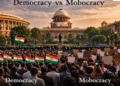
The events surrounding Dr Bhagwat demonstrate almost the opposite. USCIRF has recommended action. Mayor Mamdani has expressed strong opposition. Advocacy organisations are preparing demonstrations. American journalists are investigating the RSS and organisations around it. Meanwhile, thousands are preparing to enter Madison Square Garden to hear its Sarsanghchalak, and as of Friday evening I could find no corresponding action announced by the White House, State Department or Treasury implementing USCIRF’s demands.
These developments do not need to be artificially reconciled. They are different parts of an American system in which commissions advise, governments decide, politicians speak, journalists investigate, citizens protest and private organisations assemble.
To reduce that complicated picture to “America versus the RSS” would therefore be inaccurate. What exists instead is a debate taking place inside America, involving Americans as well as Indians, about an organisation whose significance can no longer be confined neatly within India’s borders.
THE QUESTIONS FOR THE RSS REMAIN
None of this should provide Dr Bhagwat with an escape from difficult questions. If the RSS believes that it has been inadequately or unfairly understood abroad, international engagement gives it an opportunity to make its case. It also exposes that case to interrogation.
What does Hindu Rashtra mean in a country of 1.4 billion people belonging to many faiths? How does Hindu civilisational nationalism accommodate Indians who do not consider themselves Hindu? What institutional relationships exist between the RSS and organisations abroad? How does Dr Bhagwat respond to Hindu Americans who reject the political philosophy associated with the Sangh?
Those questions deserve substantive answers. An organisation cannot reasonably seek greater international understanding while objecting to international scrutiny. The obligation, however, does not end with the organisation being scrutinised. Those making allegations against it should also be asked to establish them. Advocacy terminology should be attributed when it remains contested. Institutional relationships should be demonstrated rather than assumed, and familiar adjectives should not become substitutes for evidence simply because they have acquired wide circulation.
BEFORE BHAGWAT’S FIRST WORD AT MSG
Dr Bhagwat has already begun offering his answer in New York. In his remarks around the ISKCON engagement, he spoke of a consciousness capable of transcending diversity, duality and conflict and of an underlying oneness connecting humanity. On Saturday, before thousands at Madison Square Garden, that philosophical proposition will encounter a much harder test.
What does oneness mean when applied not to humanity in the abstract, but to the political, religious and social disagreements that have followed the RSS all the way to New York? What place does it leave for people who reject the Sangh’s conception of India? How does Dr Bhagwat explain Hindu civilisational identity to an American audience already encountering him through the vocabulary of nationalism, majoritarianism and minority rights? And will he confront those questions directly?
His answers should be examined as critically as the historical and contemporary record of the organisation he leads. The allegations made against the RSS deserve the same treatment: they should be measured against the evidence offered to support them. Neither the RSS’s description of itself nor its critics’ description of it deserves acceptance merely on authority.
Journalism has the more demanding obligation: to hear the argument, examine the record, establish as much of the truth as the evidence permits—and only then decide what words adequately describe it.