On August 25, 2016, India formally entered a new era of digital payments with the launch of the Unified Payments Interface, developed by the National Payments Corporation of India (NPCI) under the regulatory oversight of the Reserve Bank of India (RBI).
Ten years later, UPI has moved far beyond its original role as a new payment mechanism. It has become one of the central building blocks of India’s Digital Public Infrastructure (DPI) and an everyday part of the country’s economic life.
The scale of the transformation is visible in the numbers.
According to government data, annual UPI transaction volume increased from 1.78 crore transactions in FY 2016-17 to more than 24,162 crore in FY 2025-26, an almost 13,000-fold increase in a decade.
The value of transactions has expanded even more dramatically in absolute terms. It rose from just Rs 0.07 lakh crore in FY 2016-17 to around Rs 314 lakh crore in FY 2025-26, representing an increase of more than 4,000 times.
The platform now processes roughly 66 crore transactions every day, illustrating how a technology that was once largely unfamiliar to ordinary consumers has become embedded in routine economic activity, from buying vegetables and paying an auto-rickshaw driver to settling restaurant bills, transferring money to family members and paying businesses.
From 1.78 crore transactions to 24,162 crore
The journey of UPI can perhaps best be understood through its extraordinary growth curve.
In its first financial year, FY 2016-17, UPI recorded only 1.78 crore transactions. The platform was still in its early stages, with a relatively small number of participating banks and users.
The government data shows how rapidly that changed. By FY 2025-26, annual transaction volumes had crossed 24,162 crore.
Transaction value has followed the same trajectory. From Rs 0.07 lakh crore in the first year, annual transaction value has reached approximately Rs 314 lakh crore.
The simultaneous rise in volume and value demonstrates that UPI has not merely attracted occasional digital users. It has become a high-frequency payment infrastructure used for millions of small retail transactions as well as larger person-to-person transfers.
The International Monetary Fund has recognised UPI as the world’s largest real-time payment system by transaction volume. An IMF analysis has also highlighted interoperability, the ability of users of different banks and payment applications to transact seamlessly as a major factor behind UPI’s rapid adoption.
July 2026 sets a new UPI record
UPI’s growth has not slowed as it enters its second decade.
In May 2026, monthly transactions crossed the 2,300-crore mark for the first time, with 2,320 crore transactions recorded.
The platform subsequently established another monthly record in July 2026, processing 2,366 crore transactions worth Rs 29.88 lakh crore. That translates into roughly 76 crore transactions per day during the month. The government has described the platform as the world’s largest real-time payment system.
The July record is particularly significant because it shows that UPI’s expansion is continuing even after the system has reached an enormous scale.
In FY 2025-26, UPI accounted for approximately 84 per cent of India’s digital payment transactions, according to government data.
That dominance has turned UPI from one among several digital payment options into the principal interface through which millions of Indians interact with the formal financial system.
The small-vendor test: From doubts to QR codes everywhere
The UPI story also reflects a larger debate that emerged around India’s push towards digital payments after demonetisation.
In 2017, former Finance Minister P Chidambaram questioned the practicality of digital payments for ordinary Indians, particularly people in villages and small vendors. A government publication later recalled his question about whether a poor vegetable seller at a village fair could accept a small payment through a credit card, given the absence of point-of-sale machines, electricity and internet connectivity. (Central Bureau of Communication)
Chidambaram’s broader criticism was rooted in the practical challenges facing India’s cash-dependent economy. In Parliament in 2017, he questioned how a vegetable seller dealing in small-value transactions would manage digital payments and the associated infrastructure. (LinkedIn)
The evolution of UPI offers a striking contrast to those early concerns.
Instead of requiring every small merchant to install an expensive card-swiping machine, UPI enabled payments through QR codes, mobile phones and bank accounts. The interoperability of the system meant that a customer using one participating application could pay a merchant connected through another participating bank or application.
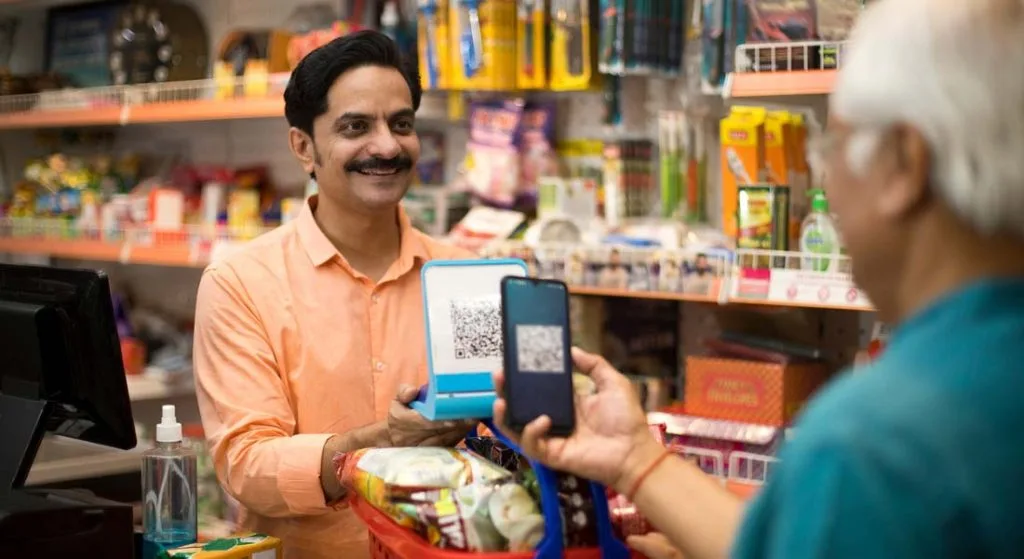
The result is visible across Indian streets and markets today: QR codes at vegetable stalls, tea shops, roadside food carts, taxis, pharmacies and small neighbourhood stores.
The significance is not that cash disappeared. It did not. Rather, digital payments became sufficiently simple and accessible to operate alongside cash and increasingly substitute for it in everyday transactions.
Chidambaram himself later acknowledged the growth of non-cash payments, while continuing to argue about the broader economic consequences of demonetisation.
Thus, the decade-long UPI journey is not simply a story of technology defeating scepticism. It is also a story of how an interoperable, low-friction system addressed some of the very practical barriers that had raised questions about whether digital payments could scale beyond urban consumers.
703 banks live on UPI; 741 by July 2026
The expansion of the UPI ecosystem has been accompanied by a dramatic increase in participating banks.
The number of banks live on UPI increased from 44 in FY 2016-17 to 703 in FY 2025-26.
The network now includes public-sector banks, private banks, small finance banks, payment banks and cooperative banks.
By July 2026, 741 banks were live on the UPI platform.
This expansion has been crucial to UPI’s interoperability. Rather than creating a separate payment network for every bank, UPI connects participating institutions through a common infrastructure.
That architecture allows users to choose among different applications while retaining the ability to transact with users and merchants connected to other banks.
The IMF has specifically identified this interoperability as one of UPI’s defining strengths. Its research found that interoperability can increase adoption by giving consumers greater freedom to choose payment applications without requiring everyone in their network to use the same platform.
From person-to-person transfers to everyday merchant payments
UPI’s usage patterns demonstrate how deeply it has penetrated everyday commerce.
Person-to-merchant (P2M) transactions account for about 63 per cent of UPI’s total transaction volume, highlighting the platform’s role in frequent retail payments.
At the same time, person-to-person (P2P) transactions account for about 71 per cent of total transaction value, indicating that individual transfers constitute a significant share of the money moving through the system.
The distinction between volume and value is important.
Merchant payments tend to be frequent and relatively small. In FY 2025-26, 86 per cent of P2M transactions were below Rs 500.
Among P2P payments, 59 per cent were below Rs 500, while 41 per cent were above Rs 500.
These figures demonstrate that UPI is not exclusively a system for large digital transfers. A substantial part of its success lies in its ability to handle tiny, everyday payments economically and conveniently.
A Rs 20 tea payment and a larger transfer between two individuals can travel through the same underlying infrastructure.
UPI and financial inclusion
The significance of UPI extends beyond convenience.
Its growth has strengthened India’s broader financial inclusion architecture by linking bank accounts, mobile phones and digital payments.
For users, the ability to make instant payments without handling cash reduces friction in everyday transactions. For merchants, especially small businesses, accepting digital payments can provide a straightforward alternative to cash handling.
The government has increasingly positioned UPI alongside other elements of India’s Digital Public Infrastructure, including Aadhaar and the Jan Dhan framework.
The broader objective is to make digital financial services accessible at population scale rather than limiting them to large businesses and urban consumers.
The IMF has also pointed to UPI’s role in India’s shift towards digital payments, noting that interoperability helped accelerate adoption and contributed to a broader transition away from cash. (IMF)
UPI goes global
The platform’s journey has also moved beyond India’s borders.
What started as a domestic payments infrastructure has increasingly become part of India’s digital diplomacy and cross-border payments strategy.
As of 2025, UPI accounted for nearly 49 per cent of global real-time payment transaction volume, according to government data.
UPI is currently operational in 11 countries:
- United Arab Emirates
- France
- Bhutan
- Sri Lanka
- Nepal
- Singapore
- Mauritius
- Qatar
- Cambodia
- Greece
- Maldives
The international expansion gives Indian travellers and businesses additional options for digital payments abroad while providing partner countries with access to an established real-time payments architecture.
More importantly, it has transformed UPI from an Indian domestic innovation into a potential model for countries looking to build interoperable and scalable instant-payment systems.
The IMF’s research has described UPI as the world’s largest real-time payment system by volume and has highlighted its interoperability as an important reason for its success.
Why interoperability became UPI’s secret weapon
One of UPI’s most important innovations is not simply that payments are instant. It is that the system is interoperable.
In a closed payment network, users may have to use the same platform to transact. UPI broke that model by creating an underlying infrastructure through which different banks and applications could communicate.
This meant a customer could choose a preferred payment application without requiring the merchant to use exactly the same app.
The result was a competitive ecosystem in which banks and fintech companies could build applications on top of the common infrastructure.
According to the IMF, this model helped increase consumer choice, encourage innovation and accelerate digital payment adoption.
This design choice also helped UPI overcome one of the biggest obstacles faced by digital networks: the need to convince both sides of a transaction to join the same network.
UPI is no longer just a payment app
Another important point in the UPI story is that UPI itself is not a single consumer-facing application.
It is an underlying payment infrastructure that connects banks, payment applications and users.
Applications such as bank apps and third-party payment platforms operate on the UPI network, while NPCI manages the underlying system.
This distinction is central to understanding why UPI has been able to scale so rapidly.
Instead of competing with every application at the consumer interface, UPI created a common layer that enabled different players to compete and innovate on top of it.
The IMF has described this interoperability as a key reason the Indian system has been able to expand so quickly.
From demonetisation-era experiment to global benchmark
The timing of UPI’s early growth is closely associated with the period following demonetisation in November 2016.
The withdrawal of high-value currency notes created a severe short-term cash crunch and pushed businesses and consumers to explore digital alternatives.
UPI was already operational by then, but the wider policy push for digital payments helped bring the platform into greater public focus.
The subsequent trajectory, however, cannot be explained by demonetisation alone.
UPI’s continued expansion over the following years was driven by its low-friction user experience, interoperability, expanding smartphone and internet access, increasing bank participation and widespread merchant acceptance.
Indeed, even critics of demonetisation have acknowledged that digital payments expanded substantially in the years that followed, while arguing that cash also remained important in the Indian economy.
The UPI story therefore represents something broader than a temporary response to a cash shortage. It has evolved into a permanent digital payments infrastructure.
The next decade: More users, more merchants, more innovation
As UPI enters its second decade, the challenge is no longer proving that real-time digital payments can work at scale.
The challenge is to make the system even more resilient, inclusive and useful.
The government has indicated that the next phase will focus on bringing more users and merchants into the ecosystem, encouraging innovation and strengthening India’s digital payment infrastructure.
The expansion will also have to address issues such as cybersecurity, fraud prevention, transaction reliability and access for users who remain outside the digital economy.
At the same time, UPI’s international expansion could open another chapter in its story.
The platform’s growing presence overseas provides an opportunity to develop more seamless cross-border payment mechanisms and strengthen India’s role in global digital financial infrastructure.
A decade of transformation
Ten years after its launch, the numbers tell an extraordinary story.
From 1.78 crore annual transactions to more than 24,162 crore, from Rs 0.07 lakh crore to nearly Rs 314 lakh crore in annual transaction value, and from 44 participating banks to more than 740, UPI has expanded at a pace few financial platforms have matched.
Its July 2026 record of 2,366 crore transactions worth nearly Rs 29.9 lakh crore in a single month provides another indication of the scale that the system has achieved.
The more consequential transformation, however, may be visible in something much simpler: the QR code at a small shop counter.
A decade ago, the question was whether digital payments could realistically reach India’s smallest merchants and ordinary consumers. Today, a customer can walk into a roadside stall, scan a QR code and transfer money instantly from a bank account.
That everyday convenience is ultimately what has made UPI more than a technological achievement. It has become a piece of national infrastructure, one that has changed how India pays and, increasingly, how the world thinks about building real-time, interoperable digital payment systems.