
Every year, as the last of the monsoon rains drain away, Keralam fills with the bright, intricate circles of pookalam, the deep, spiced aroma of the Onasadya (a banana-leaf feast that can easily run to twenty-six dishes or more), and the soft sheen of white Kasavu Mundus edged in gold.
To anyone not looking closely, the whole scene will once again appear as pure communal harmony when Onam is celebrated this year on 26 August. Over time, however, this visual spectacle has come to reinforce a top-down secular narrative that tends to set aside the festival’s distinctly Hindu character. What was once a profound and sacred rite is increasingly presented as a largely civic celebration, aligned with certain contemporary political priorities.
Beneath this colourful and inclusive public image lies a deeper question: what is the historical and religious identity of Onam? To answer that, we must look beyond its modern presentation and return to the traditional texts, inscriptions and temple traditions that have preserved its history.
King Mahabali, Vamana, and a Divine Promise
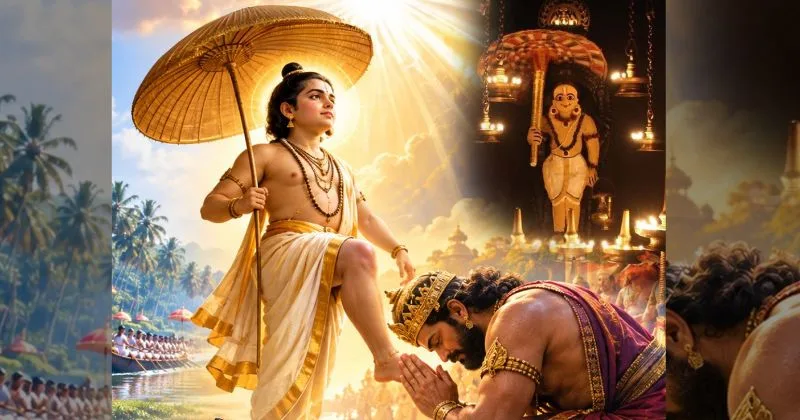
If you remove the political aspects, the story becomes simple and beautiful. Mahabali was a just and generous king of the Asura race, and his power expanded so much that it even caused the gods to feel threatened. Lord Vishnu appeared in the form of Vamana, a Brahmin who was a dwarf, and asked the king for a small gift—three paces of land to be measured by his own feet. Agreeing with his word, Mahabali did so. Vamana then grew to an immense size: the first step covered the earth, the second covered the heavens, and for the third Mahabali bowed his head, whereupon Vishnu placed his foot on it, not in order to crush him but to lift him.
Vishnu did not expel Mahabali; instead he sent him to govern Sutala, a place which the Srimad Bhagavatam is said to describe as more splendid than heaven, and promised to personally keep watch at the gate of that realm forever. The festival of Onam celebrates the day on which it is believed that Mahabali returns each year from that world to visit his people. At its core the story is one of devotion, surrender and grace — it is about a devotee’s homecoming and not a colonial conquest.
The celebration is not intended for the Asura who lost the three worlds but is instead in honour of the self who attained the Divine. Thrikkakara Temple (Vamanamoorthy Temple) in Ernakulam district, Kerala, is traditionally believed to be the site where Vishnu, in his Vamana (dwarf) avatar, placed his third foot on King Mahabali’s head and sent him to the netherworld (Sutala/Patala).
Paper Trail Hindu Roots Leave Behind
- It’s not a contemporary assertion presented as an ancient truth—the evidence in question is old and well documented.
- Copper plate inscription belonging to the Chera king Sthanu Ravi from 9th century mentions annadana, which consists of ceremonial food offerings made during Onam.
- References to the festival can be found in Sangam-era literature, for example in Maduraikkanci, over two thousand years ago, when the cultural area known as Thamizhagam extended from Kanyakumari to Gokarna.
- Both the Malabar Manual and the writings of the Colonial-era writer Francis Day clearly state that Onam is Vishnu’s annual visit to his devotee Mahabali.
- Even according to some church records, Onam’s Hindu origins have historically been recognised
- The idea that this festival has always been secular doesn’t hold true; instead, it seems to have been a Hindu festival for many centuries and only recently underwent an interpretation.
How “Secular Onam” Was Manufactured
- The notion that Onam has no religious elements didn’t just appear all at once; it was gradually developed, bit by bit, over a century.
- In the 1920s to the 1940s the first crack appeared when social reformers and the early communist leaders—most notably E.M.S. Namboodiripad—started to reinterpreting Mahabali as a symbol of “primitive communism”, portraying him as a just ruler from a low caste who was betrayed by the cunning of the Brahmins and casting Vamana not as the Lord of the universe but as the villain in a parable about caste oppression.
- 1961 – In 1961, Kerala Chief Minister Pattom A. Thanu Pillai, declared Onam the official/national festival of the state.
- 1980s – In the early-to-mid 1980s, the Kerala Tourism Department began organising large-scale Onam events as week-long cultural programmes, emphasising folk arts, performances, processions, and tourism appeal rather than strictly religious rituals
- This marked a shift from primarily home- and temple-based observances to larger public and state-organised celebrations.
- 2020 – Former Kerala Finance Minister T.M. Thomas Isaac tweeted: “We celebrate Mahabali who did not discriminate by caste or creed, not Vamana who cheated him.” This reflected a Marxist/Left interpretation of the Puranic legend and drew significant controversy.
- 2024 – In September 2024, the Syro-Malabar Church (via a note prepared under its Doctrinal Commission) clarified that Keralites view Onam as a cultural festival and that its elements (feasts, floral decorations, performances) are expressions of cultural pride, not religious rituals, encouraging Christian participation on that basis.
Instead of focusing on its religious roots, Onam is being presented as a story about caste and class.
Even political flashpoints reveal the asymmetry. When the BJP’s national leadership once greeted the public on “Vamana Jayanti” — naming the festival for what it actually commemorates — the backlash in Kerala was instant and furious, denounced as an attempt to “Hinduise” a secular occasion.
Onam Is Sanatana — But Its Spirit Is for Everyone
To say Onam is Sanatana is not to say it should exclude anyone from the table. It is to insist that Mahabali’s homecoming be understood for what it is: a story of divine grace, of a devotee’s surrender, of dharma restored — not a folk parable about caste betrayal, and not a religion-neutral “state festival” invented for tourism brochures and political messaging. Kerala’s Hindus are entitled to see their own festival named correctly, its theology respected rather than edited out for the comfort of a secularism that asks Hindu festivals, and only Hindu festivals, to surrender their religious character in the name of inclusion. Mahabali does not need rescuing from Vishnu. He needs rescuing from a century of narrators who have used his memory for every purpose except the one he was actually celebrated for.
The Aryan-Dravidian Binary That Was Never in the Text
The biggest misconception is that the Mahabali legend contains an “Aryan versus Dravidian” conflict — that of a fair-skinned Brahmin invader defeating a noble native king. Although this is a strong political metaphor, it is not to be found in the original texts.
The Valmiki Ramayana version (in which the sage Vishwamitra tells the story to Lord Rama) and the more detailed account in the Srimad Bhagavatam both contain no mention of caste or ethnic conflict. Mahabali is described as the grandson of the great devotee Prahlada — therefore belonging to a Brahmin line rather than being considered ‘Dravidian’ if that classification is at all made. The moral that is derived from both texts is one concerning ego, ambition and humility towards the divine, not one relating to race.
Those scholars who apply Sri Aurobindo’s philosophy and Jungian psychology to the story reach the same conclusion from a different perspective: the aspect of Mahabali’s “fall” is in fact the story of a perfected ego—powerful, generous, and virtuous although self-centred—being gently dissolved in order that a deeper and truer Self may come into being. Vamana does not conquer Mahabali; he sets him free. This represents a universal spiritual pattern, not a tale based on ethnic moral principles.
Why This Actually Matters
This is not about taking away anyone’s enjoyment of Onam. The fact that Kerala’s Muslim and Christian communities take part in the pookalam and the sadya as a common cultural experience is truly beautiful—it is a real example of the inclusive and generous spirit that has always been present in Hindu festivals. The issue is not one of participation but of erasure, namely the persistent claim, often for the sake of electoral advantage, that the festival has no Hindu elements at all and that its main figures are folk heroes rather than a devotee and his Lord.
To call Onam a ‘secular’ festival doesn’t make it more inclusive; it merely gets rid of the devotion which caused Malayalis, over a thousand years, to welcome a festival of humility, gratitude and grace. In fact, returning to its Vaishnava origins is not a rejection of Kerala’s plural and harmonious nature — it is a restoration of the depth that enabled that harmony to exist.
It is not the case that Onam is a festival which happens to include Hindus; rather, Onam is a Hindu festival for which Kerala, out of its generosity, has always shared it with everyone.