Turkey targets India in Israel row; Deems as a strategic challenge
October 4, 2026
  • Read Ecopy
  • Circulation
  • Advertise
  • Careers
  • About Us
  • Contact Us
Android AppiPhone AppArattai
Organiser
  • ‌
  • Bharat
    • Assam
    • Bihar
    • Chhattisgarh
    • Jharkhand
    • Maharashtra
    • View All States
  • World
    • Asia
    • Europe
    • North America
    • South America
    • Africa
    • Australia
  • Editorial
  • International
  • Opinion
  • RSS @ 100
  • More
    • World Hindu Congress 2026
    • Op Sindoor
    • Analysis
    • Sports
    • Defence
    • Politics
    • Business
    • Economy
    • Culture
    • Special Report
    • Sci & Tech
    • Entertainment
    • G20
    • Azadi Ka Amrit Mahotsav
    • Vocal4Local
    • Web Stories
    • Education
    • Employment
    • Books
    • Interviews
    • Travel
    • Law
    • Health
    • Obituary
  • Subscribe
    • Subscribe Print Edition
    • Subscribe Ecopy
    • Read Ecopy
  • ‌
  • Bharat
    • Assam
    • Bihar
    • Chhattisgarh
    • Jharkhand
    • Maharashtra
    • View All States
  • World
    • Asia
    • Europe
    • North America
    • South America
    • Africa
    • Australia
  • Editorial
  • International
  • Opinion
  • RSS @ 100
  • More
    • World Hindu Congress 2026
    • Op Sindoor
    • Analysis
    • Sports
    • Defence
    • Politics
    • Business
    • Economy
    • Culture
    • Special Report
    • Sci & Tech
    • Entertainment
    • G20
    • Azadi Ka Amrit Mahotsav
    • Vocal4Local
    • Web Stories
    • Education
    • Employment
    • Books
    • Interviews
    • Travel
    • Law
    • Health
    • Obituary
  • Subscribe
    • Subscribe Print Edition
    • Subscribe Ecopy
    • Read Ecopy
Organiser
  • Home
  • Bharat
  • World
  • Operation Sindoor
  • Editorial
  • Analysis
  • Opinion
  • Culture
  • Defence
  • International Edition
  • RSS @ 100
  • Magazine
  • Read Ecopy
Home World

Turkey Targets India in Israel Row: Ankara casts New Delhi as part of a wider strategic challenge to its interests

A conflict rooted in Syria is now being given an India angle, as Turkish media links New Delhi’s ties with Israel, Greece, Cyprus and the UAE to a wider regional power contest. India, however, has its own strategic interests and has shown no intention of becoming part of the Israel-Turkey confrontation

Dr Vishnu AravindDr Vishnu Aravind
Aug 24, 2026, 01:00 pm IST
inWorld, West Asia, Analysis, Asia, International Edition
Follow on Google News
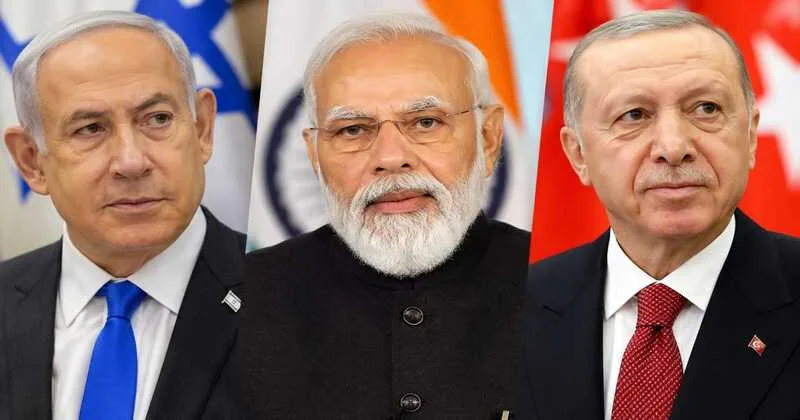
Israeli Prime Minister Benjamin Netanyahu,Prime Minister Narendra Modi, Turkish President Recep Tayyip Erdogan

Israeli Prime Minister Benjamin Netanyahu,Prime Minister Narendra Modi, Turkish President Recep Tayyip Erdogan

Facebook
Twitter
WhatsAppTelegramEmail

New Delhi: Turkish media is increasingly drawing India into the rapidly worsening strategic rivalry between Israel and Turkey, despite New Delhi having no direct role in the confrontation. A recent Turkish media presentation placing Prime Minister Narendra Modi alongside Turkish President Recep Tayyip Erdogan and Israeli leadership illustrates how India is being portrayed as part of a wider geopolitical contest centred on the West Asia, particularly post-Assad Syria.

The narrative has emerged as Israel-Turkey tensions have intensified following Israel’s August 18 airstrikes on Syria’s Abu al-Duhur airbase near Aleppo. Israel said the strikes were intended to prevent a possible Turkish military deployment at the facility, while Ankara rejected the allegation and condemned the Israeli action. Reuters reported that eight Israeli strikes hit the airbase, with the United States subsequently pushing for a deconfliction mechanism involving Israel, Turkey and Syria to prevent further escalation.

Against this backdrop, sections of Turkish media are increasingly presenting India’s expanding relationships with Israel, Greece, Cyprus and the United Arab Emirates as components of a wider strategic alignment that could constrain Ankara.

India drawn into a rivalry centred on Syria

The attempt to place India inside the Israel-Turkey confrontation is significant because the immediate dispute is fundamentally rooted in developments in Syria. Turkey has emerged as an important player in post-Assad Syria and has strengthened its relationship with the country’s new political leadership under President Ahmed al-Sharaa. Israel, meanwhile, is seeking to prevent military developments in Syria that it considers a potential threat to its security.

The August 18 strike dramatically exposed the growing friction. Israel argued that a possible Turkish deployment at Abu al-Duhur represented a security concern, while Turkey denied that it was preparing such a deployment. Washington has since sought to establish communication and deconfliction arrangements between the three countries.

The wider strategic picture helps explain Ankara’s sensitivity. Brookings has described the Israel-Turkey rivalry as a structural constraint affecting Syria, the Eastern Mediterranean and other regional theatres. It has also noted the tightening Israel-Greece-Cyprus relationship around Turkey.

⚠️ 🇹🇷 OFICINA DEL PRIMER MINISTRO:
“Turquía avanzó para ampliar su presencia militar en Siria hacia la frontera con Israel. Israel detectó la amenaza y actuó antes de que escalara.”

Mirá el mapa. Mirá lo que ocurrió. pic.twitter.com/Aa5aHTl3Rj

— Doron (@plexaleOK) August 21, 2026

A July 8 analysis published by the Greek-Australian outlet Ta Nea went further, describing an emerging Greece-Israel-India-UAE-Cyprus strategic alignment as a potential long-term challenge for Turkey. The article acknowledged that this is not a formal military alliance but argued that increasingly interconnected defence, security, economic and energy partnerships could reshape the regional balance.

This distinction is crucial. India’s defence cooperation with Israel is substantial, while New Delhi has also expanded defence and diplomatic engagement with Greece. Yet bilateral partnerships do not automatically constitute an anti-Turkey military coalition.

India’s foreign policy continues to be driven by strategic autonomy and issue-based partnerships. New Delhi maintains extensive relations with Israel while simultaneously engaging Arab countries, Iran, Europe, Russia, the United States and other major powers. Its defence relationships are principally shaped by national security requirements, access to advanced technology, maritime interests and broader geopolitical objectives.

Strategic autonomy, not an anti-Turkey bloc

There is little evidence that India intends to enter an Israel-Turkey confrontation. New Delhi has no obvious strategic incentive to become directly involved in a military contest in the Eastern Mediterranean or Syria. India’s immediate priorities include protecting its interests in the Indian Ocean, strengthening defence capabilities, securing energy supplies, maintaining critical trade routes and expanding partnerships with major global powers.

The Turkish narrative therefore risks turning independent Indian foreign-policy decisions into evidence of a coordinated strategic campaign against Ankara.

Also Read: Who Is Abdul El-Sayed? Michigan’s Bid for America’s first Muslim Senator and How is he linked to Bin Laden & Al-Qaeda?

Turkey’s concern, however, is not entirely without strategic logic. From Ankara’s perspective, stronger India-Israel and India-Greece relations become more consequential when viewed alongside the growing Israel-Greece-Cyprus partnership and the UAE’s regional role. Together, these relationships may appear to Turkey as part of a broader network capable of reducing its strategic room for manoeuvre.

But perception is different from an established military alignment. India’s engagement with Israel and Greece serves Indian interests. New Delhi has also consistently avoided becoming formally tied to military blocs. Even where strategic partnerships deepen, India generally retains freedom of action rather than accepting obligations to participate in another country’s regional confrontation.

That makes the Turkish media portrayal of Prime Minister Narendra Modi alongside Erdogan and Israeli leaders more revealing of Ankara’s strategic anxieties than of India’s actual intentions.

The larger issue is the changing geopolitical architecture around Turkey. Ankara increasingly sees Israel, Greece and Cyprus developing closer defence cooperation, while the UAE adds another important regional relationship. India’s growing economic, technological, diplomatic and defence weight gives this network an additional Indo-Pacific dimension. Ta Nea explicitly linked these partnerships across the Eastern Mediterranean, Gulf and Indo-Pacific.

For India, however, the most rational course remains clear that deepen bilateral partnerships wherever they advance national interests while avoiding unnecessary entanglement in conflicts that do not directly concern New Delhi.

The Israel-Turkey confrontation is likely to remain focused on Syria, the Eastern Mediterranean and the competing regional ambitions of Ankara and Jerusalem. Washington’s current effort to establish a deconfliction mechanism underscores the seriousness of the risk.

India therefore need not choose sides in this rivalry. Its strategic autonomy allows New Delhi to maintain strong relations with Israel and Greece without accepting the premise that those partnerships amount to participation in an anti-Turkey coalition.

If Turkish media continues to frame India as part of a regional campaign against Ankara, the distinction between partnership and alliance will become increasingly important. India’s growing global partnerships are designed to expand its strategic options, not to inherit another country’s geopolitical confrontation.

Topics: geopoliticsWest Asia ConflictCyprusIndiaIsraelNew DelhiTurkeyAnkara
Dr Vishnu Aravind
Dr Vishnu Aravind
Dr Vishnu Aravind is a researcher, political commentator and writer based in New Delhi, with a PhD from Jawaharlal Nehru University (JNU). His areas of interest include international politics, Indian foreign policy, electoral politics, election analysis, political developments, and cultural affairs. [Read more]
Share
Tweet
SendShareSend
✮ Subscribe Organiser YouTube Channel. ✮
✮ Join Organiser's WhatsApp channel for Nationalist views beyond the news. ✮
Previous News

Odisha: Dharmendra Pradhan rebuts Naveen Patnaik for misleading people over MMDR Bill; Hails growth in mining revenue

Next News

Reclaiming Onam: How Its Sanatana Roots Are Being Erased Through a Manufactured Mahabali-Vamana Narrative

Related News

ECI controversy resembles Bangladesh regime change playbook; Is it a CIA conspiracy to destabilise India?

Narco kingpin Navpreet Singh deported to India from Turkey; Amit Shah vows destruction of drug menace by 2029

Hamam Al-Hammami’s extremist past and reported security concerns at Oman Air now under scrutiny after Flydubai cockpit attack

Omani-Syrian Hamam Al-Hammami identified as Flydubai co-pilot who attacked captain and tried to crash Tel Aviv flight

AI Generated Representative Image

India’s official map standardises names of 28 places in Ladakh; Strategic move against China’s cartographic aggression

USS
Theodore Roosevelt

West Asia Conflict: US sends third carrier USS Theodore Roosevelt with 10K troops as Trump weighs next move on Iran

Representative Image

Flydubai Hijack Scare: How did a Omani pilot board Tel Aviv flight! Alarms security lapse & a spine in UAE-Israel ties?

Load More

Latest News

Elderly man dies at unauthorised protest of CJP at Shivaji Park in Mumbai

CJP Protest in Mumbai’s Shivaji Park: Elderly man dies of heart attack at unauthorised demonstration

Indian Men's Hockey team which won gold medal in Asian Games 2026

Asian Games 2026: India retains men’s hockey gold, defeat Malaysia

Israeli passenger Tzvika Manes recounts how passengers overpowered Omani terrorist co-pilot Hamam al-Hammami during the Flydubai cockpit crisis.

“Crew were asking us to untie the terrorist”: Israeli passengers recall second threat during Flydubai hijack chaos!

Akhil Bharatiya Vanvasi Kalyan Ashram Addressing the press conference

Rajasthan: Vanvasi Kalyan Ashram passes resolution seeking ‘National Memorial Status’ for Mangarh Dham

Government approves five Centres of Excellence for Classical Assamese, Bengali, Marathi, Pali and Prakrit

Tamil Nadu: TVK faces student opposition over memorial for its five declared icons on Madras University ground

ECI controversy resembles Bangladesh regime change playbook; Is it a CIA conspiracy to destabilise India?

The Shrichakra Rangoli reflects the ancient Indian interplay of geometry, mathematics, spirituality and cosmic symbolism

Shrichakra Rangoli: How ancient India turned geometry, mathematics and cosmic thought into a sacred art form

The Rigveda’s cosmic wheel with 12 spokes and 360 divisions reflects the ancient Vedic understanding of time and its endless cycles

The Cosmic Wheel of Time: Decoding the Rigveda’s mysterious twelve spokes and 360 divisions

The Supreme Court has backed regulated green crackers ahead of Diwali while rejecting a blanket ban and stressing pollution, noise and public health concerns

Supreme Court backs green crackers ahead of Deepawali, says festive sentiments & public health must both be considered

Load More
  • Privacy
  • Terms
  • Cookie Policy
  • Refund and Cancellation
  • Delivery and Shipping

© Bharat Prakashan (Delhi) Limited.
Tech-enabled by Ananthapuri Technologies

  • Home
  • Search Organiser
  • Bharat
    • Assam
    • Bihar
    • Chhattisgarh
    • Jharkhand
    • Maharashtra
    • View All States
  • World
    • Asia
    • Africa
    • North America
    • South America
    • Europe
    • Australia
  • Editorial
  • Operation Sindoor
  • Opinion
  • Analysis
  • Defence
  • Culture
  • Sports
  • Business
  • RSS @ 100
  • Entertainment
  • More ..
    • Sci & Tech
    • Vocal4Local
    • Special Report
    • Education
    • Employment
    • Books
    • Interviews
    • Travel
    • Health
    • Politics
    • Law
    • Economy
    • Obituary
  • Subscribe Magazine
  • Read Ecopy
  • Advertise
  • Circulation
  • Careers
  • About Us
  • Contact Us
  • Policies & Terms
    • Privacy Policy
    • Cookie Policy
    • Refund and Cancellation
    • Terms of Use

© Bharat Prakashan (Delhi) Limited.
Tech-enabled by Ananthapuri Technologies