Uttar Pradesh Basic Education Department issued a familiar checklist ahead of the 2026-27 academic session complete school infrastructure repairs, chase hundred percent enrolment, firm up NIPUN Bharat targets. Tucked inside that routine instruction to keep the kitchen gardens running. That single line points to one of the more consequential, least publicised reforms in the state school system.
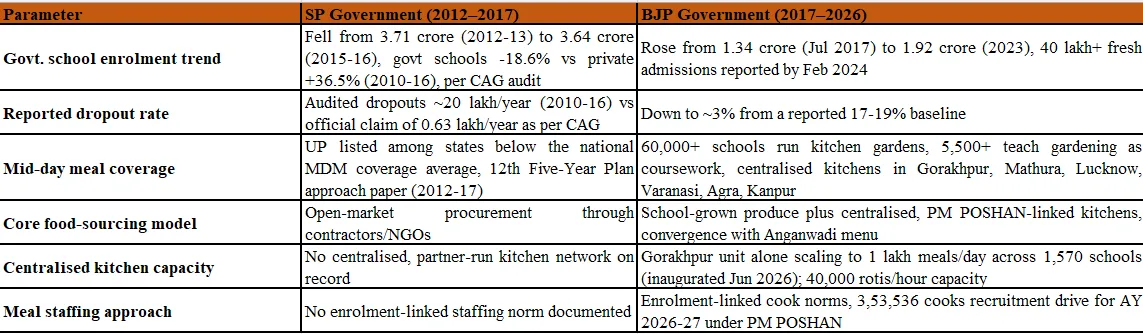
More than 60,000 government schools across Uttar Pradesh now maintain kitchen gardens, growing seasonal vegetables that go directly into the mid-day meal. In upwards of 5,500 schools, children are taught basic gardening and agriculture as coursework, so the produce they eat is the produce they helped raise. The chain from soil to plate runs almost entirely within the school boundary with no vendor invoice, no transport delay and no middleman skimming margin off a state-subsidised ingredient bill.
Logistics Over Budget
School meal programmes across India have historically stumbled not for want of money but at the last mile of moving fresh, safe food from a supplier to a classroom, every working day, without fail. Uttar Pradesh kitchen-garden network sidesteps that last mile altogether. It reflects a reading of the mid-day meal problem that treats it as an engineering challenge first and a budgetary one second.
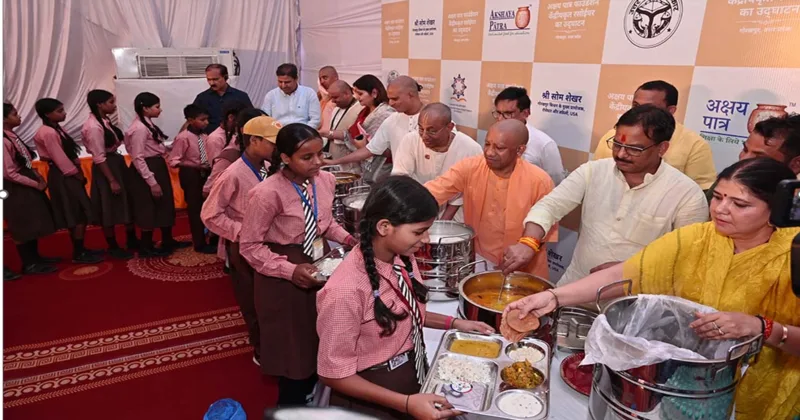
That instinct extends beyond the vegetable patch. The state has been building large centralised kitchens with partners such as the Akshaya Patra Foundation. A facility inaugurated in Gorakhpur in June 2026 will eventually serve one lakh hot meals daily across 1,570 schools, joining existing centres in Mathura, Lucknow, Varanasi, Agra and Kanpur. The state government has pushed for a uniform menu across Anganwadi centres and primary schools, so nutrition support for three-to-six-year-olds and the mid-day meal for older children draw on the same kitchen wherever the two sit close together, cutting duplicate logistics rather than duplicate budgets.
Inside the Gorakhpur Model
The Gorakhpur facility is a useful test case for what a logistics-first reform looks like once it moves from slogan to supply chain. Chief Minister Yogi Adityanath inaugurated the Akshaya Patra Foundation’s centralised kitchen in Gorakhpur on 25 June 2026, built with Uttar Pradesh government support under the PM POSHAN umbrella. On day one, the plant began serving hot meals to more than 55,000 children across 546 schools, with design capacity to scale up to one lakh students across 1,570 schools as it ramps up. Two automated roti-making lines with a combined output of 40,000 rotis an hour anchor the kitchen, and a fleet of 23 electric vehicles carries the cooked food out to schools across Gorakhpur and the surrounding block, because electric-vehicle-based delivery keeps last-mile cost and delay low, reinforcing the same “no vendor invoice, no transport delay” logic that defines the kitchen-garden network. Gorakhpur now sits alongside Mathura, Lucknow, Varanasi, Agra and Kanpur in Akshaya Patra’s Uttar Pradesh network, giving the state a hybrid model and industrial-scale centralised kitchens for dense urban clusters rather than a single template applied uniformly across a state as large and varied as Uttar Pradesh.
The Policy Floor Beneath the Gardens
Under PM POSHAN government rebranded and expanded successor to the Mid-Day Meal Scheme that the Union Cabinet approved for 2021-22 to 2025-26, states and union territories are permitted to spend up to 5 percent of their total recurring budget on a “flexi” component, which can fund School Nutrition Gardens and supplementary nutrition in identified districts. Nationally, the scheme covers roughly 11.8 crore children across about 11.2 lakh schools, with a Union Budget allocation of Rs 12,750 crore for 2026-27, which gives some sense of the scale against which Uttar Pradesh’s 60,000 schools and 5,500-plus gardening classrooms sit.
National Family Health Survey-5 (2019-21) data put child stunting at 35.5 percent, wasting at 19.3 percent and underweight prevalence at 32.1 percent nationally, with the Hindi heartland among the more acutely affected regions. The United Nations 2025 State of Food Security and Nutrition report separately flagged India as recording the world’s highest child-wasting rate even as broader hunger indicators improved a signal that the problem is driven less by food scarcity than by dietary quality and micronutrient gaps, which a fresh-vegetable, locally sourced meal is specifically designed to address. Seen against that backdrop, a vegetable patch outside a primary school classroom reads less as a quaint agricultural exercise and more as a targeted response to a documented nutrition gap.
Staffing the Last Mile: 3.53 Lakh Cooks
A kitchen, however well designed, is only as reliable as its staffing, and Uttar Pradesh’s most recent move on that front came in July 2026. The Basic Education Department began the process to select 3,53,536 cooks for council-run schools under PM POSHAN for the 2026-27 academic session, after clearance from the Union government, with district Basic Shiksha Adhikaris told to complete the exercise within 15 days. Staffing is tied to enrolment rather than handed out as a flat allocation:
● Up to 25 students: 2 cooks
● 26 to 100 students: 3 cooks
● 101 to 200 students: 4 cooks
● 201 to 300 students: 5 cooks
● 301 to 1,000 students: 6 cooks
● 1,001 to 1,500 students: 7 cooks (schools above 1,500 students follow separate provisions)
Beyond keeping meals on time, the exercise has a second, less-discussed effect: cook-cum-helper positions under PM POSHAN have historically gone to women from rural, low-income households and self-help groups, so a recruitment round of this size functions as a livelihoods programme riding on the back of a nutrition one.
Where Uttar Pradesh Stands Nationally
The state enrolment gains are not simply a story Uttar Pradesh tells about itself, they show up in the Centre’s own school-data audit. The Unified District Information System for Education Plus (UDISE+) report for 2021-22 recorded total school enrolment across India, from primary to higher secondary, at 25.57 crore, up from 25.38 crore the year before, a rise of 19.36 lakh students nationally. Within that all-India count, the ministry singled out Uttar Pradesh as the state that recorded the highest number of new enrolments in government schools and the highest teacher recruitment, even as the overall Gross Enrolment Ratio at the higher-secondary level improved nationally from 53.8 percent in 2020-21 to 57.6 percent in 2021-22. That places Uttar Pradesh post-2017 enrolment curve inside a broader, verified national dataset rather than resting solely on the state government’s own year-on-year announcements, and it is one reason the Basic Education Department kitchen-garden and centralised-kitchen investments have drawn attention beyond the state a government-school system serving close to two crore children is, by sheer scale, one of the largest single laboratories anywhere for testing whether a reliable meal changes whether a family keeps a child enrolled.
Two Governments, Two Trajectories
Enrolment data from the two periods tells a sharper story than any policy note could. Under the Samajwadi Party government (2012-2017), enrolment in Uttar Pradesh government primary and upper-primary schools did not grow. A Comptroller and Auditor General report tabled in the state assembly recorded enrolment declining from 3.71 crore in 2012-13 to 3.64 crore in 2015-16, even as private unaided schools grew enrolment by 36.5 percent over roughly the same window, government schools saw an 18.6 percent decline. The same audit flagged a wide gap in dropout accounting the state’s own claimed average of 63,000 dropouts a year sat against an audit estimate closer to 20 lakh a year between 2010 and 2016. Separately, the Planning Commission approach paper for the Twelfth Five-Year Plan (2012-17) listed Uttar Pradesh among the states whose mid-day meal coverage sat below the national average.
The Yogi Adityanath government has repeatedly pointed to enrolment as one of its clearest gains in school education the student numbers in Basic Education Council schools rose from 1.34 crore in July 2017 to 1.92 crore by 2023, an increase of 58 lakh in six years. By February 2024, the government reported more than 40 lakh additional admissions, alongside infrastructure upgrades across 1,32,000 schools under the Kayakalp Abhiyan. The Chief Minister said in May 2026 that the dropout rate has fallen from around 17-18 percent to close to 3 percent, with zero as the stated goal.
The climb was not perfectly linear, and the government’s own numbers reflect that. Enrolment had already reached roughly 1.80 crore within the first three years (by 2019) from the 1.34 crore baseline of July 2017, by the Chief Minister’s own account, before COVID-19 halted School Chalo Abhiyan activity through 2020. The campaign resumed in April 2022 from Shravasti, the state’s lowest-literacy district, and by January 2023 the Basic Education Department was citing more than 40 lakh new enrolments over four years under the campaign, including 3,96,655 previously out-of-school children and 2,55,136 children with disabilities brought in under the Samarthya Abhiyan. On the dropout question, the Chief Minister’s public figures have varied slightly by occasion a 17-18 percent baseline in some statements, 19 percent in others have stayed consistent. When CM launched the second phase of ‘School Chalo Abhiyan-2026’ from Saharanpur in July, alongside an honorarium hike for part-time instructors (Shiksha Mitras) from Rs 7,000 to Rs 17,000 a month and close to 23,000 scholarships for differently-abled girls in the 2025-26 academic year.
Admission Increased in BJP Government: Year by Year
The state has not published a single continuous annual enrolment series in the public domain, what exists is a set of figures the Chief Minister and the Basic Education Department have cited at different points since 2017, some measuring total enrolment strength and others measuring cumulative admissions under a specific campaign. Laid out year by year:

None of Uttar Pradesh recent enrolment gains rest on kitchen gardens alone. Better toilets, teacher recruitment drives, digital attendance tracking and free uniforms, bags and footwear have all played a part in the School Chalo Abhiyan’s results. But nutrition sits close to the centre of that list, because a reliable, fresh mid-day meal remains one of the few daily, visible reasons a family keeps sending a child to a government school rather than withdrawing them for work or shifting them to a private one.
The mid-day meal reform fits a broader approach visible across Uttar Pradesh’s governance since 2017, treat welfare delivery as a supply-chain and engineering problem first, and a funding question second. The same instinct shows up in the state’s push toward centralised, trackable disbursal of scholarships and pensions, and in its electricity and road infrastructure programmes. But as a case study in repairing a chronically underperforming welfare scheme by re-engineering its supply chain rather than simply enlarging its budget, the state has 60,000-plus school gardens now backed by industrial-scale kitchens like Gorakhpur’s and a staffing drive of over 3.5 lakh cooks, offer one of the clearer examples on record. The enrolment numbers since 2017 suggest families have noticed.