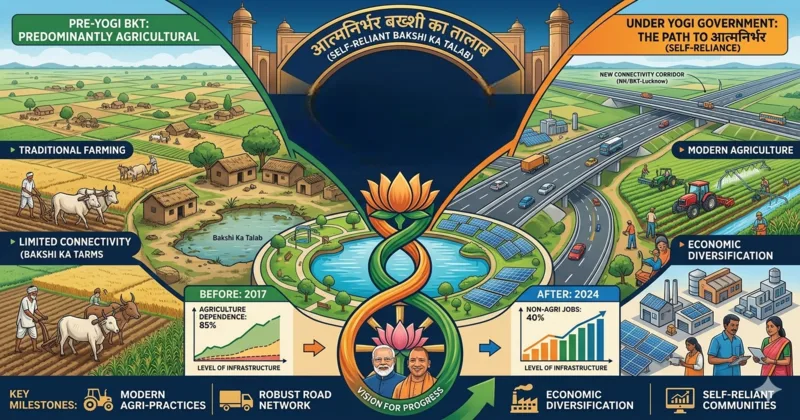
Located on the outskirts of Lucknow, Bakshi Ka Talab has long been known as a semi-rural belt with strong agricultural roots. With a population of over 4 lakh in its rural block alone, the region represents a typical North Indian constituency where farming, small-scale industry, and village life intersect. Today, however, the narrative is changing. What was once a region defined by limited connectivity and traditional agriculture is now emerging as a case study of grassroots development.
Before 2017 vs After 2017: A Shift in Development Approach
Roads and Connectivity: In Bakshi Ka Talab, the rural road construction is visible in the way that interior villages are now directly linked to Lucknow city through improved road networks. Farmers who earlier depended on seasonal routes can now transport their produce to nearby mandis without delays, while students and workers benefit from easier daily travel. Villages that once depended on muddy or seasonal roads are now linked by all-weather roads. The focus has not only been on building roads but on ensuring they connect people to markets, schools, and healthcare facilities.
After 2017, under the leadership of Yogi Adityanath, from a spatial planning perspective, Bakshi Ka Talab sits at a critical transition zone between rural Lucknow and urban expansion corridors. The most important among them is the Sitapur Road corridor (NH-30 influence zone), which serves as the main route connecting BKT villages directly to central Lucknow. In addition, link roads extending toward the Hardoi border belt strengthen inter-district connectivity more and support trade flow, agricultural exchange, and movement between neighbouring rural markets.
Direct Income Support to Farmers: Agriculture remains the backbone of Bakshi Ka Talab, but the way farmers are supported has changed in recent years. After 2017, under the leadership of Yogi Adityanath, the focus shifted towards a more stable and long-term support system. Schemes like PM-KISAN brought a major change, where Rs 6,000 is directly transferred to farmers’ bank accounts every year. This direct-benefit facility has ensured timely financial support without delay. Farmers are now less dependent on informal borrowing. They are not only focusing on traditional crops but are also diversifying into dairy and other activities. Many are also exploring small-scale business opportunities as well.
Power supply in rural areas has improved significantly in recent years. According to official state government data, villages in Uttar Pradesh are now receiving around 18 hours of electricity supply on average, compared to much lower, irregular supplies before 2017. In Bakshi Ka Talab, this has supported both agriculture (through better use of electric pumps) and daily household needs.
Uttar Pradesh, under CM Yogi’s leadership, has constructed over 37,000 farm ponds since 2017-18 under the Khet Talab Yojna to improve water availability. In Bakshi Ka Talab, where agriculture often depended on rainfall, such changes have helped farmers store water and manage irrigation more effectively, especially during dry periods.
Building on this, the Yogi government has introduced the “Land is Lab” model, in which farmers use their own fields to test new seeds and farming methods. Experts and farmers will work together, adopt better techniques, increase production, and reduce costs.
3. Infrastructure: Infrastructure has always been a key political issue in Uttar Pradesh, but the approach has clearly changed over time. Before 2017, large infrastructure projects in Uttar Pradesh were often criticised for delays in execution and limited last-mile impact. After 2017, the focus shifted towards faster, time-bound delivery, with projects such as the Purvanchal Expressway and the Bundelkhand Expressway completed within defined timelines. This change in approach is also evident at the constituency level, in areas such as Bakshi Ka Talab, where infrastructure development is now more closely monitored and aligned with local needs.
A large-scale township project called Naimish Nagar Township Project is being developed in Bakshi Ka Talab for which the estimated cost of land acquisition is Rs 4,785 crore. The plan is to move from rural isolation to a peri-urban growth hub. This is a sign of transformation under CM Yogi and will bring new opportunities in jobs, real estate, services, etc..
Constituency Matters: Why Bakshi Ka Talab is Politically Significant?
In Bakshi Ka Talab, these changes are visible on the ground. Residents are aware of improved roads that now connect villages to Lucknow, reducing their travel time and improving access to markets. Farmers highlight the benefits of direct income support and better irrigation facilities, while families note that improved electricity supply has made daily life more convenient. With growing connectivity, many young residents are also exploring education and job opportunities beyond the constituency.
Government initiatives are not just policies on paper here, they are experienced through better roads, improved access to welfare schemes, and enhanced public services. For instance, rural connectivity programmes have expanded significantly over the years, with government data showing that a majority of eligible habitations are now connected under PMGSY, improving access to markets and essential services.
Similarly, as mentioned above, welfare schemes such as PM-KISAN have brought direct financial support to farmers, with Rs 6,000 annually transferred into beneficiaries’ bank accounts. In a constituency like Bakshi Ka Talab, where agriculture remains a key livelihood, such schemes are evaluated not by announcements but by their day-to-day impact on households.
Before 2017, one of the biggest concerns was leakages in the system. Benefits often were delayed or reduced due to middlemen, and many eligible beneficiaries struggled to receive full support. After 2017, under the leadership of Yogi Adityanath, the focus shifted towards direct and transparent delivery. One of the biggest governance changes post-2017 has been the expansion of Direct Benefit Transfer (DBT). Means, subsidies, and scheme benefits are being deposited directly into bank accounts, which has reduced middleman interference. Across India, over Rs 43.3 lakh crore has been transferred directly to beneficiaries through DBT, reducing leakages and ensuring money reaches the right person.
As electoral dynamics evolve in Uttar Pradesh, such ground-level transformations are likely to play a crucial role in shaping voter perception.