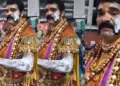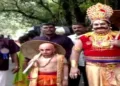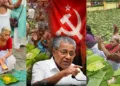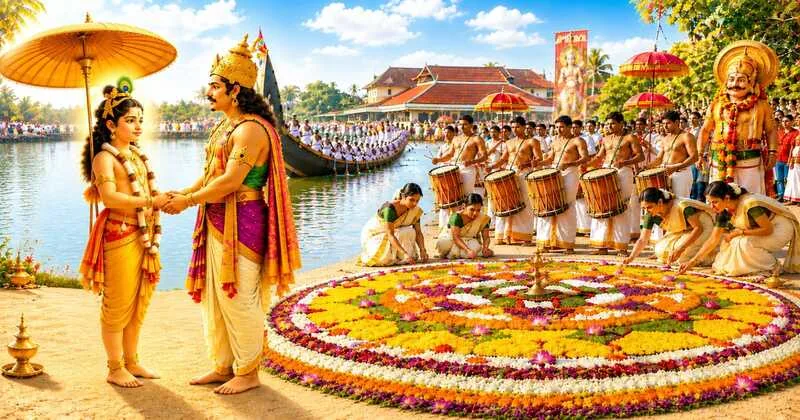
As Keralam prepares to celebrate Onam this year, the ten day festivities will culminate in Thiruvonam on August 26, following the opening of the celebrations with on August 16. Across the state, homes, mandirs and public spaces will come alive with pookkalams (floral decorations), Onasadya (grand feasts) cultural programmes and traditional festivities.
Onam is today presented in many public narratives as Keralam’s quintessential harvest festival, a celebration of prosperity, equality, flowers, feasting and cultural togetherness, often detached from any specifically Hindu civilizational framework. There is truth in describing Onam as a festival deeply embedded in Keralam’s social life. But history becomes less straightforward when the religious foundations of the festival are removed altogether.
In contemporary Keralam, however, the story of Onam has increasingly become a battleground of competing ideological narratives. Alongside the traditional account of Mahabali and Bhagwan Vamana, a section of Left and Marxist discourse has sought to reinterpret Mahabali as an Avarna ruler and to frame the Vamana–Mahabali episode through the language of caste conflict. In this interpretation, Bhagwan Vamana is sometimes presented as a Brahmin representative of an oppressive social order, while Mahabali is recast as a subaltern, Dalit or indigenous ruler whose defeat represents the triumph of Brahminical power.
Some versions go further and construct the episode as a North Indian–South Indian binary, portraying Bhagwan Vamana and the Brahminical tradition as an external northern force confronting an indigenous southern king. Such interpretations certainly exist in contemporary intellectual and political discourse. But the historical evidence does not establish that Mahabali was a Dalit ruler in the modern constitutional or sociological sense, nor does it establish a historical North Indian–South Indian war behind the Onam narrative. The danger lies in converting a complex Hindu traditional story into a modern caste or regional binary and then presenting that reinterpretation as the original historical meaning of the festival.
Another increasingly prominent narrative seeks to remove the Hindu cultural identity of Onam altogether, presenting it exclusively as a secular harvest festival centred on equality, prosperity, social harmony and Keralam’s cultural identity. There is nothing objectionable about celebrating Onam as a festival that brings people across communities together. Indeed, its contemporary social reach is one of its great strengths. The problem begins when inclusiveness is treated as evidence that the festival has no Hindu civilisational foundation.
But the older textual record places the Vamana–Bali story within a much wider Hindu sacred geography. Bhagawan Vishnu’s three strides are already present in Vedic literature that the Vamana narrative develops through the Puranic traditions. The Mahabharata and Ramayana preserve versions of the Bali and Vamana story and Tamil literary and temple traditions contain references to celebrations associated with the Thiruvonam star and Bhagawan Vishnu.
Keralam subsequently developed its own distinctive Onam traditions, especially around Thrikkakara Vamana murti Mandir, Mahabali and the agricultural calendar.
Before Mahabali: The Vedic roots of Bhagawan Vishnu’s three strides
The deepest layer of the tradition is not the popular image of Mahabali returning to Keralam but the much older Vedic conception of Bhagawan Vishnu as the murti of the three strides.
The Rigveda contains several references to Bhagawan Vishnu’s famous Trivikrama, the three cosmic strides through which He measures and establishes the worlds. Rigveda 1.154.2, in transliteration, reads: “pra tad viṣṇuḥ stavate vīryeṇa mṛgo na bhīmaḥ kucaro giriṣṭhāḥ | yasyoruṣu triṣu vikramaṇeṣu adhikṣiyanti bhuvanāni viśvā ||” Its English translation is: “That mighty deed of Vishnu is praised, like a fearsome beast roaming the mountains; in whose three wide strides all the worlds have their dwelling.” The meaning is that Bhagawan Vishnu’s three expansive strides encompass the entire universe, presenting Him as a cosmic and all-pervading power; this ancient Vedic three-stride imagery later becomes central to the Puranic Vamana–Mahabali narrative.
The story becomes more recognisably Vamana-like in the Brahmana literature. The Shatapatha Brahmana contains a version in which Bhagawan Vishnu, appearing in dwarf form, obtains from the Asuras the amount of land he can cover in three steps. He then expands and encompasses the levels of existence. The Vedic meaning is therefore considerably older than the Keralam festival tradition that the dwarf who becomes cosmic is fundamentally a story about Bhagawan Vishnu’s sovereignty over the universe.
Onam is Hindu festival – Bhagawan Vishnu's Avatar, Vamana, is worshipped.
Pongal is a Hindu festival – A Hindu harvest festival to thank Sun, Nature and the farm animals. No one else worship Sun and Nature.
Bonalu and Bathukamma are Hindu festivals – Mahankali Amma and Gouri… pic.twitter.com/5ni8ItV4n7
— Gudumba Satti 🇮🇳🕉🚩 (@GudumbaSatti) August 21, 2026
The Puranic tradition subsequently gives the story a more elaborate narrative structure. Bali, son of Virochana and grandson of Prahlada, becomes extraordinarily powerful. During a great sacrifice, Bhagwan Vamana approaches him and asks only for three paces of land. Bali agrees. Bhagwan Vamana then expands into the cosmic Trivikrama, covering earth and heaven with two steps. With nowhere left for the third, Bali offers his own head. Bhagwan Vamana places his foot upon him and sends him to Sutala.
This is crucial to understanding the civilisational framework of Onam. Bhagwan Vamana is not an invention of Keralam folklore. Mahabali is not an isolated Keralam character. Their relationship belongs to a pan-Indian Hindu textual tradition that predates the modern political and cultural categories through which Onam is now interpreted.
The Ramayana, Mahabharata and Puranas: A pan-Indian sacred narrative
The Vamana–Bali story travelled through multiple layers of Hindu literature. The Ramayana preserves the Bhagwan Vamana incarnation narrative in the Balakanda, where Vishwamitra tells Bhagawan Rama and Lakshmana about Bhagawan Vishnu’s incarnation. The Mahabharata likewise contains references to Bhagwan Vamana and Bali, including the account of the young Brahmachari approaching the Danava king and measuring the world in three steps.
The Puranas expand the story still further. The Bhagavata Purana describes Bali as a powerful ruler performing a sacrifice when Bhagwan Vamana arrives. Bali’s generosity and commitment to his word become central to the episode. Even after losing his kingdom, Bali refuses to break his promise. He ultimately offers his head for the third step. The Bhagavata’s narrative consequently presents Bali not simply as an evil figure but as a powerful being whose devotion, generosity and adherence to truth are recognised by Bhagawan Vishnu.
This point matters because the modern binary between “Hindu Vamana” and “beloved secular Mahabali” is historically simplistic. The Hindu tradition itself preserves a complex relationship between the two. Bali is a Asura king and the grandson of Prahlada, a celebrated devotee of Bhagawan Vishnu. His defeat is not merely a morality tale about a villain being destroyed. It is a devotional narrative about power, humility, dana, devotion and surrender before the Supreme.
The Puranic geography is equally significant. Some textual traditions locate Bali’s sacrifice on the Narmada, while the Vamana Purana associates Vamana with Kurukshetra. The Bhagavata tradition likewise does not identify Mahabali simply as an ancient Malayali king ruling a historically verifiable Keralam kingdom.
Thus, one should distinguish the pan-Indian Hindu narrative of Vamana and Bali from the later Keralam-specific cultural elaboration in which Mahabali becomes the returning king of the people.
Onam before the modern Keralam identity
The historical evidence also challenges the assumption that Onam emerged solely as a modern Keralam festival.
Tamil literary evidence is especially important. The Maduraikkanchi, associated with the Sangam corpus and attributed to Mankudi Maruthanar, contains a reference to an Onam celebration in the Pandyan context.
The description connects the festival with the mandir, royal festivities, public entertainment and religious observance. The evidence places an Onam-related celebration in the ancient Tamil cultural sphere, centuries before the creation of the modern state of Keralam.
Later Tamil Vaishnava literature provides further evidence. References to the Thiruvonam festival appear in the Vaishnava devotional tradition, where the star is associated with Bhagawan Vishnu. The Nalayira Divya Prabandham contains references to Thiruvona celebrations, while the sacred-site tradition includes Thrikkakara in Keralam among the 108 Divya Desams (Sacred lands).
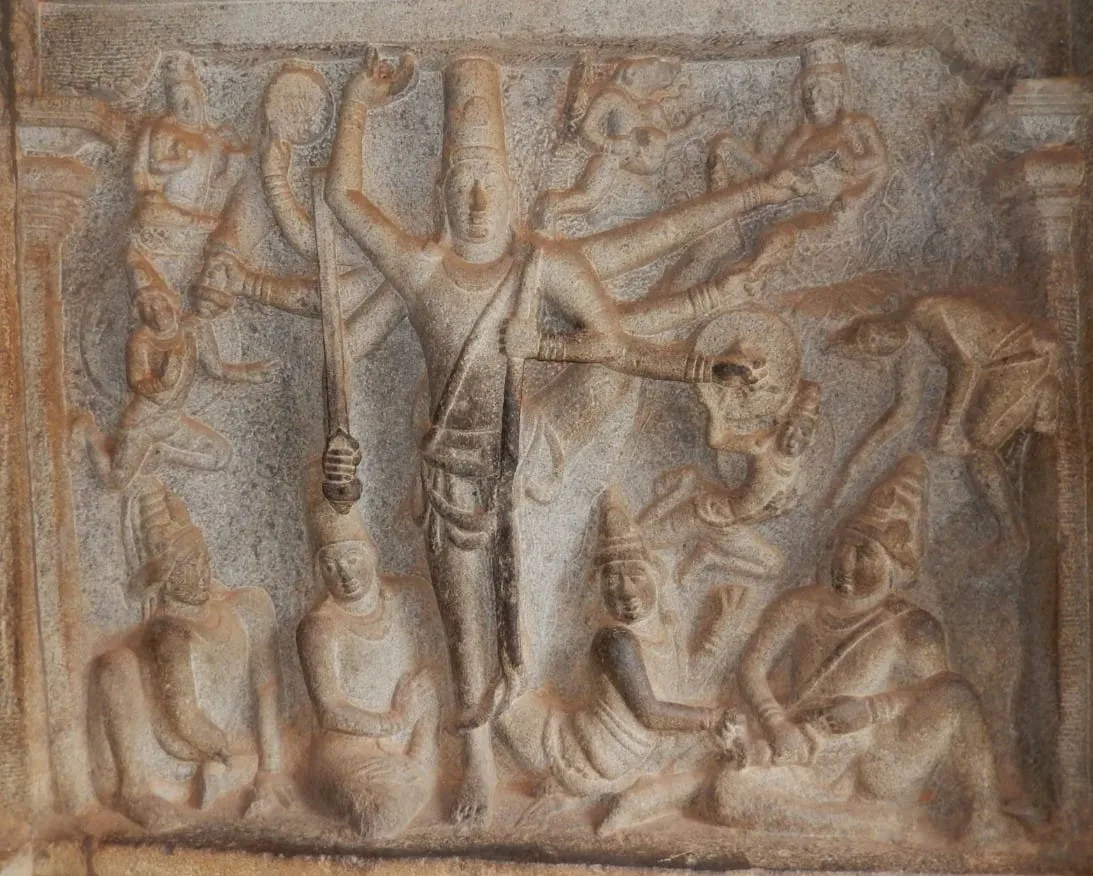
A seventh-century reference attributed to the Shaivite saint Thirugnanasambandar is also cited in connection with Onam festivities at the Kapaleeswarar mandir in Mylapore in Tamil Nadu. The evidence is significant not because it proves that ancient Tamil Nadu celebrated exactly the same ten-day Onam that modern Keralam does, but because it demonstrates that Thiruvonam-related religious observances existed beyond the geographical boundaries of present-day Keralam.
This distinction is essential. Historical continuity does not require every region to have maintained identical rituals. Festivals travel, acquire local forms and absorb regional customs. The existence of pookalams ( flower rangoli), boat races, Onasadya and Mahabali processions in Keralam does not erase the older Hindu traditional networks in which the Vamana–Thiruvonam tradition circulated.
Thrikkakara and the Keralam Transformation of Onam
Keralam nevertheless possesses a distinctive and exceptionally important centre of the tradition, Thrikkakara.
The Thrikkakara Vamana mandir in Ernakulam district is traditionally associated with the place where Bhagwan Vamana is believed to have taken his cosmic stride against Bali. The mandir’s principal moorti is Bhagwan Vamana, while a representation of Mahabali is also present. Keralam’s own traditional account therefore does not require choosing between Bhagwan Vamana and Mahabali as mutually exclusive identities. Both belong to the same sacred Hindu tradition.
Medieval inscriptions provide a more concrete historical layer. A copper-plate record from the reign of Sthanu Ravi Varma, dated to 861 CE, refers to Onam-related ritual activity at a Mandir in Thiruvalla in Keralam. Another Thiruvalla inscription from the 12th century records the income and expenditure connected with an ‘Avani Onam’ celebration. Evidence from Thrikkakara likewise associates Onam observances with Bhagwan Vamana worship.
The Onam boat race is more than a spectacular tradition, it is Kerala’s celebration of unity, teamwork and joy. 🇮🇳🌸 Let us celebrate this special festival by cheering on the skilled boatmen who participate in this culturally rich event. #onam #kerala #speed #skill #bharat pic.twitter.com/Z0RsPCcks6
— Meenakashi Lekhi (@M_Lekhi) August 21, 2026
An 11th-century Thrikkakara inscription is particularly significant because it identifies ‘Puradam’, ‘Uthradam’ and ‘Thiruvonam’ as important days in the mandir calendar. The festival was considerably more elaborate than the modern three-day public celebration familiar to many people. The historical tradition associated with Thrikkakara describes a much longer ceremonial period, with rulers and local chiefs participating.
The traditional account further describes gatherings involving 56 local kings and 64 village chieftains, reflecting the political importance of the festival in medieval Keralam. When rulers could no longer travel to Thrikkakara mandir, tradition holds that they were instructed to celebrate locally with the image of Thrikkakaraappan or Bhgwan Vamana.
How Mahabali became the heart of Keralam’s popular Onam
The most recognisable modern image of Onam is not Bhagwan Vamana measuring the universe but Mahabali returning to see his people. The popular legend presents Mahabali as a just and generous ruler whose subjects enjoyed prosperity. Bhagawan Vishnu, appearing as Vamana, defeats him but ultimately grants him permission to return annually to his people. Keralam’s official cultural narrative preserves this story and identifies Thiruvonam with Mahabali’s annual visit.
Yet historians have pointed out that the Mahabali-centred interpretation appears more prominently in later Keralam tradition than in the earliest evidence for Onam. One historical interpretation suggests that changing agrarian and social relationships contributed to the elevation of Mahabali as a popular symbol, particularly from the medieval period onward.
The idea is not that Mahabali was invented in modern times, but that the relative emphasis placed upon him changed over centuries. The distinction between textual antiquity and popular prominence is important. The Vamana–Bali story is unquestionably ancient within Hindu literature. What cannot be established with the same certainty is that ancient Keralam households were already celebrating precisely the modern belief that Mahabali physically returns every year.
Even the historical accounts of European visitors complicate the picture. The 17th-century Jesuit missionary Jacobo Fenicio, in his 1609 work Book on the Religion of the East Indians (Livro da Seita dos Índios Orientais), provides an early European account associating Onam with Mahabali’s annual homecoming, while later European descriptions interpreted the festival through different religious frameworks
Therefore, the intellectually honest conclusion is neither that “Onam has always been exactly the same” nor that “Mahabali is a later non-Hindu invention.” The festival evolved, but it evolved within a Hindu civilisational landscape.
From sacred festival to secular symbol
The decisive transformation came in the modern period, when Onam moved from a network of Mandir, agrarian and household observances into a state-wide public festival. After Independence, Keralam’s government increasingly institutionalised Onam as a public cultural celebration. In 1961, the state officially declared Onam its national festival. The move helped turn a historically diverse set of rituals and regional practices into a common public identity for Keralam.
That process had positive consequences. Onam became a shared cultural festival across communities. Pookalam (flower Rangoli) competitions, Onasadya, cultural programmes, sports, boat races and public celebrations transformed it into an extraordinary expression of Keralam’s social identity. Malayalis carried it far beyond Keralam through migration, and it is now celebrated wherever substantial Malayali communities live.
But inclusiveness and secularisation are not necessarily synonymous. A festival can be socially inclusive while retaining a Hindu civilisational foundation. Deepawali, Christmas, Vesak and many other religious festivals have developed cultural dimensions beyond strictly ritual observance without requiring historians to erase their religious origins. Onam deserves the same intellectual treatment.
The secularisation of Onam becomes problematic when inclusiveness is used to imply that its Hindu foundations are somehow illegitimate or embarrassing. The Vedic Vishnu tradition, the Vamana incarnation, the Mahabharata and Ramayana narratives, the Puranic accounts of Bali, the Vaishnava mandir tradition, the Thrikkakara cult and medieval inscriptions cannot simply be written out of the history of the festival.
The more convincing historical understanding is therefore layered. Onam is a Keralam festival, but its sacred narrative is not exclusively Keralam. It is a harvest celebration, but it is not merely a harvest celebration. Mahabali is central to popular Keralam memory, but Mahabali cannot be separated from the Vamana–Vishnu Hindu tradition in which his story exists. And Onam is culturally inclusive without becoming historically religionless.The challenge today is not to make Onam less inclusive. It is to make its history more complete.