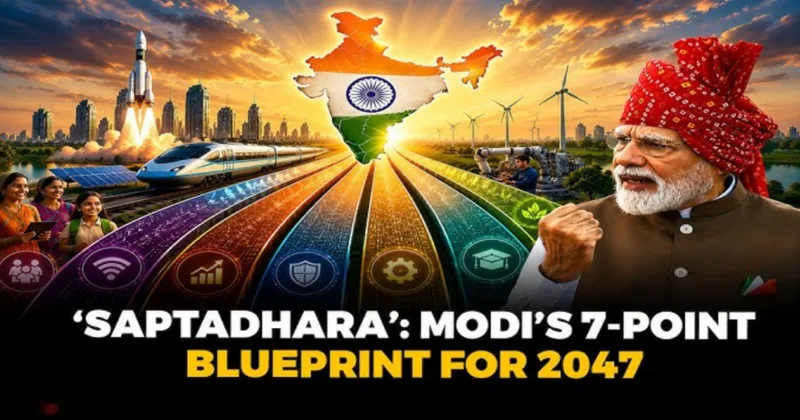
Prime Minister Narendra Modi’s Independence Day address from the Red Fort on August 15, 2026 introduced a striking framework for India’s next phase of development, ‘Shakti ki Sapta Dhara’, implying seven streams of national strength. The expression gives a conceptual structure to what might otherwise appear as a collection of economic, technological, strategic and cultural priorities. PM Modi identified seven streams, manufacturing, agriculture and food production, technology and innovation, Gati Shakti and infrastructure, defence capability, green and blue economy and India’s soft power. He presented these as mutually reinforcing sources of national strength for the coming five to seven years and linked them to the larger objective of a developed India by 2047.
The idea of ‘seven’ has a deep and recurring presence in the Bharatiya intellectual and cultural tradition. It is visible in the Sapta-Sindhu of the Vedic world, the seven rivers invoked in later ritual traditions, and in numerous classifications across Indian philosophical, cosmological and cultural literature. Similarly Sapta – Rishi, the seven saints on whose names the gotra system of identifying the family is still prevalent, and Sapta – Puri, the seven sacred pilgrimage cities. The familiar invocation, गङ्गे च यमुने चैव गोदावरि सरस्वति । नर्मदे सिन्धु कावेरि जलेऽस्मिन् सन्निधिं कुरु ॥, invokes seven sacred rivers, Ganga, Yamuna, Godavari, Sarasvati, Narmada, Sindhu and Kaveri, within a single body of water. The important conceptual movement is from plurality to unity, many rivers, diverse geographical regions, one sacred presence.
The imagery of dhara is significant. A dhara, is a stream or continuous flow. Seven streams may have different courses, uses and visible forms, but they can originate from a common source and ultimately contribute to a common civilisational landscape. In this sense, Sapta Dhara should not be read merely as a seven point government programme. It can be understood as an attempt to articulate a systems approach to national power, in which productive capacity, agriculture, knowledge, connectivity, security, ecological sustainability and cultural influence reinforce one another.
The deeper question, therefore, is not merely what the seven streams are. It is, What is the one source from which these streams derive their power? The answer is human capability, the knowledge, character, creativity, enterprise and collective confidence of the Indian people.
Manufacturing
The first stream is manufacturing. Modi placed particular emphasis on three attributes, cost, quality and scale. India’s manufacturing ambition is no longer simply about replacing imports, it is about becoming globally competitive and integrating Indian production into international value chains.
This distinction is important. Self – reliance does not mean economic isolation. The government’s message, as reflected in the speech, was that Indian enterprises should use expanding international market opportunities while ensuring that Indian products meet or are ahead of the global standards. India has entered into free trade agreements with nearly 40 countries since 2014 and the Prime Minister urged MSMEs to use these opportunities to take Indian textiles, machinery, medicines and other products to global markets.
Manufacturing also has a multiplier effect. A semiconductor plant creates demand for engineering, chemicals, logistics, skilled labour, research and design. Defence manufacturing stimulates electronics, materials science, aerospace and artificial intelligence. Thus, manufacturing is not an isolated sector, it is an industrial ecosystem.
The real challenge will be to move from assembly to design, from low value production to high value manufacturing and from technology consumption to technology creation.
Agriculture and food production
The second stream is agriculture and food production. This is particularly significant for India because agriculture is simultaneously an economic activity, a livelihood system, a food security mechanism and an ecological institution. The Prime Minister’s emphasis on agricultural and food production strength included the potential of Indian products such as millets, fruits and spices in global markets. Reports of the speech also highlighted the importance of moving towards chemical free agriculture and developing integrated farm-to-export chains.
The future of Indian agriculture cannot be based merely on increasing production. It must simultaneously address productivity, farmer income, water efficiency, soil health, post harvest management, food processing, storage, logistics and export quality.
Here the Bharatiya knowledge tradition has considerable contemporary relevance. Traditional agricultural knowledge developed through long term observation of soils, seasons, seeds, water and biodiversity. Its proper place today is not as an unquestionable substitute for modern agronomy, but as a source of hypotheses and locally adapted practices that can be scientifically evaluated.
Technology and innovation
The third stream is technology and innovation. This may ultimately become the most powerful multiplier of the other six. The Prime Minister referred to areas including space, quantum technology, robotics and 6G, while also announcing a programme to train one crore young Indians in artificial intelligence skills over the next year.
The announcement reflects a fundamental transition. India cannot achieve technological sovereignty merely by becoming a large market for technologies developed elsewhere. The strategic objective must be to build capabilities in research, intellectual property, advanced manufacturing, foundational science and technology entrepreneurship.
The semiconductor emphasis is particularly important. The government has approved 12 semiconductor projects across six states, involving more than ₹1.6 lakh crore in investment, and several projects have already entered production. Technology is not only hardware, it includes algorithms, scientific knowledge, data, standards, patents, human capital and institutions.
India’s ancient intellectual traditions also remind us that technology rests upon knowledge. The Taittiriya Upanisad declares, सत्यं वद । धर्मं चर । स्वाध्यायान्मा प्रमदः ।. The injunction toward svadhyaya, is highly relevant to a knowledge economy. A technologically powerful India must be a researching India, not merely a consuming India.
Gati Shakti and infrastructure
The fourth stream is Gati Shakti, the power of movement and connectivity. In contemporary terms, this includes high speed rail, highways, inland waterways, ports and integrated infrastructure. Infrastructure is frequently understood as physical capital, but its deeper significance is the reduction of time, distance and transaction costs.
A farmer’s produce reaches a market faster. A factory receives components more reliably. A port connects domestic production with global markets. A student can access educational resources digitally. A defence force can move personnel and equipment rapidly. Thus, connectivity is itself a form of national power.
India’s historical experience also demonstrates the importance of networks. Ancient trade routes, ports, knowledge centres and pilgrimage networks connected distant regions. The modern challenge is to recreate this interconnectedness through digital, physical, economic and knowledge infrastructure.
Raksha Shakti
The fifth stream is defence capability. The Prime Minister stressed defence self – reliance and referred to drones, counter drone systems, hypersonic technologies and cybersecurity as areas where India must build advanced capabilities.
The nature of national security has changed fundamentally. Military strength is no longer determined only by the number of soldiers, tanks or aircraft. It increasingly depends upon semiconductors, artificial intelligence, cyber capability, space systems, electronic warfare, autonomous systems, quantum technologies, advanced materials and secure communications. Therefore, the defence stream is closely connected to the manufacturing and technology streams.
This is precisely why Sapta Dhara is better understood as a network than as seven independent pillars. A technologically dependent defence sector cannot provide complete strategic autonomy. Conversely, defence requirements can stimulate advanced domestic technology.
Green and blue economy
The sixth stream is the green and blue economy. It encompasses green manufacturing, renewable and nuclear energy, fisheries, coastal development and related sectors.
Energy security is particularly important because economic growth ultimately depends upon reliable and affordable energy. The Prime Minister stated a target of 100 GW of nuclear power capacity by 2047, along with five new nuclear reactors during the current decade. He also highlighted India’s progress in fast breeder reactor technology. This indicates that India’s energy transition is being conceived not simply as an environmental issue, but as a question of strategic autonomy.
The green economy therefore connects environment, technology, manufacturing and national security. Similarly, the blue economy connects oceans, fisheries, ports, tourism, coastal infrastructure and maritime security.
Soft power
Soft Power is perhaps the most distinctive element because it extends national power beyond conventional economic and military measurements. India’s civilisational traditions, Yoga, Ayurveda, Buddhism, Indian languages, mathematics, philosophy, music, cinema, cuisine, democracy and cultural diversity, contribute to India’s international influence.
Soft power, however, should not be understood merely as cultural publicity. Genuine soft power emerges when a country’s ideas, institutions, culture, products and values acquire credibility and attractiveness abroad. India’s civilisational heritage can contribute significantly here, but only when presented through serious scholarship rather than superficial cultural branding.
The convergence
The seven streams ultimately converge upon one source i.e., human capability. Manufacturing requires engineers and skilled workers. Agriculture requires knowledgeable farmers and scientists. Technology requires researchers and innovators. Infrastructure requires planners and technicians. Defence requires scientists and soldiers. The green economy requires technological expertise. Soft power requires artists, scholars, entrepreneurs and cultural institutions. This explains why the youth occupied such a prominent place in the 2026 Independence Day address. The Prime Minister announced AI training for young people, free online coaching for competitive examinations for poor and middle class families, and a nationwide sports talent hunt for children aged five to 15. These announcements are not peripheral to Sapta Dhara. They concern its underlying resource, the human capital.
The seven streams form a circular system of national development. The metaphor of dhara is consequently more appropriate than that of isolated pillars. Pillars stand separately, streams flow, intersect and ultimately nourish a larger system. This also gives Sapta Dhara a deeper civilisational resonance. Indian thought has repeatedly used the imagery of rivers and streams to describe plurality emerging from unity. The Rigveda speaks of rivers moving toward the ocean, समुद्रार्थाय सिन्धवः।. The metaphor suggests that diversity need not imply fragmentation. Different streams can have different functions while contributing to a common destination.
The vision of Viksit Bharat 2047 will ultimately depend upon whether India can convert demographic strength into human capital, human capital into knowledge, knowledge into technology, technology into productive capacity, productive capacity into prosperity and prosperity into national strength. That is the deeper significance of Sapta Dhara, seven streams, one source and one national current flowing towards a developed and self-confident India.