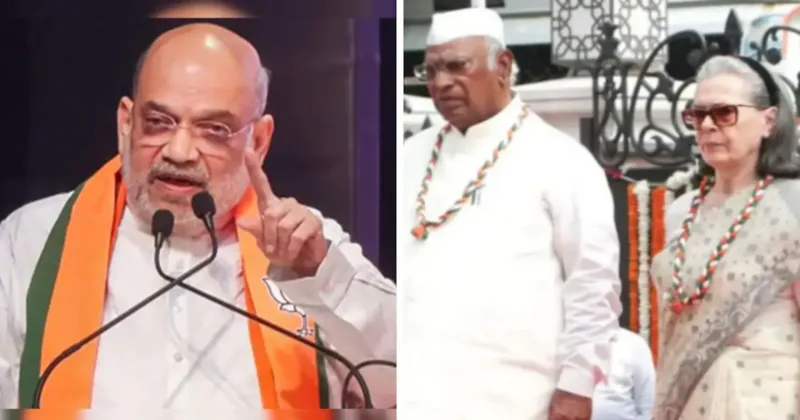
Amit Shah, who was in Tamil Nadu to attend the 31st Southern Zonal Council meeting near Mahabalipuram, criticised the Congress decision in a post on social media. Shah said the decision to restrict the rendition of Vande Mataram to two stanzas was not merely a political position but, according to him, amounted to defiance of a law enacted by Parliament.
He alleged that the Congress had historically compromised on Vande Mataram for the sake of appeasement. Referring to 1937, Shah claimed that the Congress had then divided the song into two parts and argued that this contributed to circumstances in which the two-nation theory gained strength and eventually led to Partition.
Shah wrote that on the 150th anniversary of Vande Mataram, the Narendra Modi government had sought to correct what he described as a historic mistake by giving the full song legal form. He further accused the Congress, under Rahul Gandhi’s leadership, of returning to what he called “appeasement” politics for electoral gains.
Shah appealed to citizens to unite and oppose what he described as the Congress’s attempt to revive the politics of appeasement.
कांग्रेस कार्यसमिति ने 'वंदे मातरम्' के पूर्ण गान की जगह केवल दो अंतरे गाने का जो फैसला लिया है, वह न केवल देशविरोधी है, बल्कि संसद के बनाए कानून की खुली अवहेलना भी है।
1937 में तुष्टीकरण के लिए कांग्रेस ने ही 'वंदे मातरम्' के दो टुकड़े किए। वहीं से दो-राष्ट्र सिद्धांत को ताकत… pic.twitter.com/VCGhnro8Wc
— Amit Shah (@AmitShah) August 20, 2026
Shah: Congress ‘opposed the spirit’ of Vande Mataram
In another message attributed to the Union Home Minister, Shah alleged that the Congress had opposed the spirit of Vande Mataram by dividing it in 1937. He linked the historical controversy to what he described as Muslim appeasement and said the Congress was now rejecting the spirit of a law passed by Parliament. Shah further asserted that “appeasement politics” would no longer work.
BJP steps up attack on Congress
The BJP has joined the attack, with party national spokesperson Sudhanshu Trivedi describing the Congress resolution as “highly condemnable”. Trivedi argued that the decision demonstrated that the Congress considered its party position to be above the nation, Constitution and laws enacted by Parliament.
He also drew a parallel between the Congress’s present position and the Muslim League’s opposition to Vande Mataram in 1937. Trivedi alleged that the Congress had now ended speculation over whether it had become what he described as the “new Muslim League”, claiming that the party had adopted a similar position over the National Song.
🚨 BIG ATTACK BY HM AMIT SHAH 🔥
"By dividing Vande Mataram for MUSLIM APPEASEMENT in 1937, Congress laid the foundation for the PARTITION of the country."
"Congress OPPOSED the spirit of Vande Mataram. Congress is now REJECTING Parliament’s law."
"APPEASEMENT POLITICS will… pic.twitter.com/yDRqMPsyHe
— Megh Updates 🚨™ (@MeghUpdates) August 20, 2026
Suvendu Adhikari backs Amit Shah, attacks Congress
West Bengal BJP leader Suvendu Adhikari also backed Amit Shah’s criticism and accused the Congress and its INDIA alliance partners of pursuing what he called “deeply entrenched appeasement politics”. In a post on X, Adhikari said that refusing to sing Vande Mataram in its entirety demonstrated what he described as contempt for India’s national heritage, Parliament and the legacy of Bankim Chandra Chattopadhyay, who authored the song.
Adhikari recalled the historical role of Vande Mataram during the freedom movement, describing it as a rallying cry that inspired and united people against British colonial rule. He accused the Congress of “dissecting” the song to appeal to vote banks and said such a position amounted to disrespecting the sacrifices made during the freedom struggle.
Adhikari also alleged that the Congress and INDIA alliance’s approach reflected disregard for national symbols and democratic institutions.
I wholeheartedly stand with Hon'ble Union Home Minister Shri @AmitShah Ji, in exposing the deeply entrenched appeasement politics of the Congress and its INDI Alliance partners.
By refusing to sing our National Song Vande Mataram in its entirety, the Congress has once again… https://t.co/qKoni2CKqi— Suvendu Adhikari (@SuvenduWB) August 20, 2026
Bankim Chandra’s descendant seeks apology from Sonia Gandhi
The controversy has also drawn a response from BJP MLA Sumitro Chatterjee, a direct descendant of Bankim Chandra Chattopadhyay, the author of Vande Mataram. Chatterjee has sought an unconditional apology from Congress Parliamentary Party chairperson Sonia Gandhi over an alleged incident during the Congress’s Independence Day event at the AICC headquarters on August 15.
Writing as an ordinary citizen, patriot and descendant of Bankim Chandra, Chatterjee said the alleged episode had caused him “deep pain, emptiness, and anger”. He invoked Sri Aurobindo’s description of Vande Mataram as a mantra associated with patriotism and argued that any reluctance to recite the complete song in independent India amounted to an insult to the sacrifices of freedom fighters, including Khudiram Bose.
Chatterjee also referred to the song’s place in the history of the freedom movement, recalling Rabindranath Tagore’s rendition of Vande Mataram at the 1896 Calcutta session of the Indian National Congress and Sarala Devi Chaudhurani’s recitation at the 1905 Benares Congress session.
🇮🇳 “Vande Mataram” Row: Bankim Chandra Chatterjee’s Descendant Demands Apology!
BJP MLA Sumitro Chatterjee, a descendant of Bankim Chandra Chattopadhyay, has sought Sonia Gandhi’s apology over the alleged disruption of ‘Vande Mataram’ at AICC headquarters.
Calling it “a… https://t.co/vpeFicwQbQ pic.twitter.com/nKxSNCvdUB
— Sanatan Prabhat (@SanatanPrabhat) August 17, 2026
Vande Mataram is not property of any political party’
Chatterjee stressed that Vande Mataram does not belong to any political party and instead forms part of India’s collective memory and Bankim Chandra’s legacy. He said the song had become a national symbol through the sacrifices of freedom fighters and argued that respecting it was inseparable from respecting India’s freedom struggle.
The BJP MLA appealed to Sonia Gandhi to tender an unconditional apology to the country, particularly to the people of West Bengal, whom he said had been deeply hurt by the alleged incident. He also called on Gandhi to introspect over the issue.
Vande Mataram becomes fresh political flashpoint
The controversy has now turned Vande Mataram into another flashpoint between the Congress and BJP, with the two parties sharply divided over its historical, cultural and political significance.
While the BJP has framed the Congress’s reported decision as an issue involving national heritage, parliamentary authority and alleged appeasement politics, the Congress position has triggered a broader political debate over the manner in which the National Song should be rendered.
The BJP’s latest attacks have also brought the history of Vande Mataram during the freedom movement back into the political discourse, with leaders from both sides likely to face renewed questions over the song’s historical and constitutional status.