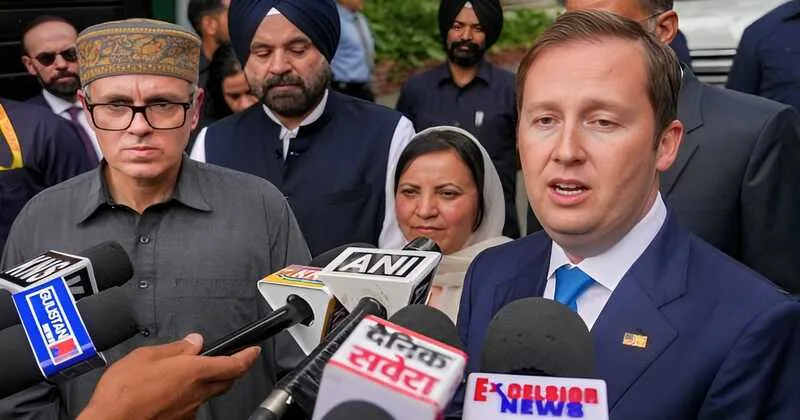
US Ambassador to India Sergio Gor’s first visit to J&K has put Pakistan on the diplomatic defensive after he described the Union Territory as an “important part of India” during his engagements in Srinagar on August 19, 2026. The statement came as Gor met Jammu and Kashmir Chief Minister Omar Abdullah and discussed India-US relations, economic cooperation and opportunities in the Union Territory.
Pakistan responded within hours by summoning US Charge d’Affaires Natalie Baker in Islamabad and lodging a strong protest against the ambassador’s remarks.
Gor’s Srinagar visit puts Pakistan on the back foot
Gor, who assumed charge as US Ambassador to India earlier this year and also serves as President Donald Trump’s Special Envoy for South and Central Asia, arrived in Srinagar as part of his maiden visit to J&K. His visit is the first by a US ambassador to the Union Territory in six years and comes after heightened security concerns following the April 2025 Pahalgam terror attack and India’s subsequent Operation Sindoor.
After his meeting with Omar Abdullah, Gor described the discussions as “very good” and said the two sides would pursue follow-up conversations in Washington and New Delhi. He said the discussions covered the broader India-US relationship, economic collaboration and opportunities that could benefit both countries. He also praised Kashmir’s natural beauty, calling it an “incredibly beautiful place”, and said he was thrilled to visit the region for the first time.
“This is an important part of India. I am here, visiting for the first time. It is an incredibly beautiful place. I am thrilled to be here, thrilled to see this place.
We just had a very good meeting. We have some follow-ups, so we hope to take back to Washington, back to Delhi.… pic.twitter.com/Sw1KNaLOtM
— All India Radio News (@airnewsalerts) August 19, 2026
The significance of the visit lies not in any external validation of J&K’s status, but in the fact that an American ambassador, speaking from Srinagar, referred to the Union Territory as an “important part of India”. India’s position on J&K is longstanding and unequivocal: the entire Union Territory, including territories under Pakistan’s illegal occupation, is an integral part of India. Gor’s statement nevertheless immediately exposed the widening diplomatic discomfort in Islamabad and prompted an unusually swift Pakistani response.
Omar Abdullah draws clear line on Washington
Ahead of Gor’s arrival, Chief Minister Omar Abdullah had already established the framework for the meeting. Abdullah said he would discuss J&K with the visiting ambassador but would not use the occasion to complain about India or seek solutions to the Union Territory’s domestic issues from a foreign government.
Abdullah said it was not his habit to lodge complaints about his country with an ambassador of another country. He made it clear that the resolution of J&K’s problems would not come from Washington and that solutions lay with India’s central government. He also said he intended to listen to Gor, while recognising that the US envoy was coming to listen as well.
The position ensured that the Srinagar meeting remained focused on bilateral engagement, economic cooperation and opportunities rather than turning into a forum for international intervention in India’s internal affairs. Gor’s subsequent remarks similarly centred on economic possibilities, security and tourism rather than any proposal for political mediation.
The visit also comes against the backdrop of wider India-US cooperation. Gor had met Union Home Minister Amit Shah in June, with counter-terrorism, narcotics control, border security and law-enforcement cooperation among the issues discussed. His Kashmir visit therefore forms part of a broader engagement between New Delhi and Washington rather than an isolated diplomatic exercise.
Travel advisory may face review
Gor also indicated that the United States could reconsider its travel advisory for Jammu and Kashmir, an issue that has remained a concern for the region’s tourism sector. The US State Department currently places J&K, except eastern Ladakh and Leh, under a Level 4 “Do not travel” advisory because of terrorism and civil unrest. The warning specifically flags Srinagar, Gulmarg and Pahalgam among tourist destinations where American citizens could face risks.
“Important part of India”- a welcome political affirmation. Asim Munir and Shehbaz Sharif will have noted the significance of this remark. Let us see the reaction from Pakistan. https://t.co/3e4J1SPsPc
— Kanwal Sibal (@KanwalSibal) August 19, 2026
Speaking after his meeting with Abdullah, Gor said the United States periodically reassesses travel warnings and that the advisory for Jammu and Kashmir would be examined. He did not announce an immediate change, but said the security improvements made by the Centre, the J&K administration and local authorities would be considered while reviewing the warning.
Any easing of the advisory could have implications for Kashmir’s international tourism sector. Former Chief Minister and Peoples Democratic Party president Mehbooba Mufti had recently appealed to Gor to withdraw or reconsider the warning, pointing to the thousands of families whose livelihoods depend on tourism. She argued that the advisory had become a barrier for Kashmir’s engagement with international visitors.
Islamabad lodges strong protest
Pakistan reacted sharply to Gor’s Srinagar remarks. Its Foreign Ministry summoned US Charge d’Affaires Natalie Baker in Islamabad and lodged what it described as a “strong demarche”. Islamabad strongly condemned and rejected Gor’s description of Jammu and Kashmir as an “important part of India”.
The Pakistani Foreign Ministry reiterated its claim that Jammu and Kashmir is an internationally recognised disputed territory and argued that its final status should be determined according to relevant UN Security Council resolutions and what it described as the aspirations of the Kashmiri people. Islamabad also claimed that Gor’s remarks were inconsistent with what it described as the United States’ longstanding position on the Kashmir dispute.
The protest, however, has done little to alter the central reality of the episode that the remarks were made publicly by the serving US Ambassador to India during his visit to Srinagar, while the Pakistani response came in the form of a formal diplomatic protest in Islamabad. The sequence has placed Pakistan in the position of protesting the words of a senior American diplomat while India continues to deal with Jammu and Kashmir within its own constitutional and administrative framework.
Gor’s visit thus combined economic engagement, discussion on tourism and security, and a direct diplomatic exchange involving Islamabad. His planned visit to Ladakh will further extend his engagement with India’s Union Territories. For Jammu and Kashmir, the immediate focus remains development, security, tourism and economic opportunities, while Pakistan’s formal protest has added a fresh diplomatic dimension to an otherwise India-US engagement in the region.