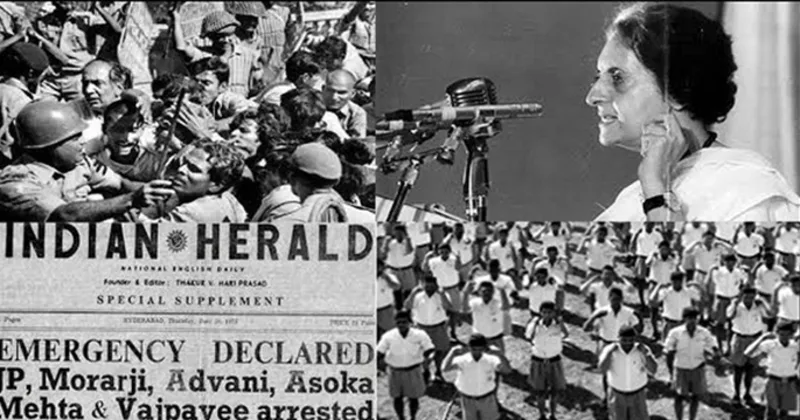
June 25, 1975, remains one of the darkest and most controversial dates in the history of independent India. On this day, the proclamation of the Emergency fundamentally altered the democratic landscape of the nation. Civil liberties were curtailed, political opposition was suppressed, press freedom was restricted, and thousands of political activists, journalists, social workers, and nationalist thinkers were imprisoned.
For many Indians, June 25 is remembered as a “Black Day”—a solemn reminder of a period when democratic institutions were tested and the constitutional freedoms of citizens faced unprecedented challenges.
The Emergency was not merely a political event; it was a defining struggle between state power and democratic values. It serves as a reminder that democracy must be constantly protected by vigilant citizens, independent institutions, and a free society.
The Background: From political crisis to democratic emergency
The early 1970s witnessed growing public dissatisfaction due to inflation, unemployment, corruption allegations, and political unrest. Student movements in Gujarat and Bihar gained momentum, and a nationwide call for reform emerged under the leadership of Jayaprakash Narayan, popularly known as Loknayak.
His movement for “Total Revolution” inspired millions of students, youth, and citizens to demand greater accountability and transparency in governance.
The political situation intensified after a landmark judgment by the Allahabad High Court concerning the election of Prime Minister Indira Gandhi. Amid mounting political pressure, an Internal Emergency was declared on the night of June 25, 1975.
India awoke the next morning under extraordinary constitutional restrictions.
The suspension of democratic freedoms
Following the declaration of the Emergency, fundamental rights were effectively suspended. Thousands of opposition leaders and activists were detained without trial under preventive detention laws. Freedom of speech and expression was severely restricted. Public protests and political mobilization were discouraged or prohibited.
Perhaps the most visible impact was on the press. Newspapers were subjected to pre-publication censorship, and editors were required to obtain government clearance before publishing sensitive material. Many newspapers responded with silent protest by leaving editorial spaces blank, symbolizing the suppression of free expression.
Prominent journalists, including Kuldip Nayar, were imprisoned. The Emergency remains a defining chapter in discussions about press freedom in India.
The ban on the Rashtriya Swayamsevak Sangh(RSS)
Among the organizations most affected during the Emergency was the Rashtriya Swayamsevak Sangh (RSS). On July 4, 1975, the organization was banned. Government authorities viewed its extensive grassroots network and social influence as potential sources of resistance to Emergency rule.
RSS offices were raided, publications were confiscated, and thousands of volunteers were arrested across the country. The ban represented not merely an administrative action against an organization but, in the eyes of many supporters, an attempt to suppress a broad nationalist and socio-cultural movement.
The arrest of Balasaheb Deoras
The then Sarsanghchalak (Chief) of the RSS, Balasaheb Deoras, was arrested shortly after the Emergency was declared. His detention symbolized the government’s determination to neutralize organizations perceived as capable of mobilizing opposition.
Despite imprisonment, Deoras remained an influential figure for RSS volunteers. His messages and correspondence reportedly continued to inspire workers involved in efforts to restore democratic freedoms. Within RSS history, the Emergency period is often remembered as one of the organization’s greatest tests.
Thousands of RSS Leaders and Volunteers Imprisoned The crackdown extended far beyond the top leadership. Thousands of RSS pracharaks (full-time workers), office-bearers, and volunteers were detained under laws such as the Maintenance of Internal Security Act (MISA).
Among the prominent RSS-associated figures affected during this period were:
- Rajendra Singh
- Bhaurao Deoras
- Moropant Pingle
- Nanaji Deshmukh
- Kushabhau Thakre
- Sundar Singh Bhandari
In many instances, local RSS workers were arrested simply for organizational activities or for maintaining contact with opposition networks.
The underground resistance
While thousands were imprisoned, many others continued to operate underground.
Secret communication channels were established. Pamphlets and newsletters were distributed discreetly. Networks of volunteers worked to spread information, support detained families, and maintain morale among those resisting authoritarian measures.
Among the young RSS pracharaks active during this period was Narendra Modi, who was then working in Gujarat. Later accounts describe how numerous volunteers adopted disguises and covert methods to avoid arrest while continuing organizational work.
The underground resistance became an important component of the broader democratic movement.
The imprisonment of national leaders
The Emergency was not confined to one ideology or organization. Leaders from across the political spectrum were jailed.
Prominent figures included:
- Atal Bihari Vajpayee
- Lal Krishna Advani
- George Fernandes
- Morarji Desai
- Charan Singh
Many of these leaders later reflected on the Emergency as a defining lesson in the importance of democratic institutions and constitutional safeguards.
Life inside the prisons
For political detainees, imprisonment became an experience of sacrifice, resilience, and reflection. Many prisoners spent months or years away from their families. Careers were disrupted, businesses suffered, and financial hardships became common.
Yet prison cells also became spaces for political discussion, constitutional study, and ideological exchange. The experiences of those detained during the Emergency continue to form an important part of India’s democratic memory.
1977: The democratic verdict
When elections were eventually held in 1977, the Indian people delivered a historic verdict. The election was more than a political contest—it was a reaffirmation of democratic principles.
The electorate demonstrated that ultimate authority in a democracy rests not with governments, but with the people. The peaceful transfer of power following the election remains one of the most significant examples of democratic resilience in modern political history.
Lessons for future generations
The Emergency should not merely be viewed through a partisan lens. Its enduring significance lies in the lessons it offers about democracy, constitutional governance, and civil liberties.
It reminds future generations that:
- Freedom of expression is essential to democracy.
- An independent press is a safeguard against excesses of power.
- Judicial independence is crucial to constitutional governance.
- Organized civil society plays a vital role in protecting democratic values.
- Citizens must remain vigilant in defending their rights and responsibilities.
Democracy is not sustained by elections alone; it survives through active public participation and respect for constitutional principles.
“Bodies were confined, but ideas remained free; Darkness prevailed, yet the flame of liberty endured. Those who sacrificed comfort for democracy, Those who chose prison over silence, Those who stood firm when fear ruled the land—Their courage remains a permanent chapter in India’s history”.
Let June 25 remind every generation that liberty is precious, that democracy demands vigilance and that whenever freedom is threatened, the spirit of India will rise again to defend it”.
On this remembrance of June 25, tribute is paid to all democracy activists, journalists, social workers, political prisoners, RSS volunteers and countless citizens who endured hardship to preserve democratic values and constitutional freedom in India.