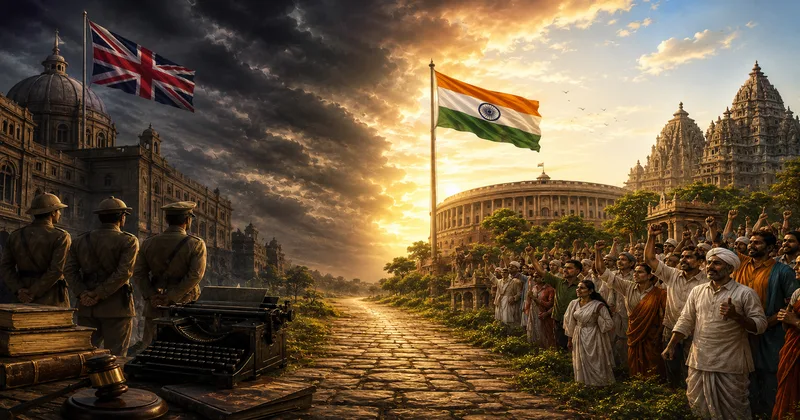
Decolonising Bharat: India’s journey beyond colonial rule
September 4, 2026
  • Read Ecopy
  • Circulation
  • Advertise
  • Careers
  • About Us
  • Contact Us
Android AppiPhone AppArattai
Organiser
  • ‌
  • Bharat
    • Assam
    • Bihar
    • Chhattisgarh
    • Jharkhand
    • Maharashtra
    • View All States
  • World
    • Asia
    • Europe
    • North America
    • South America
    • Africa
    • Australia
  • Editorial
  • International
  • Opinion
  • RSS @ 100
  • More
    • Op Sindoor
    • Analysis
    • Sports
    • Defence
    • Politics
    • Business
    • Economy
    • Culture
    • Special Report
    • Sci & Tech
    • Entertainment
    • G20
    • Azadi Ka Amrit Mahotsav
    • Vocal4Local
    • Web Stories
    • Education
    • Employment
    • Books
    • Interviews
    • Travel
    • Law
    • Health
    • Obituary
  • Subscribe
    • Subscribe Print Edition
    • Subscribe Ecopy
    • Read Ecopy
  • ‌
  • Bharat
    • Assam
    • Bihar
    • Chhattisgarh
    • Jharkhand
    • Maharashtra
    • View All States
  • World
    • Asia
    • Europe
    • North America
    • South America
    • Africa
    • Australia
  • Editorial
  • International
  • Opinion
  • RSS @ 100
  • More
    • Op Sindoor
    • Analysis
    • Sports
    • Defence
    • Politics
    • Business
    • Economy
    • Culture
    • Special Report
    • Sci & Tech
    • Entertainment
    • G20
    • Azadi Ka Amrit Mahotsav
    • Vocal4Local
    • Web Stories
    • Education
    • Employment
    • Books
    • Interviews
    • Travel
    • Law
    • Health
    • Obituary
  • Subscribe
    • Subscribe Print Edition
    • Subscribe Ecopy
    • Read Ecopy
Organiser
  • Home
  • Bharat
  • World
  • Operation Sindoor
  • Editorial
  • Analysis
  • Opinion
  • Culture
  • Defence
  • International Edition
  • RSS @ 100
  • Magazine
  • Read Ecopy
Home Bharat

Decolonising Bharat: From the mass movements that won Independence to the challenge of breaking colonial legacies

India’s freedom struggle was shaped by decades of revolutionary resistance and mass movements that ultimately ended British rule in 1947. However, several colonial-era institutions, systems and narratives continued after independence, influencing governance, education, law and the country’s cultural self-understanding

WEBDESKWEBDESK
Aug 15, 2026, 03:00 pm IST
inBharat, Culture
Follow on Google News
Facebook
Twitter
WhatsAppTelegramEmail

Bharat’s political independence in 1947 marked a moment that highlighted the enduring presence of colonial structures that continued to shape the newly sovereign nation.

Bharat’s Political Independence (1947): The Culmination of Mass Movements

Bharat’s political independence in 1947 was the culmination of decades of fervent nationalist struggle, characterised by a series of powerful mass movements that mobilised millions across the subcontinent.

Revolutionary movements: Revolutionary movements against the British emerged across Bharat with fearless leaders from various regions. In Maharashtra, Vinayak Damodar Savarkar led armed resistance and founded Abhinav Bharat. Uttar Pradesh saw Chandrashekhar Azad and Ram Prasad Bismil in the Hindustan Socialist Republican Association (HSRA). Bengal produced Khudiram Bose, Prafulla Chaki, and Surya Sen, who carried out daring attacks on Britishers. Tamil Nadu had Vanchinathan, who assassinated British officials. Punjab witnessed Bhagat Singh, Udham Singh, and the Ghadar Party striking against British imperialism. These movements, united in sacrifice, ignited the spirit of independence nationwide.

Non-Cooperation Movement (1920-1922): Led by Mahatma Gandhi, this movement encouraged Indians to boycott British goods, institutions, and services. It significantly sparked political awareness among the masses, encouraging active participation in the struggle for independence. The movement strengthened national unity, led to the establishment of many Indian schools and colleges, and boosted Bharatiya industries like Khadi due to the boycott of British goods.

Civil Disobedience Movement (1930-1934): This movement, also spearheaded by Gandhi, involved nonviolent defiance of unjust colonial laws, most famously the Salt March. It aimed to attain swaraj (self-rule) and oppose discriminatory taxes. The movement inspired numerous acts of defiance, involved mass participation from citizens willing to risk arrest, and played a crucial role in shaping India’s quest for self-governance, exemplifying the power of nonviolent resistance. Although it did not achieve immediate independence, it impacted the Bharatiyas, strengthening their determination and shattering their faith in British rule’s legitimacy, laying groundwork for future struggles.

Quit India Movement (1942): Launched during World War II, this movement called for an immediate end to British rule. It marked a turning point, showcasing the determination, unity, and sacrifice of the Bharatiyas. Despite severe British repression, including mass arrests and violence, the movement led to widespread protests, strikes, and civil disobedience. It strengthened nationalist sentiments, united people across regions, saw significant participation from women and youth, and attracted international attention, ultimately compelling the British government to reevaluate its approach to Bharat and consider steps towards self-governance in the post-war period.

These movements, alongside other forms of resistance, culminated in the Indian Independence Act of 1947, which ended Crown suzerainty and partitioned British India into the Dominion of India and the Dominion of Pakistan. On January 26, 1950, the Constitution of India was adopted, formally establishing the Republic of India and laying the foundations for its democratic institutions.

Persistence of Colonial Structures

After independence, Communist-influenced leadership retained and expanded colonial-era structures in education, bureaucracy, and historiography to attack the ‘SWA of Bharat’. Controlling key institutions like the ICHR, universities, and textbook boards, they marginalised Hindu nationalist leaders and thinkers such as Savarkar, Sri Aurobindo, Bhagat Singh, Lala Lajpat Rai, and Subhash Chandra Bose, framing them through communal or sectarian lenses.

Adopting Eurocentric-Marxist frameworks, they reinforced colonial narratives on caste, communalism, and Western superiority, sidelining Bharat’s civilizational ethos. By retooling British historiographical biases, they shaped public memory and academic discourse to fit class-struggle narratives, weakening the cultural selfhood vision of many freedom fighters and delaying the intellectual decolonisation essential for a truly self-defined Bharat.

Also Read: Adani Case Dismissed in US: Questions raised over Abhijit Dipke, Sam Pitroda & political network of CJP

Bureaucratic Hierarchy: The Indian Civil Service, built for British imperial control, became the IAS post-independence, with British officers replaced by Indians by the 1950s. Though serving a democratic India, it retained its colonial bureaucratic framework, continuing administrative practices originally designed to govern in the interests of the British Crown.

English Dominance: Macaulay’s 1835 Minutes promoted English for colonial administration, sidelining traditional knowledge and vernaculars, and creating a Westernised elite. Post-1947, English persisted in higher education, governance, and law as a unifying link language. Laws, courts, and legal education remained English-centric, despite initiatives to promote Hindi, Tamil and regional languages.

Colonial Legal Codes: The Indian legal system largely mimicked British common law, retaining outdated laws like sedition, which were originally used to suppress freedom fighters. Special laws pertaining to tribal areas, which exempted certain groups from general civil and criminal jurisdiction and placed them under direct British control, also persisted. This continuity meant that the very structure of the state often operated within a colonial frame, governed by laws designed for imperial control rather than civilizational flourishing.

Education System: The education system remained largely shackled to the colonial blueprint, designed to produce clerks and administrators rather than empower Indians. Textbooks often glorified British ‘reforms’ while downplaying Bharat’s civilizational achievements, ignoring or caricaturing ancient sciences, spiritual philosophies, and alternative epistemologies. This led to cultural alienation, where English-educated Indians often felt distanced from their own traditions and languages, fostering a sense of inferiority and a loss of cultural identity.

 

Topics: Colonial LegacyIndian historyFreedom struggleIndian Independencedecolonisationcolonial mindsetBritish RuleCivilisational Identity
Share
Tweet
SendShareSend
✮ Subscribe Organiser YouTube Channel. ✮
✮ Join Organiser's WhatsApp channel for Nationalist views beyond the news. ✮
Previous News

Independence Day 2026: AIMIM leader Waris Pathan refuses to sing Vande Mataram while hoisting tricolour in Mumbai

Next News

Independence Day 2026: CM Yogi urges citizens to fulfill national duties; Highlights 25cr people lifted out of poverty

Related News

Kumari Maina

13-year-old Kumari Maina faced the British Empire without fear: The forgotten child martyr of 1857

Vande Mataram remains an enduring symbol of Bharat’s civilisational heritage, national unity and deep-rooted love for the motherland

Vande Mataram: Reclaiming a civilisational legacy against opposition cynicism

Why objection to Vande Mataram? A symbol of national consciousness, struggle & sacrifice!

Great Calcutta Killings 1946

Great Calcutta Killings in August 1946: Urban pogrom and the teleology of partition in colonial Bengal and India

Decolonisation saw nations across Africa and Southeast Asia reclaim their cultures, languages and identities after independence (This image is generated by AI)

From Colonial Rule to Cultural Revival: How African and Southeast Asian nations shed their colonial legacies

India’s journey from Swadhinta to Swatantrata begins with decolonising minds and embracing Bharatiya values (This image is generated by AI)

Decolonising the Mind: How citizens can embrace Bharatiya languages, traditions & values to realise absolute freedom

Load More

Latest News

Manipur CM Khemchand Singh

Manipur: 36000 IDPs returned to home, 24000 still living in camps; CM informed assembly

Hyderabad startup develops India’s fastest interceptor drone at 498 Kmph

Ahuti Mk-II: Hyderabad startup develops India’s fastest interceptor drone at 498 Kmph

RSS Akhil Bharatiya Prachar Pramukh Sunil Ambekar during a press interaction in London

Dr Mohan Bhagwat in UK | RSS seeks to deepen civilisational dialogue with World: Sunil Ambekar

Golden Jubilee of the Hindu Swayamsevak Sangh (HSS)-UK (Image from 2016)

HSS: Hinduism more inclusive and not exclusive?

ISRO Successfully Launches EOS-05: India’s indigenous “eye in the sky” to power development & national security

Tamil Nadu: ED raids properties linked to Nizaruddin, Syed in Chennai, Nagapattinam, Ramanathapuram in narcotics case

Yasin Malik met his wife Mushaal Hussein Malik during a 2005 trip to Pakistan

Yasin Malik’s New victim narrative: Divorce, death penalty bid and denial in Sarla Bhat murder case

RSS Sarsanghchalak Dr Mohan Bhagwat

Dr Mohan Bhagwat in UK: Over 100 British Hindu and community organisations welcome RSS Sarsanghchalak

Kolathur Election Result: Madras HC Rejects MK Stalin’s Writ Plea

Tamil Nadu: Stalin’s bid to overturn Kolathur defeat through writ petition fails

Calcutta High Court Orders Demolition Of Abhishek Banerjee’s Sebashray Structures

West Bengal: Calcutta High Court orders demolition of Abhishek Banerjee’s Sebashray built on a playground in Falta

Load More
  • Privacy
  • Terms
  • Cookie Policy
  • Refund and Cancellation
  • Delivery and Shipping

© Bharat Prakashan (Delhi) Limited.
Tech-enabled by Ananthapuri Technologies

  • Home
  • Search Organiser
  • Bharat
    • Assam
    • Bihar
    • Chhattisgarh
    • Jharkhand
    • Maharashtra
    • View All States
  • World
    • Asia
    • Africa
    • North America
    • South America
    • Europe
    • Australia
  • Editorial
  • Operation Sindoor
  • Opinion
  • Analysis
  • Defence
  • Culture
  • Sports
  • Business
  • RSS @ 100
  • Entertainment
  • More ..
    • Sci & Tech
    • Vocal4Local
    • Special Report
    • Education
    • Employment
    • Books
    • Interviews
    • Travel
    • Health
    • Politics
    • Law
    • Economy
    • Obituary
  • Subscribe Magazine
  • Read Ecopy
  • Advertise
  • Circulation
  • Careers
  • About Us
  • Contact Us
  • Policies & Terms
    • Privacy Policy
    • Cookie Policy
    • Refund and Cancellation
    • Terms of Use

© Bharat Prakashan (Delhi) Limited.
Tech-enabled by Ananthapuri Technologies