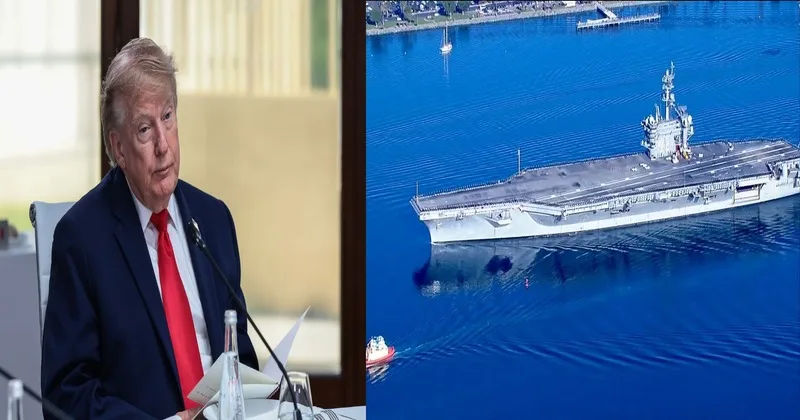
Washington DC: The US Navy is preparing to send the Japan-based USS George Washington towards West Asia to relieve the USS Abraham Lincoln, whose deployment has stretched beyond 250 days. The decision of the Pentafgon comes amid mounting concerns over crew fatigue, shortages, plumbing failures and mental health risks of the personnl.
Meanwhile, lawmakers demand greater accountability from the Pentagon, as the US Navy faces the wider challenge of sustaining an intense operation across West Asia, which it triggered & began months ago.
USS George Washington moves West as Lincoln’s prolonged deployment comes under scrutiny
The USS George Washington has begun moving west towards West Asia, after departing Da Nang, Vietnam, where it had made a port visit from July 30 to August 5. Ship-tracking data subsequently showed that the Nimitz-class aircraft carrier is travelling through the Singapore Strait and Strait of Malacca alongside other US Navy vessels.
A US official also confirmed the carrier’s movement through the Strait of Malacca, placing it on a route towards the Indian Ocean and ultimately to West Asia. Reports also suggested that the USS George Washington is expected to replace the USS Abraham Lincoln.
The move could provide the Lincoln and its roughly 5,000 sailors with an opportunity to return home after an unusually prolonged deployment. The carrier left Naval Base San Diego on November 21, 2025, for what was initially expected to be a seven-month deployment. It operated in the Indo-Pacific before being redirected towards West Asia in January 2026 as tensions escalated with Iran.
The naval vessel Lincoln supported US military operations against Iran and later became involved in efforts to blockade Iranian ports. Its deployment has continued well beyond its original schedule, with the carrier spending more than 250 days on deployment and according to lawmakers, more than 200 days without a port call.
The prolonged mission has raised questions about whether the Navy’s operational demands are beginning to outpace its military infrastructural capacity, ability to sustain crews and maintain normal deployment cycles.
Food & basic amenities shortage, failures and mental health risks of crew raise alarm
The Lincoln’s extended deployment has triggered increasing scrutiny in Washington DC. Senator Richard Blumenthal, a member of the Senate Armed Services Committee, wrote to Defence Secretary Pete Hegseth and Acting Navy Secretary Hung Cao on August 12 seeking detailed answers about the carrier’s conditions and deployment extensions.
Other reports cited shortage of basic supplies, water contamination, plumbing problems, deck-safety concerns and disruptions to mail deliveries on the USS Lincoln. Reports have also pointed to broken toilets, laundry facilities and unreliable hot water, while families have raised concerns about food and other essential supplies to the crew members.
The Navy has acknowledged that combat operations created a highly contested environment in which traditional supply hubs in West Asia were disrupted. Mission-critical supplies were prioritised, with food taking precedence over hygiene items and mail.
Crew wellbeing has emerged as an equally significant concern. Many asked the Pentagon to explain how it is monitoring fatigue, morale, mental health and operational readiness aboard the carrier. They also sought information on every extension of the Lincoln’s deployment and the operational justification for those decisions.
A sailor aimed to jump overboard
Concerns over the safety of the crew members further intensified after a sailor went overboard in early August and was rescued quickly. The sailor was medically evaluated aboard the carrier before being transferred elsewhere for further care. The circumstances surrounding the incident remain under investigation.
The Navy has said it has not observed an increase in suicidal ideation or suicide attempts aboard the ship and has emphasised that medical, religious and mental-health professionals are available to sailors. Defence Secretary Pete Hegseth has also rejected reports of severely deteriorating conditions, arguing that accounts of the situation have been significantly misrepresented. However, reports increasingly flag concerns about the health status of the crew members due to unsustainable operational deployment.
Nevertheless, lawmakers are pressing for greater oversight. Senator Ruben Gallego has sought to organise a bipartisan congressional visit to the carrier, while other lawmakers have demanded information about how the Navy intends to protect sailors while maintaining prolonged combat deployments.
A pressure on US military to sustain operation in West Asia?
The George Washington is normally forward-deployed to Yokosuka, Japan and plays an important role in US signalling and deterrence efforts involving regional allies and partners across the Indo-Pacific. Sending the carrier to West Asia could sreduce some routine operations and engagement missions involving countries such as Japan and the Philippines.
Many experts and subject analysts have warned that the operational demands generated by the Iran conflict could take years to resolve before the US Navy returns to its preferred readiness posture. The strain is not limited to the Lincoln. The USS Gerald R. Ford returned to Norfolk in May after a 326-day deployment, another unusually lengthy assignment.
The unsustainable and extended missions has added to concerns that prolonged carrier deployments could become a recurring feature of US naval operations, raising apprehension about infrastructure deficit in the US military. The George Washington’s movement therefore represents more than a routine carrier rotation. It highlights the growing pressure on Washington to sustain military operations in West Asia.